MAN from Munich to Nuremberg
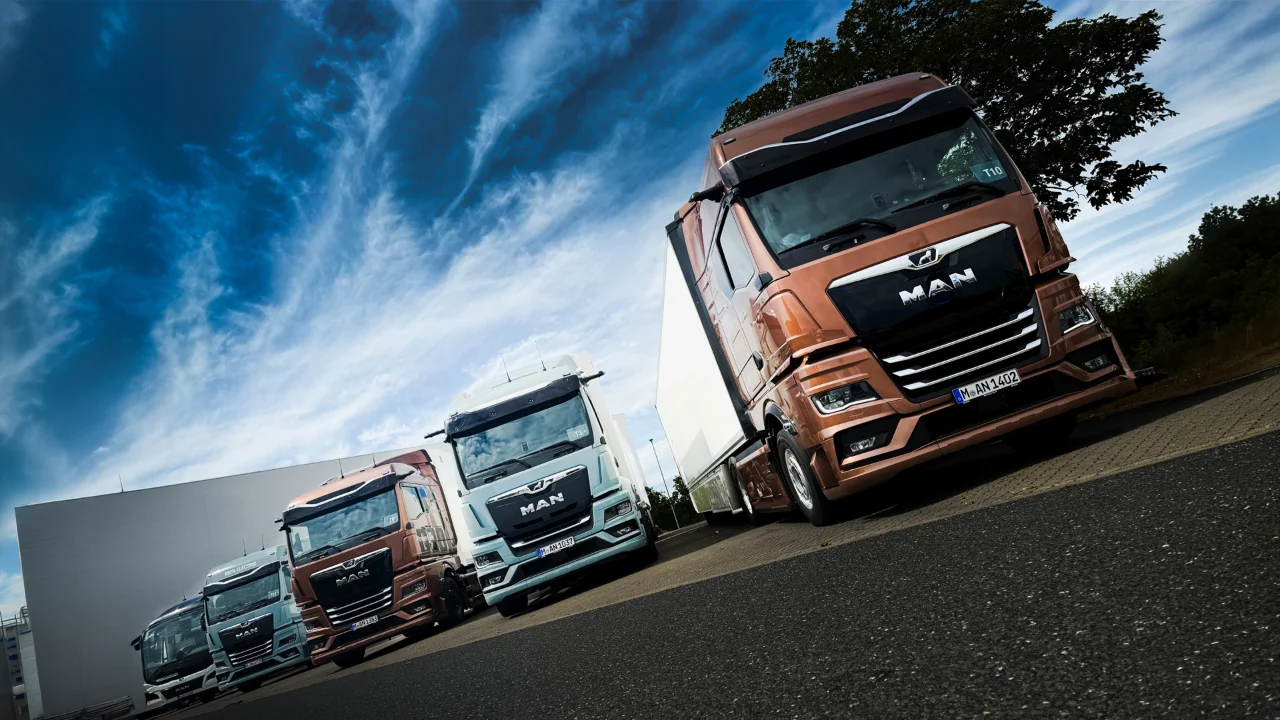
Three trucks and two energy sources to travel from Munich to Nuremberg: MAN offered us a full-scale test ahead of IAA Transportation in Hanover. I started in the silence of an electric eTGS, continued behind the wheel of the small eTGL distribution truck, before getting back into the D30 diesel engine of a TGX 480. An ideal route to compare uses and remind us of an obvious fact: no solution today meets the needs of every transport business.
First stage: the MAN eTGS in its element

Leaving Munich, I take control of an electric eTGS. This is not the large eTGX intended for long-distance transport, but a truck equipped with the low cab from the TGS range, perfectly suited to regional transport, parcel delivery or public works.
Our vehicle is a 6x2 rigid truck coupled to a trailer, with two 7.80 m swap bodies. This is a very common configuration in Germany, but one that is also known in France among express delivery operators. You drop off one body, pick up another and the truck sets off again. In this type of relay operation, the driver generally does not sleep on board very often, even though this cab does nevertheless have two berths.
Inside, there is no change of scenery. The dashboard, controls and environment are those of a traditional MAN. This is precisely one of the manufacturer’s choices: not to create a completely separate electric truck, but to integrate a battery-electric powertrain into a familiar architecture. For the driver, getting to grips with it is immediate. You switch on, select forward gear and the truck moves off, without noise and without effort.
This is the first thing that strikes you: the silence, of course, but above all the smoothness. In Munich’s urban traffic, this 18.75 m combination is driven with astonishing ease. Camera-based rear vision follows the trailer through bends and makes it possible to maintain a good view of the surroundings. In the city, electric clearly feels at home: it starts without any break in torque, does not vibrate and moves with great smoothness.
400 kW and six battery packs
This eTGS develops 400 kW, or around 544 hp. The powertrain is common to the brands within the Traton Group: the same technical base can be found at MAN as well as Scania. The electric motor and gearbox are combined into a single unit installed in the chassis. The batteries occupy, in particular, the space normally reserved for the engine under the cab and the fuel tanks between the truck’s axles. Our rigid truck receives six packs, enough to envisage a range close to 500 km when the conditions and type of operation are suitable.
Today we are driving at 34 tonnes on a mainly motorway route. In Germany, heavy-duty vehicles are limited to 80 km/h and, given the density of traffic, maintaining this speed is already good news. This limitation obviously favours electricity consumption. On this type of route and in this configuration, the computer indicates around 90 to 95 kWh/100 km. With a usable capacity close to 500 kWh, 500 km becomes credible on paper.
But beware of jumping to conclusions too quickly. As always with an electric vehicle, range depends on weight, weather, topography and above all driving style. If you keep your foot to the floor, you will not achieve the best figures. If you let the truck and its predictive system do the work, the result changes completely, sometimes at the risk of being a little too conservative.
Predictive driving favours free metres
Like almost all manufacturers today, I can see that MAN has improved its predictive cruise control. Once the speed has been programmed, the system uses route data to prepare for climbs and descents. On a slight downhill slope, it lets the combination build momentum up to 85 or 86 km/h, without consuming energy. It then maintains this momentum and only restores power when the road rises again.
This management nevertheless leads to variations in speed. Programmed at 80 km/h, the truck can rise to 85, then drop back towards 75 km/h before accelerating again. For the vehicle behind, the “yo-yo” effect can become annoying. The range is adjustable, but it illustrates the constant conflict between driving comfort and the search for the best efficiency. Humans naturally tend to accelerate to maintain their speed; the machine accepts losing a few kilometres per hour to save energy and therefore optimise range.
Charging, still the real issue
Our first stage takes us to a station equipped with an MCS charger, capable of exceeding 700 kW. At this power level, a legally required break can make it possible to recover a considerable amount of energy. This is probably the type of infrastructure that will really change the game for long-distance electric transport, but let’s be honest, they are almost non-existent for the time being.
The observation is quite simple: yes, manufacturers have done their job. The trucks exist, drive well and can already meet certain missions, but I also have to be very clear on this subject: the weak point remains the network. On a dedicated route between point A and point B, with charging at the depot or halfway through the journey, the eTGS can work today and, with the current incentives, your TCO will probably be lower than that of a diesel truck. For a national groupage operation, with destinations changing every day and customers spread out, it is another story. As long as heavy-duty vehicle charging stations remain scarce, it is better not to tell fairy tales: electric will not replace diesel everywhere and immediately.
Second stage: the eTGL, the small truck that makes sense

I move into a completely different category with the MAN eTGL, a 12-tonne rigid truck intended for urban delivery. With its small cab and only two battery packs, it claims a real range of around 190 to 200 km. This may seem limited, but a truck must be judged according to its job. For an urban route with a daily return to the depot, 200 km can be more than enough.
Our vehicle is equipped with a refrigerated body, therefore heavier. At 12 tonnes, it retains around 3.7 to 3.8 tonnes of payload. With a conventional delivery body, we could approach 5 tonnes. This is not huge, because the batteries are heavy, but it remains consistent for last-mile deliveries and urban routes.
The small eTGL uses the range’s large electric motor, limited here to 200 kW, or a little over 270 hp. For a 12-tonne vehicle, this is already more than sufficient. Power arrives immediately, torque is linear and the truck accelerates as if it were empty. Its transmission has only two gears. The shift from one to the other is more noticeable than in the eTGS, without reaching the interruptions of a diesel.
2% recovered in 1.5 km
On the motorway, this small eTGL is obviously not in its preferred environment. Yet, at 12 tonnes, its consumption stabilises at around 60 kWh/100 km, then drops towards 58 kWh/100 km as we approach Nuremberg. This confirms that it can calmly complete a well-organised day of distribution.
The terrain becomes more pronounced around Nuremberg. On a 6% downhill section, limited to 60 km/h, I let the automatic mode manage everything. The truck identifies the speed limit, stabilises its speed and uses the electric motor as a generator. After 1.5 km, the battery goes from 82 to 84%. Two points recovered in a single descent: the demonstration speaks for itself.
However, not everything is perfect. At low speed, particularly when leaving the motorway, shifting from second to first gear causes jerks. During acceleration, the eTGL is smooth and pleasant; during downshifting, there is still some fine-tuning to be done. We are not here to polish the boots: this defect is noticeable enough to be pointed out.
Back to diesel with the MAN TGX 480

For the third part of the journey, I get back into a 480 hp diesel TGX. You know my attachment to the combustion engine, so yes, I was smiling again! Yet after several hours in an electric vehicle, the contrast is surprising. The engine can be heard, the gears shift and the interruptions in power delivery reappear. After a few kilometres of silence, we had almost forgotten all this mechanical operation.
This TGX receives the Group’s six-cylinder D30, combined with the 14-speed TipMatic gearbox. At Scania, this same transmission is announced with 13 gears, because the crawler gear is not counted in the same way. This is largely marketing because, yes, we have to say it, engine, gearbox and axle are now shared within the Group, as has long been the case at Daimler or between Renault Trucks and Volvo Trucks.
With 2,500 Nm of torque, the 480 hp is an excellent fleet truck, versatile and capable of covering most missions. We are driving here at 37 tonnes and, unlike the electric vehicle, the weight is felt more. The engine pulls from low revs, the gearbox works and the combination remains pleasant. On this route, without chasing a record and in the middle of traffic, the computer shows around 26 l/100 km, then 25.8 l/100 km. At 37 tonnes, the figure is perfectly consistent. Remember our test of the big brother with 560 hp: it is the one that holds the fuel consumption record on our test route.
Diesel versus electric: driving pleasure changes sides
I remain in favour of diesel for its versatility and the peace of mind it provides today. A petrol station can be found almost everywhere and filling up takes only a few minutes. There is no need to organise your day around an available charger. But the price of fuel means that calculations are more important than ever, and it would be dishonest to deny the advantage of electric in terms of driving pleasure.
In the eTGS, acceleration is continuous, the silence is impressive and the 34 tonnes seem to disappear. In the TGX, you live with the mechanics: you hear the six-cylinder engine, feel the gear changes and the load. Some will prefer this character, others the smoothness of electric. My role is not to choose for you, but to tell you what really happens behind the wheel.
Compression brake and retarder: why choose?
The D30 has a compression brake, complemented on our vehicle by a hydraulic retarder. For me, this is the best of both worlds. On a long descent, this combination makes it possible to control the 37 tonnes without using the main brake. This therefore retains all its potential for a real emergency.
Some manufacturers remove the secondary retarder to gain a few points in Vecto calculations. I understand the search for efficiency, but the real world reminds us of another priority: safety. In the Alps or on a very demanding route, having both the compression brake and the retarder provides an incomparable margin for manoeuvre. I would rather see this equipment become standard than sacrificed on the altar of a regulatory calculation put in place by people who have never sat behind the wheel of a truck.
Digital rear vision that does not completely convince me
MAN’s digital rear vision is excellent at low speed. The screens are large, the image is sharp and the view of the trailer makes manoeuvring easier. On the road, my opinion is more reserved. The wide-angle processing placed on the outer part of the image creates a distorted or blurred area that bothers me when a car approaches. The central screen provides additional assistance, but this system is not one of my favourites. Some drivers will get used to it immediately; personally, I am not completely convinced. Taking inspiration from a German cousin would be a good idea.
The next MAN trucks are already hiding behind this test
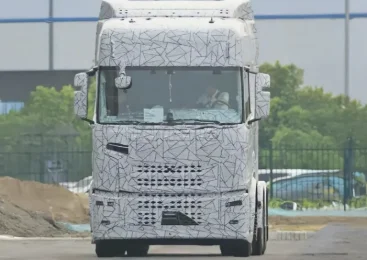
This journey between Munich and Nuremberg also served as a preview of IAA Transportation in Hanover. I was able to discover MAN’s next developments, but the images remain confidential for the time being. I can nevertheless reassure you: the manufacturer is not abandoning its identity. I am slipping in a few photos as a teaser, but you will see, you will not be disappointed.
The current cab is evolving without a revolution. The front end becomes more rounded, the grille more pronounced and the whole vehicle gains around fifteen centimetres in order to improve aerodynamics. The truck remains immediately recognisable as a MAN. This evolution will concern both electric and diesel versions, with an announced gain of a few per cent in fuel consumption and CO₂ emissions.
The interior is also progressing to meet the new European rules relating to weights, dimensions and driver visibility. The dashboard is being revised to clear the field of vision further. This is still an evolution of the existing cab; a much deeper transformation could take place around 2028 because from 2029 onwards, the profile of the trucks we know will change considerably.
Nuremberg, where the two worlds meet
Our journey ends at the MAN plant in Nuremberg. The location perfectly sums up the day. This historic site manufactures the brand’s diesel engines, including competition engines that I personally know well. Today, batteries intended for electric trucks are also assembled here.
Diesel is not dead, far from it. It still represents the vast majority of the fleet and will remain essential for many missions. At the same time, electric is progressing and becoming credible on regular routes, in urban distribution and in operations capable of managing charging.
After this test, my verdict is therefore simple: the eTGS impresses with its smoothness and regional potential, the eTGL intelligently meets the needs of the city, while the TGX 480 retains the advantage of versatility and operational peace of mind. Technologies should not be opposed as a matter of principle, but the right truck should be chosen for the right job, and fleets will have both energy sources available to them, obviously.
The rest will arrive very soon on TruckStop. We will show you the new MAN trucks as soon as the embargo is lifted, then we will meet again at IAA for the new products from MAN, Scania, Volvo and the other manufacturers. Until then, keep the app close at hand because it is free: new tests, revelations and several surprises are already being prepared. Drive safely, be careful and see you very soon out in the field!
Text and photos: Fabien Calvet