Behind the wheel of a Volvo 780: 57 tonnes of pleasure!
You know our taste for real-world road tests, so for the TruckStop team it’s off to wide open spaces for a subject that shouldn’t leave you indifferent. We head to Gourdon in the Lot, for a day of immersion in the world of timber with chestnut stake delivery and firewood loading on the programme. At the Sisterne family, wood runs through their veins just like the passion for fine equipment. Fasten your seatbelts, this week’s road test is going to put a smile on our faces, because Mathieu starts behind the wheel, gives me the briefing, then hands me his rig. And there, I promise you, the 3,800 Nm of maximum torque take on a whole other dimension.
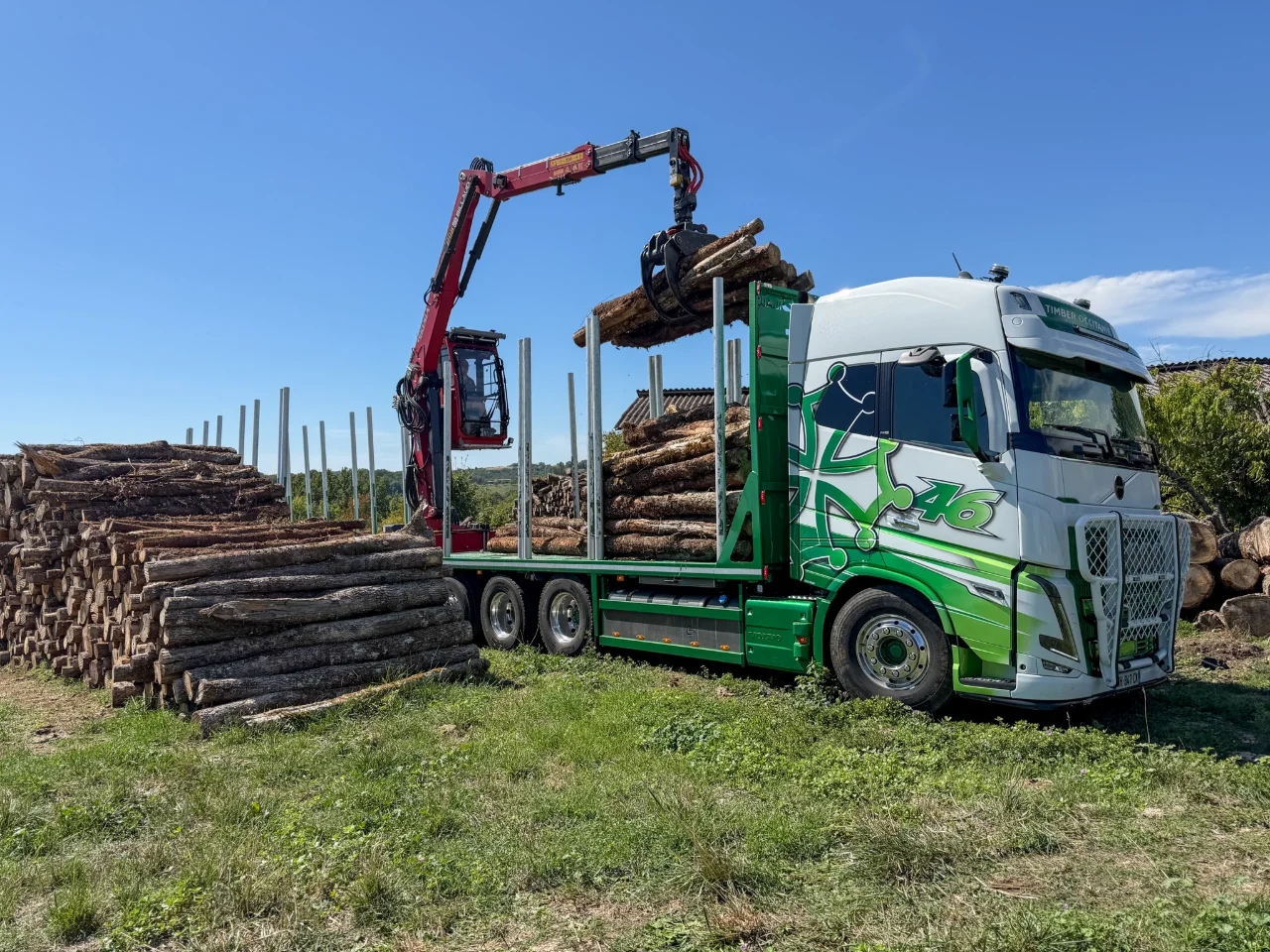
The first thing that surprises me is not the power. It’s the smoothness. From the outside, this Volvo commands respect: a rigid 8x4, a cab crane, a trailer and timber neatly stacked between the stanchions. If for the first few kilometres I’m in the passenger seat getting a proper briefing on the machine, as soon as I take the wheel it immediately becomes a different story. From the driver’s seat, after the first few kilometres, I discover a rig that steers with surprising ease. Obviously you have to take the size into account and keep an eye on what’s happening behind. But the contrast between the truck’s mass and the lightness of the controls is quite incredible.
Mathieu is beside me. Before handing me his wheel, he explained the particularities of his equipment, starting with the behaviour of the tridem and its rear steering axle. The engine, for its part, quickly makes its introductions. We are loaded to the maximum legal weight (57 tonnes), the terrain starts to demand something from the mechanics and the big six-cylinder pulls from the bottom, without giving the impression of straining. This is exactly what we come looking for in these company road tests: understanding a truck in the work for which its owner has configured it.
At Sisterne, wood is the boss

I already know Mathieu. In a previous life at a print magazine, we had done a report with his previous Mercedes, also dedicated to timber transport. With this Volvo, he has changed trucks, but kept a very precise approach to his trade. At Sisterne, it’s not just transport. The activity includes forestry operations, a bit of trading and delivery. The timber can be bought standing, cut, sawn, skidded, then sold and delivered with the company’s equipment. The truck plays a role throughout this well-oiled organisation.
This explains certain choices that might seem surprising to someone looking only at its silhouette. The 8x4 rigid, for example, also answers the need for deliveries made without the trailer. Mathieu must be able to enter private properties, pass through gateways and access places where every metre counts. “The aim is to have the maximum payload and a reduced wheelbase,” he explains. In its configuration, the rigid can work at 32 tonnes, versus 26 tonnes for a three-axle. The tridem and its steering axle provide the manoeuvrability needed to exploit this capacity in difficult access points. The choice therefore comes from the terrain, not the sales brochure.
Chestnut stacked to perfection

Our first load gives a good idea of these constraints. We are transporting 1.60-metre chestnut, destined for a stake manufacturing plant. The stacks are impeccable. Mathieu has arranged them to perfection, and I can tell you it’s not just to make pretty photos.
These small pieces of timber require care. They easily shift sideways and can move. The bodywork has therefore been adapted to the products carried, with a spacing between stanchions allowing these short lengths to be held in place. Here, Mathieu has chosen 1.30 metres between the relevant posts. It’s an essential detail in his use. Equipment adapted for longer timber does not necessarily answer the same need. And when the pieces measure 1.60 metres, they must be properly secured throughout the entire delivery run.
Another detail about this type of transport: loading, securing and cleaning represent nearly two hours of work for a rig like this morning’s. Before even taking to the road, there’s already a lot of skill involved. We will see this even more clearly at unloading, when Mathieu takes back each stack with the crane, which also doesn’t go unnoticed.
The figure that counts: 3,800 Nm

Under the FH16 designation, this Volvo now receives the D17, a 17.3-litre six-cylinder. Our version develops 780 horsepower and above all 3,800 Nm of torque, available from low revs. It’s that last figure that interests me most today. The truck pulls from low down and holds its gear on climbs that show no mercy. Very often, we are running around 1,000 to 1,200 rpm. The engine accepts the load, the I-Shift lets it work, then shifts up as soon as conditions allow.
On a more sustained climb, I watch the gearbox drop a gear and let the engine come up to seek more revs. We approach 1,400 to 1,500 rpm in order to benefit from full power so that the rig picks up speed again. As soon as the effort eases, the gearbox shifts back up and returns to its usual working zone, in its maximum torque zone which begins from as low as 900 rpm.
I promise you, with this weight and on these roads, it is impressively smooth. The gear changes are barely perceptible, the power and torque almost make you forget the shift break. Here there is no dual-clutch transmission as has existed at Volvo, but the magic combination of the new D17 paired with the I-Shift works wonders. Let’s be honest, we could do the work with fewer horsepower, but let me be clear, I would not have the same pleasure behind the wheel. Here, the reserve is used to pull away again and to maintain fluid driving, without having to hunt for revs at every difficulty. The truck doesn’t strain, it works!
On the climbs, you also have to know when to ease off

Even more impressive, on a long climb, the Volvo holds its effort with an ease that makes me smile. It has real muscle, and you feel it. Yet I sometimes have to ease off the throttle even while we’re climbing. Why? Because the road keeps turning. The available power changes neither the radius of the bends nor the height of the load. The engine could keep pushing, but it’s up to the driver to prepare for the next corner, at the risk of putting the whole thing in the ditch.
It’s incredible what you feel behind the wheel: you know the weight is there, you see it in the mirrors, and yet the mechanics give a constant impression of ease, almost as if we were empty! Frankly you have to be gentle with such a machine and above all you have to keep your bearings and drive the whole rig, without letting yourself be carried away by the ease of the engine.
Mathieu knows these roads. He knows where to prepare a pull, where to let it run and where to pull back the margin. For me, discovering his truck, his advice counts as much as the first few kilometres. The 780 horsepower replaces neither the reading of the terrain nor anticipation, it’s important to stay alert.
The tridem takes some getting used to

Manoeuvrability is the other big surprise. Despite its size, the rigid places itself well and turns tight. Mathieu warns me however: the rear steering axle modifies the reactions of the back of the truck, and therefore those of the trailer. A slightly too wide movement on the wheel can give more displacement behind than expected. On a small country road, with an uneven verge, you have to take that into account. The trailer must never leave your attention.
Mathieu also had to adapt his driving when coming from a 6x4. Today, he would struggle to go back, particularly for his solo deliveries. With this rigid he accesses places that previously gave him more difficulty. I find this advantage clearly behind the wheel. The truck responds easily, but this ease demands measure. You avoid large steering inputs, you prepare your placements and you look behind. In reverse too, you have to learn the reactions of the whole rig. Mathieu sums it up simply: it’s a habit to acquire.
VDS, I tick that box
A few metres are enough to recognise the Volvo Dynamic Steering. You know my opinion: for me it is a reference in terms of steering. On this type of work, it makes complete sense. The effort and feedback can be adjusted from the screen. The steering facilitates placements, manoeuvres and corrections on narrow roads. I immediately find my bearings, without having to fight the wheel.
For Mathieu, this option is one of the pieces of equipment to retain on a timber truck. After this day, I understand very well why. Between accesses, direction changes and small roads, it brings a comfort that you use continuously. The general comfort also benefits from the full pneumatic chassis suspension. The truck absorbs irregularities well. I talk about a magic carpet during the road test that you can find as a video on YouTube or also on our free app, and it’s truly the sensation I take away from it.
There is still body movement, obviously. We are in a truck-trailer loaded with timber. But I don’t find the Volvo excessively wallowing. It is supple, pleasant and doesn’t shake me continuously.
On the descents, the VEB/Voith duo does the work
After the climb inevitably comes the descent. With 57 tonnes, it’s a chapter on which I watch the behaviour of the truck carefully and here again you know my preferences. Here the Volvo combines the VEB+ engine brake with an ultra-efficient Voith hydraulic retarder. Mathieu has even had the power of the latter reduced: he found its intervention too strong and wanted to limit the demands on the tyres and transmission.
In use, the combination remains largely effective. On certain descents posted at 7%, we manage to contain the truck without using the service brakes. I dose with the stalk, let the rig take its support, then increase the retardation if necessary. What I appreciate is being able to regulate the pace progressively. You prepare the descent, choose your retardation and keep some margin. When the gradient eases, you simply release.
The VEB+ and Voith combination suits this use well. It allows the service brakes to be spared on our route and contributes greatly to the serenity felt behind the wheel. Provided you use it with anticipation: pulling hard on the retarder is pointless if not to eat up the tyres!
Letting it roll, without being dragged along
Between two difficulties, the Volvo also knows how to make use of its inertia. I’m not driving here with the predictive cruise control: I prefer to manage the pace myself on these roads, with this size, this weight and above all this succession of bends. If Mathieu knows the roads, I don’t, so I prefer to keep a low profile. In any case, that doesn’t prevent you from letting the truck glide when conditions allow. I ease off, it builds momentum, then I take back control before the next difficulty. With this mass, the inertia is immediately felt, but what a pleasure behind the wheel, because when you drive looking far ahead, the whole thing happens with disarming ease. A climb can be followed by a village, a descent by a tight bend, so accelerating only to have to hold back immediately serves no purpose. The big engine provides precisely the flexibility needed to pull away again afterwards without jolting the whole rig, this 780 you have to drive cool, and then you take real pleasure from it.
On the consumption side, we are far from a motorway run at 40 tonnes. Mathieu mentions values that can range from 50 to 70 l/100 km depending on the work and the sectors. These are his operating benchmarks, not the result of a comparative test carried out that day. The weight, the terrain, the access points and the time spent using the crane are part of his daily life. They need to be kept in mind before looking at a simple figure.
On the crane, I hand it back to him

We arrive in Haute-Vienne to unload the chestnut. Mathieu takes back the crane controls, and the precision of his movements deserves a moment to watch. These short pieces of timber cannot be handled like long, well-regular pieces. You have to grip them, reposition them and keep the stacks tidy. I also have a go on the crane, but I reassure you: Mathieu is considerably better than me. The familiarity with his equipment is immediately visible and even if I have some knowledge at the controls, watching my instructor for the day is a real lesson.
His crane cab brings a real change to working conditions. Protection from the elements, air conditioning when the heat rises: after two hours of loading and securing, this comfort has a very concrete purpose. Mathieu talks about “paradise.” At the end of the day, when I am soaked from running around with the cameras and he steps down almost fresh from his cab, I understand very well what he means. You do however have to watch the cab’s bulk in relation to the timber. Space is limited, and movements require attention to avoid touching anything.
A remote control that is genuinely useful

At unloading, another piece of equipment shows its worth: the Volvo remote control. Mathieu can act from outside on several functions of the truck, including the suspension, lighting, power take-off and engine speed. For this trade, it’s particularly practical. You work around the whole rig and keep access to the useful controls without having to systematically climb back into the truck cab. From the crane, up on his perch, Mathieu keeps control of his working tool.
Another major plus of this rig: the pneumatic suspension also allows the height of the truck to be adjusted for access points and worksite exits. Road comfort is one thing; being able to gain ground clearance when the terrain demands it is another.
The bodywork also features several ideas born from experience. On this 8x4, the space available for storage compartments is limited. Possible locations had to be exploited, drawers had to be provided for storing straps flat and a washbasin with its water reservoir had to be integrated. These are details you appreciate with repeated use. A fine truck must also allow you to store, clean and work without complicating your day, and on that subject this 780 is simply top!
Empty, bring on the next load!

After the delivery, we head back towards our loading point. The rig still weighs around 26 tonnes empty, but the Volvo seems to cruise. In the Vézère valley, the comfort is remarkable, including from the passenger seat. We follow the river, the roads wind between the hills and the truck remains smooth. It doesn’t become brutal the moment you remove the load. I joke with Mathieu: roll on loading the timber again, because empty, it’s almost no longer fun! The engine has so much reserve that this part of the day asks little of it.
The landscape, however, is worth the detour. But the villages and tourist traffic always demand attention. Campervans, cyclists, motorists looking for their way: Mathieu deals with all of this throughout the summer. The available width doesn’t change because we are empty.
We then reload firewood. The lengths and arrangement of the stacks change. The wood is dry, less regular, and again requires careful stacking. The access also recalls the importance of traction: after a few showers, you can easily imagine what the same spot could be like in winter.
Very good, with a few reservations
Not everything is perfect, however. The engine speed display, for example, still doesn’t convince me. On a truck like this, I like to clearly see where the mechanics are working. The information deserves more space and more immediate readability. Mathieu shares this remark.
He also prefers the seats of his previous Mercedes. For my part, I find a good driving position thanks to the steering wheel adjustments, even if I would like to be able to move the seat further back. Seat comfort remains a personal matter, but the feedback from someone who spends their days in it deserves to be heard.
Mathieu has kept traditional mirrors. He already knows cameras, but prefers his usual references here for approaches and reversing in difficult accesses. The audible alerts from sign recognition also regularly make themselves known. Over time, their presence becomes annoying. Finally, at filling time, Mathieu highlights an AdBlue consumption higher than that of his previous truck. This is part of his operating feedback and the costs he monitors.
Loaded, it finds its element

To end the day, Mathieu hands me the wheel again. We head back towards Gourdon with the firewood. And I find exactly what pleased me in the morning: fluidity, a pleasant steering and an engine that pulls away without brutality.
I even find this Volvo more enjoyable once properly loaded. It’s there that you understand the choice of the D17 and its 3,800 Nm. The climbs give it work to do, the pull-aways show its availability and the descents allow you to appreciate the retardation of the VEB+ and secondary retarder combo.
Let’s put things in perspective: Mathieu has treated himself to a passion truck, but he has designed it for his activity. The 8x4, the tridem, the bodywork, the crane and the storage meet precise needs. The careful decoration and the painted and varnished Occitan cross add the pleasure of working with a fine tool. We are far from a sticker on the door here we are in the presence of a truck that has its place at decorated truck shows. No coincidence that this 780 proudly paraded at Le Mans last September, a moment in the spotlight for people who work hard all year. That too is the TruckStop spirit!
One thing is clear: I took a great deal of pleasure driving this fine 780. I promise you, spending a day under these conditions teaches you far more than a few kilometres on a dual carriageway. You understand what the truck contributes, what it asks of the driver and what its owner expects from it. Tomorrow morning, Mathieu will head out again to deliver our load. The Volvo will simply continue its work, that of a timber haulier who adapts to all the conditions of the terrain.
Text: Fabien Calvet Photos: Fabien Calvet and Nadège Cesse