TATA–IVECO : birth of a new global truck giant
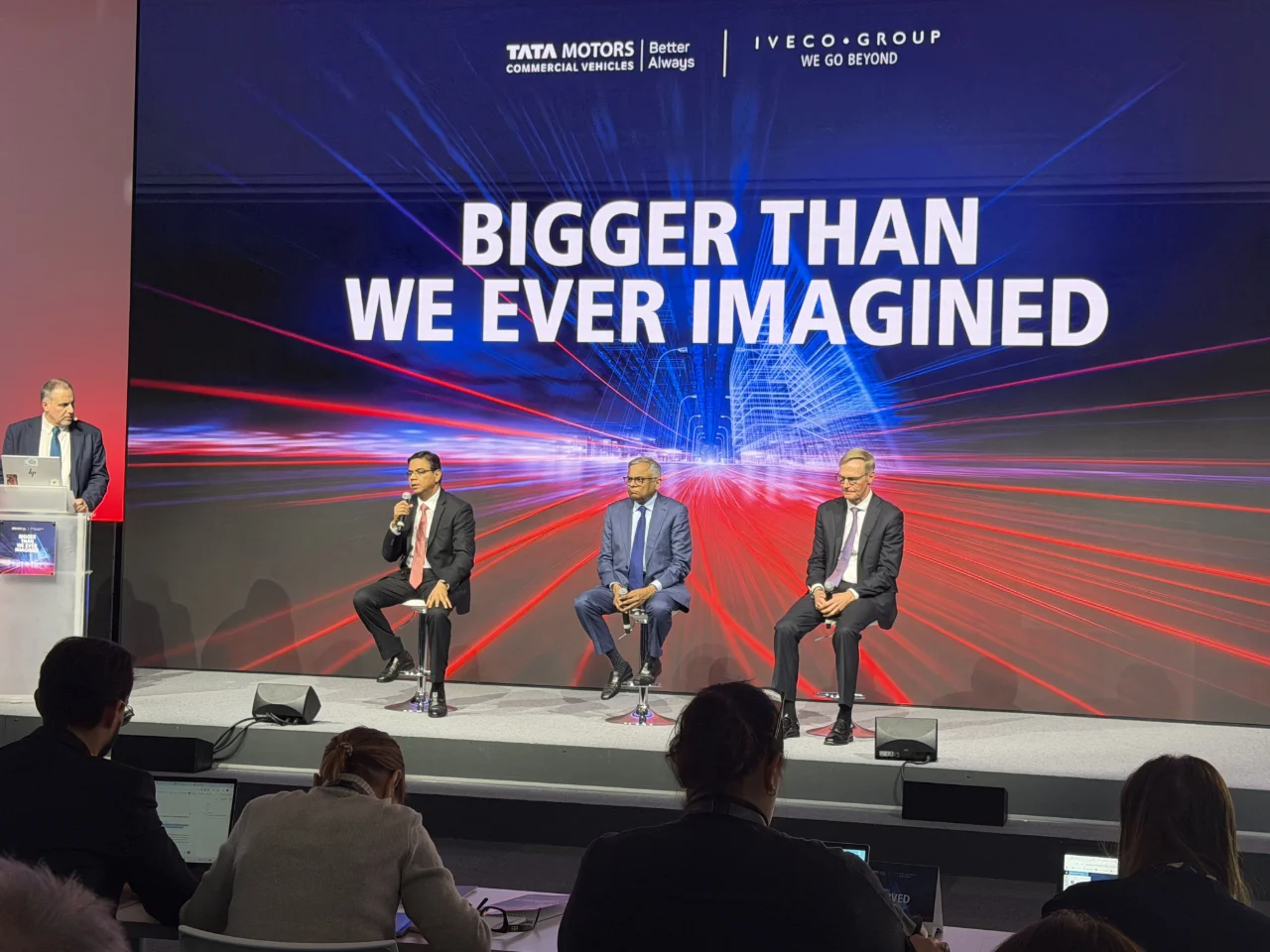
TruckStop was present in Turin, Italy, on 3 November 2026, to attend the official presentation of the coming together of Tata Motors and Iveco Group. A strategic union that gives birth to the fourth largest manufacturer of industrial vehicles over 6 tonnes in the world. Beyond the impressive figures, this operation could above all offer IVECO the means to hold its own durably in a European market where industrial consolidations have profoundly changed the rules of the game. A new page opens for the Italian manufacturer. It remains to be seen how it will be written.
In Turin, a new story begins

It is in its historic stronghold of Turin that IVECO officially presented its new face. Now integrated into the Indian group Tata Motors, the Italian manufacturer enters a new industrial and commercial dimension.
To mark this event, the leaders of both companies had brought together the international press. TruckStop was on site to discover the ambitions of this new entity and, above all, to try to understand what this union could change for the future of IVECO.
Around the table, N. Chandrasekaran, Chairman of Tata Sons, Tata Motors and Iveco Group, Girish Wagh, Managing Director of Tata Motors, and Olof Persson, CEO of Iveco Group, presented their shared vision.
The message was clear: it is not simply a matter of bringing two manufacturers together to achieve savings, but of building a global player capable of competing with the biggest names in road transport. An ambition that takes on its full meaning when one observes the evolution of the European heavy truck market.
Could IVECO still go it alone?

This is probably the real question behind this coming together. For several years, the European industrial vehicle market has been organising itself around ever more powerful groups. On one side, TRATON brings together notably Scania, MAN and International. On the other, Daimler Truck has considerable industrial and financial power, while Volvo Group can count on several brands, including Volvo Trucks, Renault Trucks and Mack Trucks in the USA.
Faced with these behemoths, IVECO occupied a particular position: that of a historic European manufacturer, with a complete range, genuine technological expertise and a strong identity in southern Europe, but with a more modest size than its main competitors.
Yet developing new engines, investing in electrification, exploring hydrogen, integrating ever more software and responding to demanding environmental regulations requires colossal financial resources. In this investment race, size becomes a decisive advantage.
Could IVECO have continued alone? Undoubtedly, at least for a certain time. But with what investment capacity and what long-term prospects?
This is where the coming together with Tata Motors takes on its full meaning. By joining a group of global dimension, IVECO could have found the partner capable of allowing it to remain in the race, rather than progressively suffering the power of its competitors.
A new giant with impressive figures
The figures presented in Turin immediately give the measure of this new alliance.
- €21 billion in combined turnover.
- Around 590,000 vehicles sold annually.
- More than 73,000 employees spread across six continents.
- 27 production sites and 25 research and development centres.
- More than 9,300 sales and service points worldwide.
- A presence in more than 130 countries.
With this entity, Tata Motors and Iveco Group now claim fourth place worldwide in sales volume in the segment of industrial vehicles over 6 tonnes.
But beyond this new power, it is above all the complementarity of the two companies that seems to constitute the interest of the operation. Tata Motors has a major foothold in India and a significant presence in several emerging markets in Asia, Africa and the Middle East. IVECO brings, for its part, its European experience, its positions in Latin America, its mastery of the heavy truck and its expertise in powertrains via FPT. Two industrial worlds that, rather than competing directly on their main markets, could strengthen each other.
Tata at the helm, but IVECO keeps its identity

This was naturally one of the questions surrounding this official presentation: what will remain of IVECO's Italian identity under the control of an Indian group?
On this point, the leaders wanted to be reassuring. The headquarters of Iveco Group will remain in Turin. The brands, teams and industrial locations will retain their own identities. Tata Motors also intends to support the strategy and investment programmes already underway.
During exchanges with journalists, Olof Persson notably confirmed the continuation of the planned investments in Italian facilities for model years 2026 to 2028. The sites linked to FPT, notably in Turin, Brescia but also Bourbon-Lancy in France, remain at the heart of this strategy. The leaders also insisted on the maintenance of European skills and on the development of new activities around engineering, software and automation.
A stated intention that will obviously have to translate into reality.
Because if respecting IVECO's identity today constitutes a strong commitment, it is the industrial strategy adopted in the coming years that will allow the real autonomy of the Italian manufacturer to be measured.
FPT, one of the great assets of this union
Among the many synergies mentioned during the conference, one name comes up insistently: FPT. The IVECO Group's engine manufacturer represents a genuine technological asset for the new entity. Its expertise covers both traditional diesel powertrains and natural gas, electric solutions and alternative technologies.
For Tata Motors, access to this expertise opens up important prospects, notably for certain vehicles in its range and for industrial applications outside Europe.
Girish Wagh however provided an interesting clarification during the press questions: Tata Motors intends to maintain its historic partnership with Cummins for its heavy trucks destined for the Indian market.
FPT will therefore not systematically replace existing powertrains. The objective is rather to exploit technological complementarities where they present a genuine interest.
This pragmatic approach could allow both companies to accelerate their developments while limiting certain costs. Cooperation could also concern batteries, components, technical platforms and digital technologies. All areas in which the pooling of resources becomes essential to remain competitive.
New commercial opportunities on a global scale
The other major interest of this alliance lies in the opening up of new markets.
With more than 9,300 sales and service points, the new entity has a particularly extensive worldwide network. Tata vehicles could thus benefit from IVECO's presence in certain regions, notably in Latin America. Conversely, certain IVECO products or technologies could find new outlets in the markets where Tata is historically well established.
During the conference, the leaders notably mentioned the possibility of introducing certain IVECO products in India through local assembly. The idea is therefore not necessarily to sell the same vehicles everywhere in the world, but to take advantage of each manufacturer's strengths to develop new opportunities. A strategy that could, in time, generate additional volumes and improve the return on industrial investments.
And for European hauliers, what could change?

This is obviously the question that directly interests TruckStop's readers. In the short term, the leaders promise continuity. Contracts, warranties, relationships with dealers and after-sales services remain unchanged. IVECO customers should therefore not notice any immediate upheaval in their relations with the brand.
In the longer term, the prospects are potentially more interesting. With the financial and industrial power of Tata Motors, IVECO could have additional means to renew its ranges, accelerate the development of new powertrains and strengthen its competitiveness. In the heavy truck segment, where competition is particularly intense, this new dimension could become an important advantage, notably in the speed of development of new products.
But caution: belonging to a large group does not automatically guarantee commercial success. Hauliers will continue to judge vehicles on very concrete criteria: reliability, fuel consumption, total cost of ownership, after-sales service quality and residual value — and on this point IVECO is currently somewhat struggling, notably in France.
It is on these elements that the new group will have to demonstrate the real benefits of this alliance.
A strategic operation, but still many unknowns
In Turin, the speeches were naturally turned towards the future, with a stated desire to build a solid, innovative and sustainable group. Yet several questions remain.
What place will IVECO really occupy in the strategic decisions of the new entity? How will investments be distributed between Europe and India? Will industrial synergies allow costs to be reduced without compromising the specificities of the different brands? And above all, will Tata Motors give IVECO the means to pursue a product strategy truly adapted to the demands of the European market? These questions are far from secondary.
The history of the automotive and heavy truck industry has shown that coming together between manufacturers could create formidable opportunities, but also lead to industrial trade-offs that are sometimes difficult. The leaders insisted on a logic of growth rather than rationalisation. An encouraging orientation, but one that will have to be confirmed over time.
A decisive new chapter for IVECO

Leaving this official presentation in Turin, one impression dominates: IVECO has probably just crossed one of the most important milestones in its recent history.
In a European market dominated by a few large-scale industrial groups, remaining independent would have represented an increasingly complex challenge.
The Italian manufacturer possesses skills, a history, products and genuine legitimacy in the world of transport. But these qualities are no longer always sufficient when it is necessary to invest simultaneously in several technologies, develop new vehicles and face global competition.
With Tata Motors, IVECO changes dimension and the new slogan "Bigger than we ever imagined" leaves no ambiguity.
The Indian group brings its power, its international presence and its capacity to envisage developments in new markets. IVECO brings its experience, its technologies, its brands and its European expertise.
Even if on paper the equation seems particularly interesting, it remains now to transform this complementarity into industrial and commercial success — and the challenge remains considerable.
Tata Motors may have just given IVECO the means for its future. It remains to be seen what direction this new giant will take and, above all, what place the Italian manufacturer will occupy on the road that opens before it.
Text and photos: Fabien Calvet