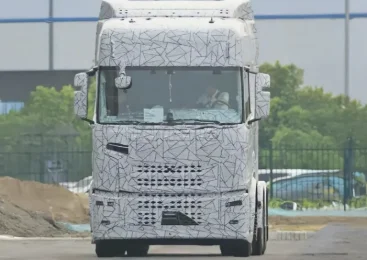
Wörth preview: TruckStop behind the wheel of the future Mercedes, between the Mercedes-Benz eArocs 400 and the second-generation Mercedes-Benz Actros H2
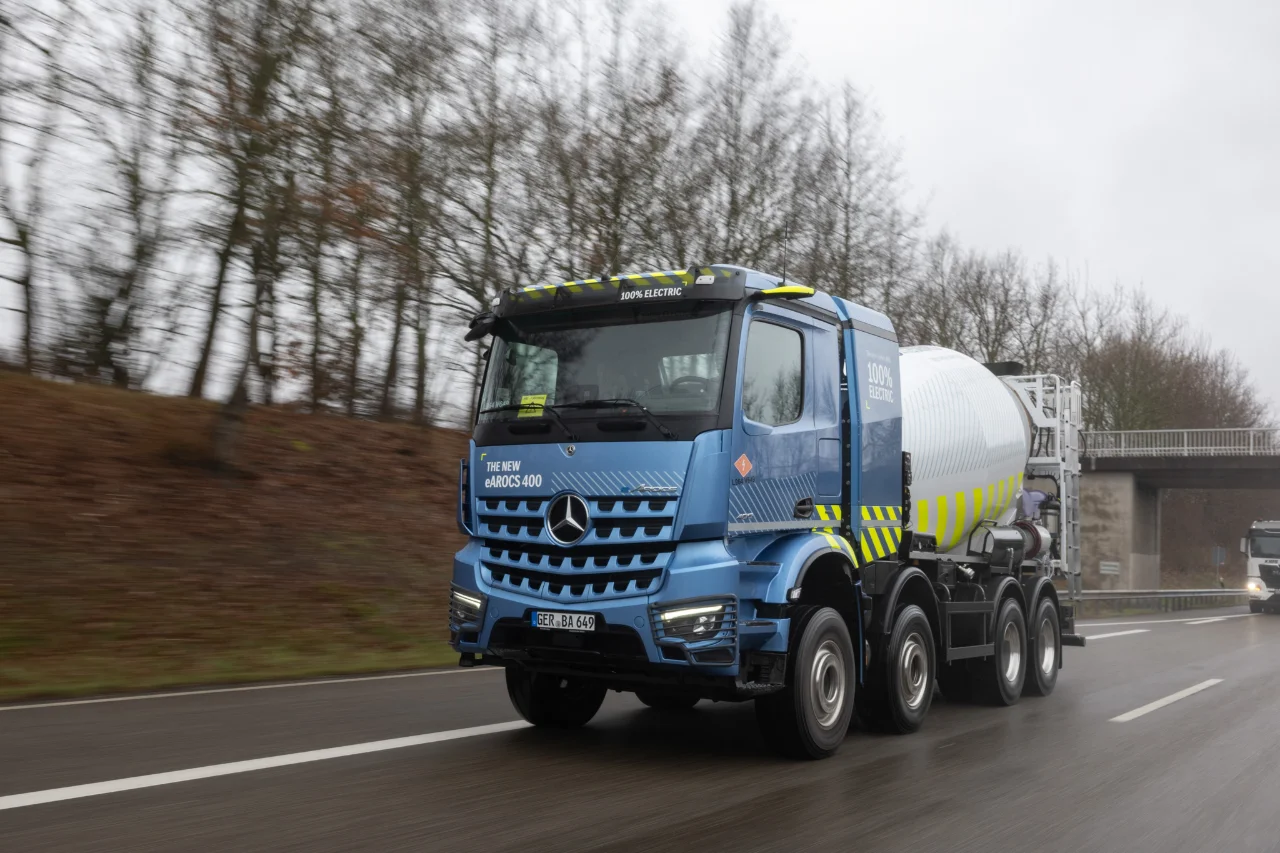
We headed to Wörth, Germany, on the home ground of Mercedes-Benz Trucks. This is the largest truck plant in Europe, producing over 400 trucks per day, and it’s safe to say that the research and development department here is enough to make many competitors jealous.
The plan for the day: discover two trucks that you won’t be seeing anytime soon on the A7 or even around Toulouse. No, this time we’re talking about real prototypes. And when I say prototype, I don’t mean a marketing word thrown into a press release. These are vehicles still under manufacturer control, with specific regulations, certified test drivers, and engineers onboard.
Two very different experiences were on the agenda. First, the new eArocs 400, a 100% electric construction truck, which we experienced from the passenger seat. Since we were driving on public roads in Germany and the truck has not yet received all regulatory approvals, only a Mercedes engineer was allowed to drive it.
For the second truck, things were very different. And believe me, I wasn’t going to hold back my excitement, because this time I got behind the wheel of the brand-new second-generation Actros H2. This was a true exclusive— to my knowledge, we are among the first French journalists to experience it this way. And for that reason alone, we had to share this day exactly as we lived it.
eArocs 400: construction goes electric too

Let’s start with the one closest to production, even though it is still a prototype. The eArocs 400 is Mercedes-Benz Trucks’ answer to a growing question: how do you continue operating on urban and peri-urban construction sites when low-emission zones, noise restrictions, and diesel bans keep increasing?
The name says it all. eArocs, because it clearly belongs to the Arocs family—the world of construction, real construction. And 400, because we’re talking about around 400 kWh of battery capacity, more precisely 414 kWh.
The goal isn’t to cross Europe with a concrete mixer or an 8x4 tipper. The goal is to fulfill a specific mission: urban construction work, concrete delivery, defined rotations, and operations in areas where diesel will no longer be welcome.
In that context, Mercedes announces around 200 km of range. Some might smile. They’d be wrong—or at least looking at the problem the wrong way. For many construction applications, 200 km already makes sense.
What really stands out is that Mercedes didn’t simply reuse the architecture of its eActros road trucks. There’s no e-axle here like on the eActros 400 or 600. This is a different approach. The rear axles remain true construction axles with hub reduction, just like on a traditional diesel 8x4.
Instead of a combustion engine and gearbox, you get an electric system supplied by ZF Friedrichshafen, the well-known eTraX 2. In our case, continuous power is rated at 380 kW, around 516 to 520 hp, paired with a three-speed transmission perfectly suited for this kind of use.
From the passenger seat, you can clearly feel that the truck was designed to stay true to the Arocs DNA. It drives like a modern construction vehicle, with that characteristic sound of hub reduction axles—slightly more noticeable than on long-haul trucks—but without the combustion engine under the cab.
In short, this isn’t an eActros disguised as an Arocs. It’s a real construction truck that keeps its fundamentals while switching to zero emissions.
The cab environment remains unchanged. You’re in a Mercedes Arocs, with the same ergonomics, layout, and driving position. Our unit still showed signs of being a prototype, with visible wiring, data recording equipment, and some elements not yet finalized. But it’s already clear where Mercedes is heading.
Production is expected to start at the end of 2026, with the first trucks hitting the road in 2027. At that point, things get serious.
Of course, weight remains a key issue. The eArocs is heavier than its diesel equivalent by about 2 to 2.5 tons depending on the configuration, with an empty weight around 12 tons.
Yes, it impacts payload. Yes, regulatory adjustments will be needed. Yes, it raises economic questions. But for certain urban construction operations where access, noise, and environmental image are critical, this type of vehicle already makes sense.
The eArocs 400 won’t revolutionize the entire construction market overnight. But it clearly shows that established manufacturers are not leaving this segment to newcomers, as we’ve seen previously with players like SANY. And given the rapid rise of some Asian competitors in electric construction vehicles, Mercedes had every reason to step up its game—although pricing will be key, because on that front, the Chinese could be very competitive.
Actros H2 Gen 2: stepping into another dimension

But let’s be honest: if this day at Wörth will be remembered, it’s not just because of the eArocs. The real highlight is the second-generation Actros H2.
We had already seen the first hydrogen prototype years ago, and even driven it. But back then, it clearly felt like an early-stage prototype: noisy, experimental, almost like a rolling lab.
With this second generation, everything changes. The truck now features the ProCabin, looks far more refined, and most importantly, feels like a product that has reached a new industrial level.
It’s still not a production vehicle—far from it. Commercialization isn’t expected before the end of the decade, around 2030. But it’s no longer just an engineer’s dream. The Gen 2 exists, it drives, it brakes, and above all, it behaves like a real electric truck.
And this is where we had a rare opportunity: driving it on the Mercedes Trucks test track.
Simply put, this is not something that happens every day. Being among the very first French to experience it from the inside is the kind of moment where the journalist becomes a kid again.
Liquid hydrogen: a 10-minute refill, and that changes everything

Before even talking about driving, you need to understand the concept. Here, Mercedes has chosen liquid hydrogen. And this distinction from gaseous hydrogen changes a lot of things—starting with the announced range.
On this prototype, we’re talking about 1,000 km with a full refill completed in about ten minutes. Yes, you read that right. Ten minutes, maybe fifteen depending on conditions. And when you come from the world of battery-electric trucks and hours spent waiting at a charger, it really puts things into perspective.
Refueling itself is surprisingly simple. The nozzle looks similar to what LNG users already know, with a mechanical coupling system, but the whole process feels even cleaner and smoother. You connect it, start the procedure, and the station takes care of everything. No need to hold a dead-man switch during the entire process. No complex handling. The system manages pressure, safety, gas recovery, and temperature control.
Since liquid hydrogen is stored at extremely low temperatures—around -250°C—the whole process is obviously highly controlled. But from the user’s point of view, it’s almost surprisingly simple.
The truck carries two large tanks, one on each side, for a total of 85 kg of liquid hydrogen. And already, you start to understand Mercedes’ approach. The goal isn’t just to say “we also do hydrogen.” The goal is to provide a credible solution where battery-electric trucks are still limited by weight, charging time, or long-haul usage.
An electric truck… without massive batteries

This is where things need to be clear, because hydrogen often suffers from confusing communication. The Actros H2 Gen 2 is not a hydrogen combustion truck. It’s not some exotic concept either.
In reality, it’s a fuel cell electric truck. And that’s fundamental.
Liquid hydrogen feeds Cellcentric fuel cells. There are two of them, delivering a combined continuous power of 300 kW. The electricity generated then powers an e-axle very similar to what we already know from the eActros 600.
So you get a true electric truck behavior: instant response, silence, smoothness, regenerative braking. The difference is that instead of carrying massive batteries, electricity is produced onboard using hydrogen. There is a small buffer battery, necessary for transient phases and low speeds, but it’s nothing like the large battery packs found in conventional electric trucks.
In other words, on paper, the Actros H2 almost combines the best of both worlds: the driving feel of electric, with range and refueling times much closer to diesel or gas.
Behind the wheel: excitement… then a shock

When I got behind the wheel, there was obviously excitement. Driving something you won’t see on the road for years, knowing you’re experiencing something rare, and carrying that exclusivity for TruckStop.
But very quickly, beyond the symbolism, came the driving experience. And honestly—big surprise. This truck behaves like a real production vehicle. Not like a rough prototype, not like a temperamental demonstrator, not like a lab on wheels. A real truck.
You immediately recognize the Mercedes electric DNA. Instant response, power available right away, smooth and natural driving. You can tell it’s still under development, but it already feels highly refined. No more parasitic noises like on the first generation. No more “test aircraft” feeling. This is a modern truck, almost ready to go to work.
On the test track, we were able to run through a full range of scenarios: banked curves, emergency braking, varying grip conditions, slopes, hill starts. And every time, the same impression: the truck does exactly what you ask, with almost unsettling ease.
Emergency braking on wet cobblestones first. 42 tonnes gross combination weight—because in Germany electric trucks benefit from an extra 2 tonnes over the standard 40 tonnes. You slam the pedal. The truck stops straight, clean, without any unwanted reactions.
Same test on a slippery metal plate: again, ABS and driver assistance systems do their job perfectly, the truck stays stable. Then on soaked concrete, at higher speed. Same result. Yes, it’s a prototype—but one that already behaves like a mature truck.
Then there’s the 18% incline. Once again, the Actros H2 showcases electric performance. Full stop, hold, then smooth restart without stress or brutality. With a diesel, especially loaded, there’s always that moment where you need to manage torque, balance, feel the truck. Here, it’s effortless. Release the brake, press the accelerator, and it moves off as if nothing happened.
500 hp on paper… much more in reality

On paper, the system delivers around 370 kW peak power—roughly 500 hp—and 300 kW continuous. Some might consider that “average” for a modern tractor.
But once again, with electric, raw numbers don’t tell the full story.
At 42 tonnes, the truck accelerates with an ease that feels closer to a 600 or 700 hp diesel. That’s the nature of electric: no lag, no rev build-up, no delay. You press, it goes.
And in this Actros H2, the absence of massive battery weight further enhances the overall efficiency.
The most impressive part is that after a few minutes, you almost forget about the hydrogen. What you have in your hands is simply a responsive, reassuring, enjoyable truck. And that’s probably the biggest compliment you can give such an advanced prototype.
The real issue: the technology is ready, the ecosystem isn’t

Of course, we shouldn’t be naive. Technology is progressing fast—very fast. But there’s still a major barrier: infrastructure.
Today, the real challenge of liquid hydrogen isn’t the truck. It’s everything around it. Producing clean hydrogen, liquefying it, transporting it, distributing it. Building stations. Reducing costs.
And let’s be honest—we’re still far from where we need to be. A 10-minute refill for 1,000 km sounds incredible on paper. But without the infrastructure, it remains a promise. A very credible promise, technically speaking—but still a promise.
That doesn’t take anything away from Mercedes’ work. Quite the opposite. With this second-generation H2 truck, the manufacturer shows that on the vehicle side, progress is happening at an impressive pace.
And if infrastructure catches up, then yes—fuel cell trucks could become a real alternative for long-haul transport, where battery-electric solutions still face limitations.
Two prototypes, two horizons, one certainty
This day at Wörth leaves a very clear impression. On one hand, the eArocs 400 shows that battery-electric trucks are already entering specialized segments like construction, with increasingly coherent products—though still costly and limited to certain use cases.
On the other hand, the Actros H2 Gen 2 opens a window into a future that is still a bit distant, but already tangible.
If I had to sum it up in one sentence, it would be this: we are no longer in science fiction. We are in industrial development.
The eArocs will arrive soon, likely from 2027. The Actros H2 will take more time, probably around 2030. But in both cases, the Daimler group is not working in a vacuum. These products exist, they drive, they are tested—and above all, they are already being pushed into real-world conditions.
The TruckStop perspective

At TruckStop, you know us—we like real-world testing. We also like to stay grounded.
Yes, we can still love diesel, the sound of an engine, the character of a big traditional truck. I won’t deny it. I drive a V8 myself, and I’m not going to wake up tomorrow and renounce everything I’ve loved.
But it would be foolish to ignore what we’ve just seen. Because technically, these trucks are fascinating. Because they show how fast the heavy-duty world is evolving. And because manufacturers are no longer just talking—they are building, testing, and putting real solutions on the road.
The eArocs 400 already answers a real need. The Actros H2 may represent a solution for tomorrow—provided the ecosystem follows. We’re not there yet.
But after what we experienced in Wörth, one thing is certain: the future of trucking is no longer just talk. We’ve seen it. I had the chance to drive it. And believe me, this short drive of the Actros H2 will stay in my memory for a long time—just like the first laps I once did in a certain Scania 143, a truck that later became legendary.
Text: Fabien Calvet Photos: Mohamed Belmokhtar & Fabien Calvet