A Haulier Discovers the Electric Truck…
Field Test: A Haulier Discovers the Electric Truck…
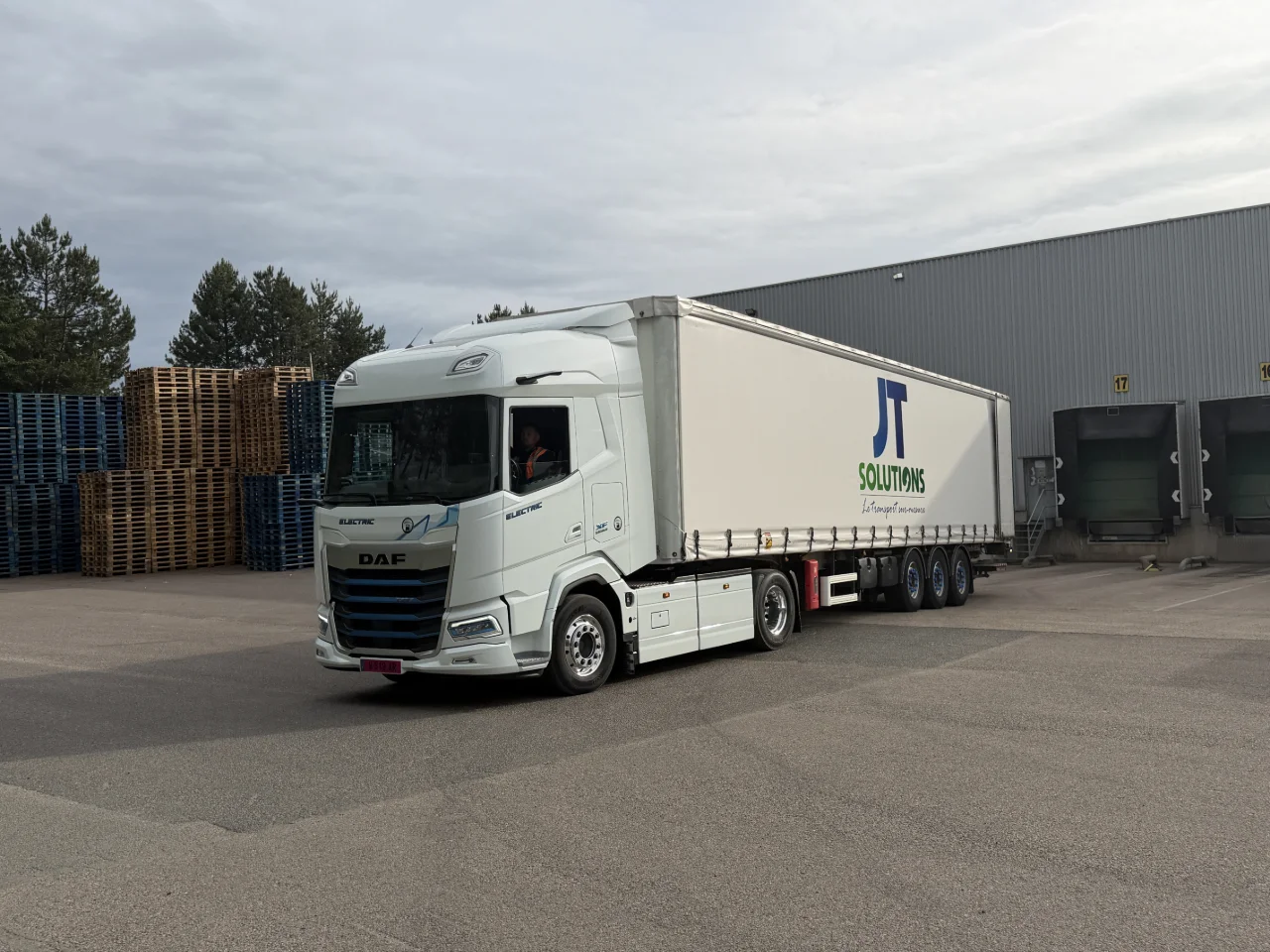
For the very first time in TruckStop tests, we reversed the roles. Instead of going to discover a haulier’s truck, it was us who arrived at his premises with a demonstrator vehicle. Behind the wheel was Jérémy Tribolet, owner of a small transport company operating five trucks and, above all, a daily user of DAF diesel tractor units. One small detail: our test driver of the day had never driven an electric heavy truck before, so he was about to discover the Truck of the Year without any specific training, relying solely on his experience of the profession. The perfect opportunity to find out whether, in 2026, switching to electric is really as simple as manufacturers promise.

For this field test, I had to adapt to our host’s working conditions. The meeting point was set for four o’clock in the morning at the DAF Lefebvre dealership, near Dijon. There wasn’t a soul in sight. In the yard, only our truck stood ready to be coupled to Jérémy’s semi-trailer for a perfectly ordinary delivery run. The mission: deliver preforms used to manufacture plastic bottles, then load the empty metal racks for the return journey to the factory. Just another working day, nothing more—the daily routine for many of us—and I must admit that this is precisely what makes this test so interesting.
The tractor unit of the day is the DAF XF Electric, recently crowned International Truck of the Year 2026 by the International Truck of the Year jury. An award recognising the Dutch manufacturer’s entire new electric range. As Vice-President of the jury, I had already had the opportunity to discover this vehicle during the international press test drives. But this day is not about repeating a manufacturer test—the real interest lies elsewhere.
Standing in front of me is Jérémy, who runs a small transport company operating five articulated combinations. His daily work is entirely focused on regional transport around Dijon. His fleet consists of the latest-generation DAF XF models… all powered by diesel engines. He knows the DAF world inside out, but let’s be clear: electric is completely unknown to him. Jérémy has never driven a battery-electric truck and, above all, has never received any form of training. In other words, he represents exactly the type of operator found today in hundreds of French SMEs wondering about the future of their fleets.
One Rule Only: No Staging

To preserve the credibility of this test, everything was carried out without a script. There was no question of choosing a favourable route. Nor was there any question of artificially reducing the payload or adopting a driving style designed to set a consumption record. Our combination weighs in at a modest 38 tonnes gross combination weight, a load perfectly representative of Jérémy’s business. The route itself combines motorway driving, the RCEA trunk road, rolling secondary roads, village crossings, urban traffic and an industrial delivery. In short, real life. We simply decided to share the driving throughout the day in order to compare our impressions.
The First Kilometres Quickly Remove Any Doubts
As soon as he settles behind the wheel, Jérémy immediately finds his bearings. Driving position, controls, central screen, drive selector, parking brake… everything feels familiar.
“If you don’t look at the information related to the electric drivetrain, you’re in a DAF,” he sums up after just a few kilometres. And that is probably this truck’s first success. The manufacturer has not tried to reinvent the driving experience. Quite the opposite. The objective is to reassure the driver by keeping exactly the same habits he already has.
The only differences appear on the digital instrument panel, where the fuel gauge gives way to information about electricity consumption and energy recovery. Apart from that, nothing changes.
Or almost nothing. Very quickly, one phenomenon catches Jérémy’s attention. Approaching a roundabout, he instinctively lifts off the accelerator… and the truck continues to glide for several hundred metres.
“You can feel there’s no more mechanical engine braking. You have to learn to anticipate much earlier.” This freewheeling sensation is undoubtedly the first real adaptation required by an electric truck.
The new reflex is to let the vehicle make use of its inertia before activating energy regeneration. A few kilometres later, the demonstration becomes particularly spectacular. Leaving the motorway, Jérémy releases the accelerator 2.6 kilometres before the toll booth. The truck covers almost the entire distance in freewheel mode, losing only 2 km/h. During this phase, energy consumption simply drops to… zero.
A completely different way of approaching driving.
More Than a Powertrain, a New Way of Driving

As the kilometres pass, the initial apprehension disappears. In its place comes genuine curiosity. Every downhill section becomes an opportunity to observe energy recovery. Every deceleration allows a few precious percentage points of battery charge to be regained. Every village becomes an exercise in anticipation.
Contrary to popular belief, this type of driving does not require more effort. It simply requires a better understanding of the road ahead. You no longer drive against the terrain. With an electric truck, you learn to work with it. And that is probably what surprises Jérémy the most. Without any prior training, he naturally adapts his driving style.
I’ll be honest—because I often tell you this—the driving experience with these new trucks quickly becomes something of a game, to the point where your habits change instinctively after only the first few dozen kilometres.
The Weight of the Batteries Completely Changes the Truck’s Behaviour

After around one hundred kilometres, first impressions give way to much more precise observations. Jérémy is a true professional and knows this route perfectly. He drives it regularly with his own diesel-powered DAF XF trucks. That is precisely what makes his analysis particularly interesting: he has a genuine point of comparison.
The first thing that surprises him is the truck’s road behaviour. The semi-trailer is carrying a relatively high load, which could suggest increased body roll through the many roundabouts along our route. Yet exactly the opposite happens.
“You can feel that the truck stays much flatter. I thought the load would push us further towards the outside, but that’s not the case.”
The explanation is simple. While an electric tractor unit is significantly heavier than a diesel model—between 11 and 12 tonnes, compared with around 8 tonnes for a conventional tractor—the additional weight is mainly concentrated in the battery packs installed between the chassis rails.
The result is a much lower centre of gravity. On the road, this translates into more stable handling and a very reassuring feeling, even when the semi-trailer is heavily loaded. That said, you mustn’t let yourself be fooled. “You feel less body roll, but the load is still there. You mustn’t forget that you’re transporting weight.”
A remark full of common sense, reminding us that no technology can replace a driver’s experience.
Impressive Power… Perfectly Under Control

Another surprise during the day is the way the truck delivers its power.
On paper, the XF Electric develops 350 kW, or around 476 hp, with 2,400 Nm of torque. Figures comparable to the most powerful diesel versions in the range, exactly what Jérémy drives every day.
Behind the wheel, however, the sensations are completely different. The electric motor eliminates gear changes entirely. Acceleration becomes perfectly linear. Every time the truck pulls away, particularly when exiting a roundabout or after traffic lights—it does so without the slightest jerk.
“I was afraid it would be brutal. In fact, it’s very progressive. You can feel the power, but it arrives incredibly smoothly,” Jérémy tells me. Indeed, even loaded to nearly 38 tonnes, the tractor unit never gives the impression of struggling. Acceleration is strong, silent and particularly pleasant.
The complete absence of vibration contributes greatly to this constant feeling of smoothness. You quickly forget that you are travelling with several dozen tonnes behind you.
Silence Also Changes Driver Fatigue

As the hours go by, another aspect becomes obvious. The noise… Or rather, the absence of it. Without an internal combustion engine beneath the cab, the driving environment changes dramatically.
Conversations become far more natural. There’s no longer any need to raise your voice on the motorway. The only sounds that remain come from the tyres, the wind and the movements of the semi-trailer.
Even the camera mirror system contributes to this feeling of calm by reducing aerodynamic turbulence around the cab. After several hours on the road, the difference is far from insignificant.
Noise or rather the lack of it is one of those benefits that people rarely think about when talking about electric trucks, yet it becomes obvious very quickly over the course of a full working day.
The Motorway Consumes… the Secondary Roads Recharge
If you’ve been following us for a while, you already know that TruckStop tests are always based on the same principle: publishing real-world figures. No optimised route. No artificially reduced speed.
We drive at 85 km/h on the motorway, exactly as we always do during our tests, in order to remain in normal operating conditions and avoid the speed fluctuations caused by different speed limiter calibrations.
And the first figures are interesting. On motorway sections, energy consumption naturally increases. At a constant speed, opportunities for energy recovery remain limited. However, as soon as the route becomes hillier, the truck’s energy behaviour changes completely.
Every downhill section recharges the batteries. Every deceleration becomes a source of energy. Every village crossing allows several kilowatt-hours to be recovered.
After around 200 kilometres, the on-board computer displays an average consumption of approximately 101 kWh per 100 kilometres.
A few dozen kilometres later, as we alternate between secondary roads, rolling terrain and more varied traffic conditions, that average gradually falls below the symbolic 100 kWh/100 km mark, eventually settling at around 95 kWh/100 km.
These figures are far from anecdotal. With a battery capacity of more than 500 kWh, they theoretically make it possible to achieve close to 500 kilometres of range under perfectly realistic operating conditions. And, above all, with a truck that is genuinely working.
We are not trying to set a record. We are simply doing our job.
The Better You Understand the Truck… the Less It Consumes

One of the most interesting lessons of the day gradually becomes apparent. At the beginning, Jérémy naturally drives exactly as he would with his diesel truck.
Then, almost unconsciously, his driving style begins to change. He anticipates more. He lifts off the accelerator earlier. And, above all, he makes better use of the long freewheeling phases.
As he uses regenerative braking with greater finesse, the results become visible almost immediately on the dashboard screens. “I get the impression that by changing my driving style a little, we’re genuinely gaining range.”
Exactly. Jérémy is absolutely right. With an electric truck, good driving habits are rewarded immediately. Several times, we even observe a rather surprising phenomenon.As we continue our journey…the displayed driving range actually increases.
The truck recovers more energy than it consumes on certain particularly favourable sections. A phenomenon impossible to reproduce with a diesel engine, because diesel fuel simply doesn’t create itself inside the fuel tank!
One Pedal Mode Finally Finds Its Purpose
On long motorway sections, One Pedal Mode offers only limited benefits. However, as soon as the route becomes more urban, it reveals its full potential.
Approaching built-up areas, traffic lights and roundabouts become increasingly frequent, so Jérémy decides to try this mode for the first time. After just a few minutes of adaptation, the conclusion is immediate.
“Once you’ve found the balance point, you do almost everything with a single pedal.” Acceleration, deceleration and energy recovery flow naturally together.
Once again, the learning process proves to be much quicker than you might imagine. Yet another demonstration that getting to grips with an electric truck does not necessarily require days of training.
For an experienced driver, just a few dozen kilometres are often enough to understand how the vehicle works.
The Return Journey Confirms the First Impressions
Once the pallets have been unloaded, our combination heads back in the opposite direction. This time, the semi-trailer is carrying only the empty metal racks that will be reloaded at the starting point. The gross weight drops to around 30 tonnes, almost eight tonnes less than on the outward journey.
Instinctively, you might think that this second part of the trip would be much more favourable in terms of energy consumption.
The reality is a little more subtle. On uphill sections, the truck naturally uses less energy.
On the other hand, on the long downhill stretches along the route, energy recovery is also reduced. The heavier a vehicle combination is, the greater its kinetic energy… and the more effective regenerative braking becomes.
This is one of the paradoxes of electric transport: a heavier load increases energy consumption, but also improves the truck’s ability to recover energy. In the end, the balance between these two effects is much more favourable than you might expect.
Range: The Last Psychological Barrier

By the middle of the afternoon, the dashboard shows 15% battery remaining. Instantly, the atmosphere changes. Not because the truck shows the slightest sign of weakness, but because that figure acts as a psychological trigger.
Jérémy admits it with a smile. “That’s when you start feeling a little drop of sweat running down your back…”
This reaction is perfectly normal. In fact, it is common to almost every driver discovering an electric truck for the first time. With a diesel vehicle, the fuel warning light still leaves a comfortable safety margin. The remaining range is rarely a source of concern.
With an electric truck, every percentage point suddenly seems important. Yet just a few kilometres later, a succession of downhill sections allows us to recover several percentage points of battery charge.
The estimated range increases. The tension disappears. In the meantime, Jérémy has also changed the way he drives. He anticipates traffic much more. He uses freewheeling more frequently. And he makes much finer use of the different regeneration levels.
“I’ve realised that I can genuinely influence the consumption. You gain several kilometres of range simply by changing the way you drive.”
That remark probably sums up one of the main lessons from this test. The efficiency of an electric truck depends not only on its technology, but also on the experience acquired by its driver. Just as eco-driving profoundly changed the fuel consumption of diesel trucks, electric vehicles now require a new set of driving habits. The difference is that the results appear immediately on the dashboard.
Mission Accomplished… Without Intermediate Charging
As the kilometres pass, the verdict becomes obvious. We will complete the entire delivery round without using any opportunity charging—the short top-up charging session that can be carried out during a mandatory break.
This scenario had initially been considered before the test began. In the end, it simply wasn’t necessary. Even better, the figures recorded throughout the day exceeded our expectations.
Average consumption settled at 95 kWh per 100 kilometres.
In other words, with a battery pack of more than 500 kWh, the DAF XF Electric is capable of covering around 500 kilometres under real operating conditions, with a fully loaded articulated combination weighing between 30 and 38 tonnes, without making any special effort to save energy.
That point deserves to be emphasised. We were not trying to set any records. We were simply doing our job. And that is precisely what gives this test its value.
The Truck Is Ready… Now the Infrastructure Has to Catch Up

At the end of the day, one obvious question naturally comes to Jérémy. What would prevent him from introducing an electric truck into his company today?
His answer is immediate. And, as you’ve probably guessed, it isn’t the driving experience, the performance, or even the range.
“The real issue today is the charging network. If the infrastructure develops, it removes a huge part of the concerns.” This is a view shared by a large part of the transport industry.
The vehicle itself is now mature and, let’s be honest, it improves month after month. Operating costs are also becoming increasingly competitive, particularly thanks to the disappearance of oil changes, filters, AdBlue and a significant portion of traditional maintenance requirements.
It is also worth pointing out that current government incentives make the Total Cost of Ownership (TCO) particularly attractive.
Of course, these incentives may not last forever, but for the moment they deserve to be highlighted. That said, let’s also be honest about the remaining challenges. Yes, public charging infrastructure remains the weakest link.
Being able to continue a journey confidently after a driver’s break, easily finding charging stations suitable for heavy goods vehicles, or recharging while loading or unloading has now become the main challenge.
The truck is no longer necessarily the problem. Its environment still has to evolve.
More Than a Test… An Experience
When he left Dijon that morning, Jérémy had never driven an electric truck. A few hours later, he had completed a full working day with the feeling that he had simply discovered…another way of driving.
That probably sums up this entire experience. Electric power does not fundamentally change the profession of a truck driver. It does not rewrite the basics of road transport. What it does require is rethinking certain habits: anticipating further ahead, using the terrain instead of fighting against it, and considering energy as a resource that can also be recovered.
Ultimately, this day mainly succeeded in breaking down a number of misconceptions. No, an experienced driver does not need several days of training to learn how to drive an electric truck. No, you do not have to drive unusually slowly to achieve a realistic operating range.
And no, electric trucks are no longer limited to carefully prepared demonstration runs. In the right operating environment, in this case, regional transport with a daily return to the depot—they are now a genuinely credible solution.
Diesel will undoubtedly remain an essential part of road transport for many years, particularly on long-haul operations. But this day demonstrates that the debate is no longer about opposing two different technologies.
The real challenge is choosing the right energy source for the right mission. And that is probably the biggest lesson from this test.
In 2026, the question is no longer whether an electric truck is capable of completing a regional distribution route. The answer is clearly yes.
The real question now is how quickly the surrounding ecosystem will evolve, and, ultimately, what the true operating costs will be, so that transport companies can achieve a cost price that remains fully compatible with the rates they charge their customers.
Text and photos: Fabien Calvet