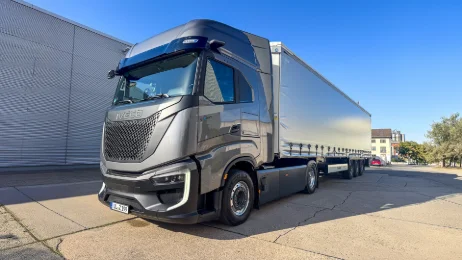
Cespira HPDI 3.0
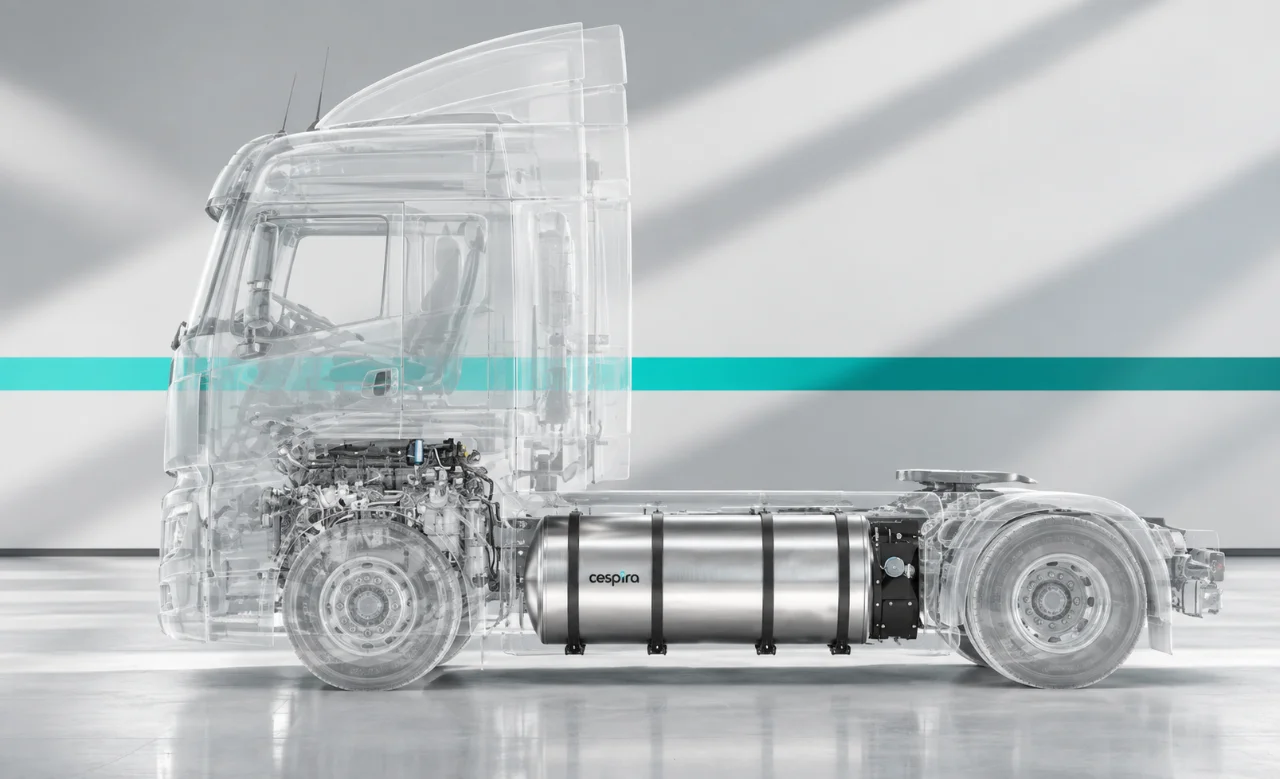
Cespira, the former Canadian entity Westport, unveils a new generation of its high-pressure direct injection system HPDI. Named HPDI 3.0, this evolution promises better control of consumption, more performance and increased durability. Enough to reinforce the place of LNG but above all bio-LNG in the energy mix of heavy transport. At TruckStop, we are already eager to verify these promises on the road!
An already widely proven technology
For many transport professionals, the name Westport is well known. It is under this name that the Canadian company became known in particular for its high-pressure direct gas injection technology that we had tested on several occasions on the Volvo LNG trucks. Today, it is under the name of Cespira that this technology continues its development, with the arrival of a third generation named HPDI 3.0.
The principle remains the same: to allow a compression ignition engine to operate mainly on liquefied natural gas (LNG) or bio-LNG, while retaining the performance and efficiency expected of a modern diesel engine.
And this technology is no longer at the experimental stage! According to Cespira, the previous generations of the HPDI system already total more than 3 billion kilometres travelled, with more than 10,000 trucks in circulation in around thirty countries including obviously France. A considerable feedback of experience that serves today as the basis for this new evolution.
HPDI 3.0: more precision to consume less
With this third generation, Cespira announces several technical improvements, starting with a new pressure control architecture in the injection rail. The objective is to obtain more precise management of fuel injection, while allowing higher pressures. On paper, this should translate into better energy efficiency, optimised performance and, above all, reduced consumption.
The system also benefits from improvements aimed at reinforcing the reliability and lifespan of components, notably through an evolution of the injector sealing technology.
Another interesting novelty: its modular architecture facilitates integration on different engine configurations, including high-power engines and V12 architectures for marine applications for example. Enough to broaden the possibilities of use if one looks further than our road transport world.
Gas remains an essential element of the energy mix
At TruckStop, we are convinced: the decarbonisation of road transport will not go through a single technology. If electric and hydrogen occupy an important place in the strategies of manufacturers, gas is obviously part of the equation of the energy mix necessary for an overall reduction of CO2 emissions. Bio-LNG, notably when it comes from renewable supply chains, can contribute to significantly reducing the carbon footprint of heavy transport over the entire fuel lifecycle. Let's be clear, for my part, today the account does not add up because if one looks at gas sales figures, Bio represents only a small part of the pie hence my question about the environmental benefits? Whatever the case, with Bio gas one must of course continue to improve the efficiency of engines running on gas as this makes complete sense.
This is also why Cespira does not stop at LNG and bio-LNG. The new HPDI 3.0 architecture has also been developed to facilitate its adaptation to future low carbon footprint fuels, with notably potential applications to hydrogen. A way of preparing for the future without giving up on solutions already operational today.
First trucks expected at the beginning of 2027
Cespira plans to launch production of its new HPDI 3.0 system in the fourth quarter of 2026, with the first equipped vehicles expected on the roads from the beginning of 2027. An essential question obviously remains for hauliers: what will the real gain in consumption be?
Because if the announced technical improvements seem promising, the manufacturer does not yet communicate a precise percentage allowing the savings achievable compared to the previous generation to be measured. And it is precisely this point that particularly interests us at TruckStop!
We are already eager to get behind the wheel of a truck equipped with this new HPDI 3.0 generation to verify, in real operating conditions, the announced gains in terms of consumption, but also the engine behaviour, its driving pleasantness and its performance, because you know my point of view on the matter, at the wheel, the Volvo LNG is for me the best truck in terms of a vehicle that runs on gas!
See you very soon therefore behind at the controls of one of these new trucks for a real field test of which we have the secret at TruckStop!