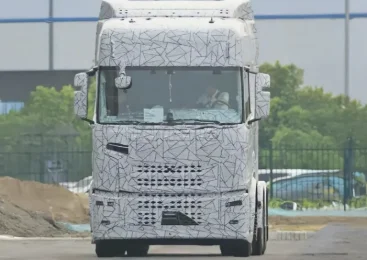
**Mercedes-Benz Unimog: 80 years and still ready for any challenge!**
The Unimog clearly belongs to the second category. For eight decades, this peculiar machine from Germany has established itself as one of the most versatile vehicles ever designed. A truck capable of ploughing a field, clearing snow from a motorway, hauling railway wagons, skidding logs through a forest, or crossing a ford during a flood. A vehicle like no other, and one that, above all, transcends generations without losing its DNA.
While all trucks are obviously built to work, certain models become icons thanks to their exceptional capabilities. The Unimog clearly belongs to that second category. For eight decades, this peculiar machine from Germany has established itself as one of the most versatile vehicles ever designed — a truck capable of ploughing a field, clearing snow from a motorway, hauling railway wagons, skidding logs through a forest, or crossing a ford during a flood. A vehicle like no other, and one that, above all, transcends generations without losing its DNA.
In 2026, Mercedes-Benz Trucks celebrates 80 years of this mechanical monument. For the occasion, TruckStop headed to Germany, to the Unimog Museum in Gaggenau, to trace the thread of this extraordinary story. An essential dive into the past to truly understand where this phenomenal Unimog comes from — and above all, why it has become what it is today. On the agenda: a museum visit, but also — exclusively — an action session on the test track, behind the wheel of several generations of the machine… with, as a bonus, a particularly spectacular anniversary prototype.
Back to Basics: The Unimog Museum

Before even turning the ignition key, a visit to the museum is simply unavoidable. Because to understand the Unimog, you first need to understand where it comes from. The story begins in 1946, in a Europe still in the midst of reconstruction. At the time, the idea was not to create a truck in the traditional sense, but a versatile agricultural vehicle capable of replacing several machines. The concept was simple: a motorised platform able to accept different tools.
Walking through the first rooms of the museum, you discover these early, tiny Unimogs fitted with side mowers, winches, or agricultural implements. The size is almost surprising when compared to modern generations.
Yet the technical foundations were already there: four-wheel drive, multiple gear reductions, and portal axles providing an impressive wheel travel. In short, everything that would later earn the vehicle its worldwide reputation.
A Machine Built to Work

Very quickly, engineers realised that their creation was not limited to agriculture. During the 1950s and 60s, Unimogs began appearing in forests, on snow-covered roads, and in municipal services.
The museum features, for example, a 411 in timber-skidding configuration, fitted with a rear winch — a small truck from the 1950s capable of hauling entire tree trunks out of forests. And the most impressive part is that these machines still work to this day.
This is, in fact, one of the most fascinating aspects of the Unimog: these are vehicles built to last. Some models are over fifty years old and continue to work on a daily basis.
Also on display are specialist versions for fire brigades, snow-clearing services, and civil engineering. The Unimog gradually became a true mechanical Swiss Army knife.
The 1970s: Birth of the Modern Unimog
The visit then takes us into the 1970s — a key period in the model's evolution. Lines became more angular, cabs gained space, and the vehicles grew in stature.
The iconic U1200, U1300, and U1400 appeared and quickly became familiar sights across Europe. Many people remember these orange trucks used by snow-clearing services and road maintenance crews.
Rail-road versions also made their appearance. Thanks to retractable steel wheels, the Unimog could run on rails and haul wagons in industrial or logistics areas.
Walking the museum aisles, one thing becomes clear: the Unimog is not a simple truck. It is a technical platform capable of adapting to almost any profession. But an Unimog is only truly understood once you are behind the wheel.
Out on the Track: Time for Action
A few hundred metres from the museum lies a test track specifically designed to put the vehicle's capabilities to the test. The setting is ideal: mud, rocks, steep climbs, bridge crossings, and water fords. In other words, terrain that would stop most trucks in their tracks — but which is the Unimog's favourite playground. To begin the test, I climb aboard a latest-generation double-cab Unimog 5023.
Unimog 5023: Technology in Service of Off-Road Performance
From the very first metres, the scene is set. The ground is waterlogged, the wheels sink into the mud, and the slope ahead looks decidedly serious.
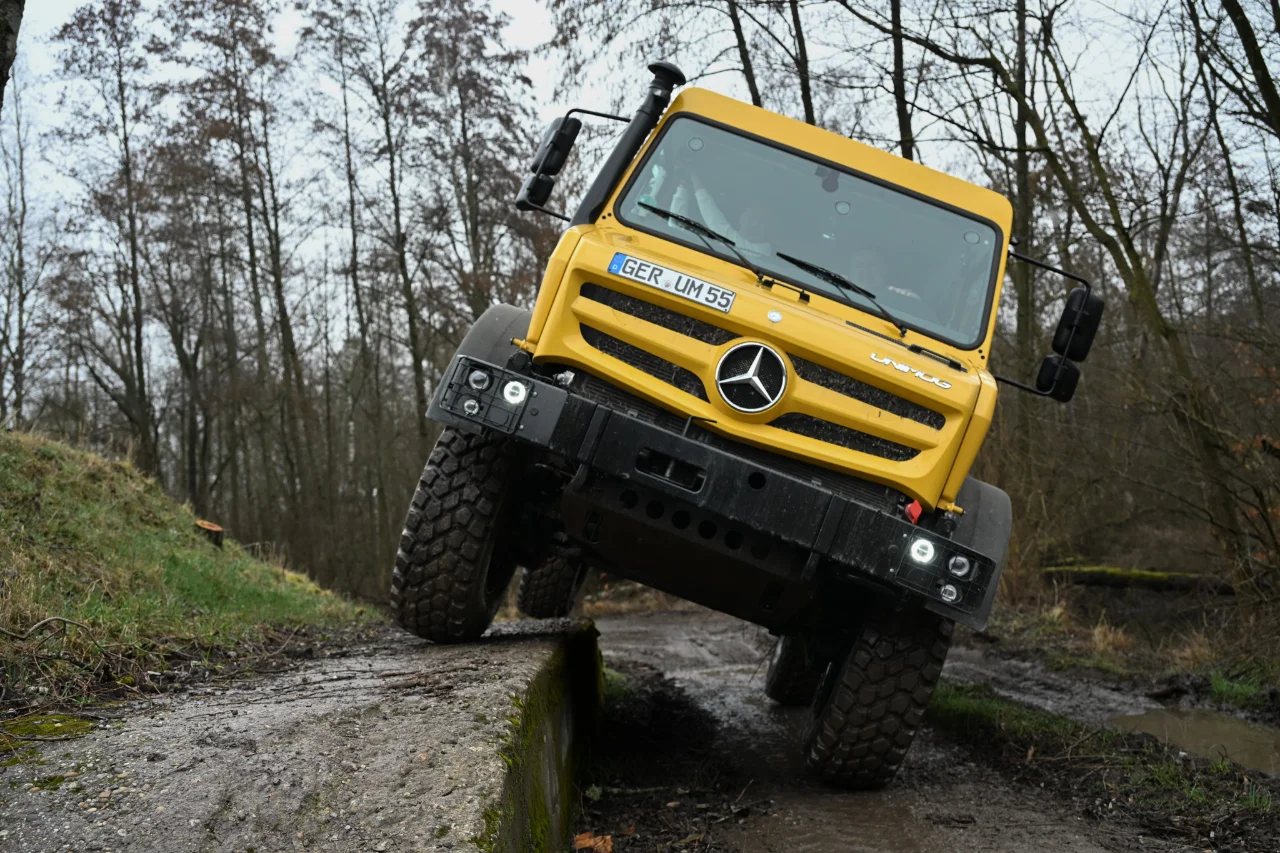
Yet the truck moves forward without a care. The Unimog's secret lies in its architecture. The extremely flexible chassis and portal axles allow the wheels to follow the terrain's contours with impressive amplitude. On a rocky section, I simply let the truck crawl forward at a low idle. The engine turns calmly and the vehicle clears the obstacle without the slightest effort. From outside, you can clearly see the axles working — each wheel adapting to the ground as though the truck were articulated.
Even on an impressive side slope, the stability is astonishing. You immediately understand why fire brigades and civil protection services deploy these trucks during natural disasters. When roads disappear, the Unimog keeps moving.
A Step Back in Time with the 416

After this technological showcase, a change of era. I climb aboard a Unimog 416, an iconic model from the 1960s and 70s. The contrast is immediate. The cab is simple, comfort is minimal, and the suspension far stiffer. But from the very first obstacles, the little 416 shows it has lost none of its talent. On technical sections, it climbs with incredible ease. It shakes a good deal more than the modern generation, but the truck gets through.
Then comes the side-slope test. The vehicle tilts progressively — thirty degrees… then a little more. Inside the cab, you have to hold on seriously. But the truck remains unshakeable. This is where you understand why so many enthusiasts are devoted to this generation. The 416 embodies the true Unimog DNA: simple, robust, and remarkably effective.
A Timeless Machine

What strikes you most with this older model is its ability to hold its own against modern machines. Despite its age, it clears obstacles with disarming ease. There is less comfort, less electronics, but a mechanically ruthless efficiency. These trucks were built to work hard, sometimes in extreme conditions. And several decades later, they still do. That is probably why the Unimog remains a world reference in off-road capability.
The Surprise: An Extraordinary Anniversary Unimog

To close out this test day, Mercedes had reserved a major surprise: an anniversary prototype designed to celebrate the model's 80th birthday. And here, the universe shifts entirely. Where the previous vehicles were working tools, this one looks almost like an off-road limousine.
The interior is entirely clad in leather with red stitching, the seats are worthy of a premium SUV, and the atmosphere clearly recalls that of a Mercedes G-Class. Under the bonnet, a six-cylinder engine produces 300 horsepower — well beyond the Unimog's usual outputs. The transmission is automatic, and the traditional mirrors have been replaced by the MirrorCam system found on the latest Mercedes heavy trucks.
Despite its spectacular appearance, this prototype retains all the technical capabilities of the range. Differential locks, four-wheel drive, and off-road modes are all present. In other words, this is no mere show car. It is a real Unimog.
A Legend That Spans the Decades

After a full day behind the wheel of these different generations, one conclusion is inescapable. The Unimog is not simply a truck. It is a mechanical concept that spans the decades without losing its relevance.
Since 1946, it has evolved, grown, embraced modern technologies — but its DNA has remained intact. That of a vehicle capable of working in the most extreme conditions. Farmers, foresters, firefighters, local authorities, explorers — all have used a Unimog at some point.
And judging by the latest generation's capabilities, this truck will, in all likelihood, continue writing its story for a long time to come. Four-wheel drive, a unique chassis, and an adventurous spirit. Eighty years on, the Unimog legend is very much alive — and I am completely in love with it.
Text: Fabien Calvet Photos: Mohamed Belmokhtar and Fabien Calvet