Clash of generations: Peterbilt 379 versus Kenworth T680, the America of trucking between myth and modernity
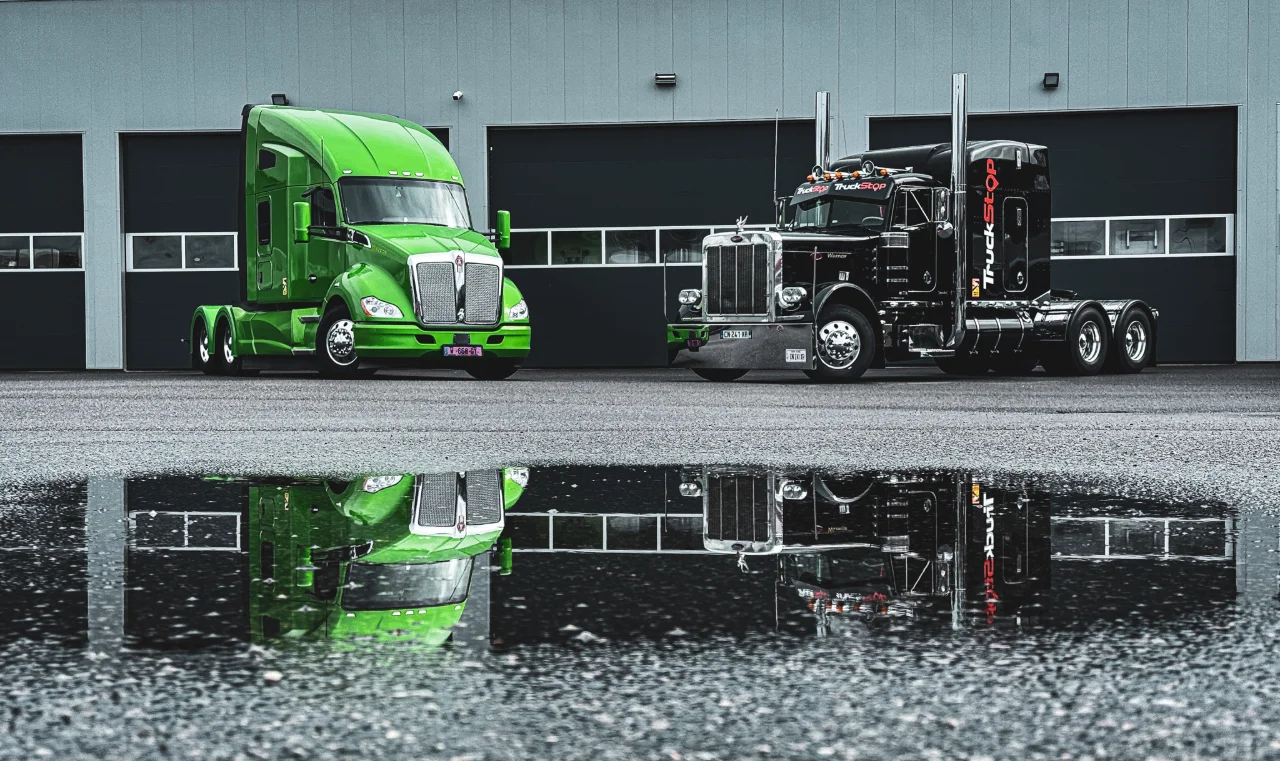
On the other, a much more recent Kenworth T680, streamlined, rational, designed for today’s road. But precisely, the whole interest of this face-off imagined by TruckStop is not to designate a simple winner. It is to truly measure, through two machines from the same culture, how much the truck has changed over the years.
First of all, I must set the scene. We are at LCR in Rodez, a French reference in roadshows and events. Here, trucks are not just used to transport, they embody an image and above all a presence. The roadshow is a real professional job and the truck is the first tool that will convey the message. In a fleet where several monuments from across the Atlantic stand side by side, the choice came almost naturally. The Peterbilt 379, a true cathedral of chrome, represents an entire imagination by itself. The Kenworth T680, for its part, embodies the shift towards another America of trucking, more aerodynamic, more technological, closer to global standards. Two visions. Two eras. Two ways of conceiving the road.
Style first: the 379, king of myth

In terms of style, for Pierre as for me, it seems clear that the Peterbilt 379 crushes the debate. It is not a matter of taste, it is a matter of symbol. Its endless hood, its large air filters, its vertical exhausts, its road locomotive proportions make it the American truck par excellence. Even for those who know little about the heavy-duty world, the silhouette speaks immediately. It tells the story of wide open spaces, highways, the cult of chrome, the figure of the independent small business owner who drives with “his” truck. In the United States, the 379 long held that position: that of a Scania for the French artisan, but here in American version.
Pierre Combemale says it rightly: “as long as you don’t have an American truck in your company, you don’t fully understand the effect it produces on people.” The 379 attracts attention, provokes reactions, generates something more emotional than rational. You have to see it standing still to measure its power of attraction. It is not only beautiful: it impresses. It has that physical presence that few trucks still manage to offer.

Facing it, the Kenworth T680 plays another score. Gone are the protrusions, the artifices, the external appendages that once made up the aesthetic vocabulary of the American truck. The T680 smooths the shapes, the tanks and large air filters fade away, the stacks disappear. There are still a few touches of chrome, because heritage is not completely denied, but you can feel that the priority has shifted. The time is no longer for a rolling monument. The time is for air penetration, ease of maintenance, cost of use. The T680 does not lack charm, far from it, but it no longer has the look of the true American truck. In its own way, here with its green livery and its well-planted stance, it even has real presence and I must admit that I even find it sexy. But one thing is clear, it does not play in the register of fantasy, it positions itself directly in the chapter of efficiency.
Under the hood: the end of mechanical legends
The second shock appears as soon as we address the drivetrain. Here again, clichés die hard. Seen from Europe, the American truck is often associated with huge engines, excessive power, a form of mechanical excess. The reality is more nuanced and some will be surprised.
The Peterbilt 379 tested here dates from 1988 and carries a 15-liter Caterpillar 3406 producing 425 hp. For the time, it was already impressive. This engine, with intercooler, was ahead of its time and built its reputation on its robustness as much as on its ability to handle tuning. This is also what contributed to its legend. A 3406 is not just a technical sheet: it is a name that enthusiasts still pronounce with respect. Its architecture, its large injection pump, its very mechanical character recall an era when the engine was not reduced to a torque curve and emission standards.
But this greatness also has its constraints. The large Caterpillar block requires attention, finesse, and ear. You have to know it, live with it, accompany it. And above all pair it with a gearbox that has nothing of a mainstream tool: a manual, non-synchronized Eaton Fuller, which requires real learning. Here, no automation, no electronic safety net, it’s quite simple, the one who will play a key role between the engine and the gearbox is indeed the one behind the wheel! It is he who synchronizes, who feels the right revs, who disengages, relaunches, accompanies. When everything goes well, it is superb. When fatigue sets in, the truck reminds you without hesitation and then it becomes a real struggle (watch our YouTube video, you will laugh).
Opposite, the Kenworth T680 tells a completely different story. Under its lighter hood, easier to tilt today because it is made of fiber and no longer aluminum, we find an MX-13. This name probably rings a bell since it is the 13-liter engine developed by DAF and adapted to the American market. Variable geometry turbo, EGR, Common Rail injection, in short a modern architecture to meet contemporary standards. The engine is more compact, cleaner, more rational and is paired with a ten-speed automated Fuller gearbox. Again, no doubt, this truck is made to satisfy a larger number of users, while allowing access to less experienced drivers and above all allowing operators to smooth consumption and clearly reduce driver fatigue. In the US as with us, the truck must be easier to drive!
This is where the comparison becomes interesting. The 379 offers the raw nobility of a living, almost carnal machine. The T680, on the other hand, brings everything modern transport requires: consistency, efficiency, ease of use, overall coherence. We must also add a point often forgotten: braking. Drums for the old one, disc brakes for the modern one. Here again, the evolution is obvious. The old world had its charm; the new one has its logic.
Getting on board: an old simplicity, a new ergonomics

Regarding cab access, both trucks recall a constant of American culture: you climb aboard easily. The cab, narrower than the chassis, creates a real staircase. The steps are clear, readable, natural. On this point, even the old Peterbilt does not disappoint. You climb without major difficulty, with the feeling that the truck was designed to be approached simply.
But the T680 goes much further. The door opens wider, the handles are better positioned, the steering wheel lifts, the seat moves away more, the entry space is more generous. The cab is wider so access is further improved and the climb is designed around ergonomics. The difference is clear, undeniable. Where the 379 remains faithful to a robust and efficient design, the modern Kenworth adds safety, gesture comfort, everyday ease. You know it, in a job where you get in and out several times a day, it matters much more than one might think, whatever your size!
At the driving position: from rustic cockpit to rolling office

Once seated behind the wheel, the gap widens further. In the Peterbilt 379, you enter a dense, tight, highly characteristic universe. The cab is narrow. The large steering wheel, the less mobile column, the endless hood and specific visual references require real adaptation. To position the truck on the road, you must understand its logic. The emblem at the end of the hood serves as a sight, the small rods added on the fenders become allies, especially at night. Nothing is intuitive at first, but everything eventually makes sense for those who accept to learn.
The dashboard resembles an old aircraft cockpit. Gauges, dials, pressures, temperatures, detailed reading of components: you don’t just drive, you monitor your machine. No doubt, the whole has crazy charm. Behind the wheel, you have the physical feeling of mastering a machine, of understanding its breathing, of monitoring the slightest issue. But the truth must also be said: this abundance of controls, this need to anticipate, this constant attention belong to another time and above all to another generation of drivers. The 379 is piloted, it is not simply driven.

The T680, on the contrary, welcomes its driver as a modern truck should. More space, better position, much greater seat adjustment, significantly better side visibility, a presentation mixing analog gauges with a digital screen, we are between two worlds. If we recognize the European influence, and more precisely the DAF universe, in the design of the driving position, we are still behind the wheel of a Kenworth. But this Europeanization is not a betrayal: it simply allowed the American truck to catch up on a delay long accepted.
The result is clear: you can work in the T680. Better, you can spend a full day there without coming out exhausted. Where the old truck required constant physical and mental involvement, the new one supports, facilitates, absorbs. The driver is no longer fighting the machine, he simply collaborates with it.
Living on board: the real cultural shift

It is perhaps in the living area that the clash of generations is most obvious. The Kenworth T680 does not just oppose a better bed to its elder. It completely changes the philosophy of the cab.
In the T680, the living space is designed as a coherent whole. The swivel seat, the facing table, the large bed, storage, fridge, side windows, natural ventilation made possible by openings and mosquito nets: everything says the same thing. Here, the driver does not remain stuck at his position. He leaves his seat and joins a real living space. You can eat, rest, watch TV, simply live. And this feeling of a rolling apartment, typically American, reaches here an industrial maturity that the old 379 never knew.

In the Peterbilt 379, the sleeper keeps charm, wood, atmosphere, a certain visual warmth. The bed is decent, the whole remains welcoming, especially compared to European cabs of the same era. But the difference is obvious: the sleeper is a volume added to a Day-Cab. You feel it, you see it, you even hear it while driving. The separation between the two spaces reveals a more artisanal, less integrated, less accomplished design.
It also lacks everything that defines modern onboard life today: independent air conditioning, independent heating, relative silence, insulation quality, continuity of use. In the past, the engine was left running to live in the truck. Today, this logic no longer has its place. And in this respect, the T680 shows how much the United States have finally integrated standards that Europe imposed long ago.
On the road: passion on one side, reason on the other

The dynamic verdict remains, the one nothing can truly replace. And on this ground, both trucks fully play their role.
Behind the wheel of the Peterbilt 379, every kilometer has a particular flavor. You must deal with the clutch, listen to the engine, catch the gears at the right moment, play with the Fuller, feel the Jacob engage, live the truck with your whole body. This is not relaxed driving, especially on the roads of Aveyron. You quickly understand why it becomes difficult to entrust this type of vehicle to just any driver. Without experience, without desire, without mechanical sensitivity, pleasure quickly turns into a chore, and the machine can suffer. This truck is clearly made for the great American highways.
Nevertheless, what character. The Caterpillar has depth, range, a unique sound presence. The 379 does not accelerate like a modern truck, it does better, it gives the sensation of dense force, of a machine pushing without ever cheating. Yes, it requires work from the driver, but honestly, it gives it back a hundredfold in sensations. It is a truck that involves you and that, precisely for this reason, can exhaust you.

The Kenworth T680 plays another tune. It offers a driving experience close to contemporary European trucks. The gearbox does the job even if shifts are slower than European trucks. The engine follows with consistency, sound insulation has made huge progress, engine braking is effective with the MX Brake, overall comfort allows you to chain kilometers without unnecessary strain. It is not less noble; it is simply more mature. The T680 takes the codes of the American truck with its long hood, its atmosphere, its space, but adds the driving ease of a modern heavy-duty truck.
And that is undoubtedly the heart of this comparison. The 379 makes you dream. The T680 gets the job done. The first tells a story. The second still allows writing the future.
The verdict: a logical winner, a sentimental hero
At the end of this clash of generations, the result almost imposes itself. For pure style, for emotion, for aura, the Peterbilt 379 remains untouchable. It wins the match of the heart. It will remain this rolling monument that alone summarizes an entire mythology of American transport.
But for everything else, the Kenworth T680 stands out obviously. Not because it is more lovable, but because it is simply the right tool for today’s world. Where the 379 already belongs to the collector vehicle, the T680 remains a credible, efficient, livable and coherent working tool.
Pierre Combemale’s conclusion perfectly sums it up: one is a modern working tool, the other a collector vehicle that can still be used, but with all the compromises that implies. This is perhaps, in the end, the real clash of generations. Not the transition from a beautiful truck to a less beautiful truck, nor from a golden age to an age of reason. But the precise moment when we understand that a legend, to survive, must accept to change form.
The Peterbilt 379 will always remain the romantic face of the American truck, the Kenworth T680 has become its adult version. If you enjoyed it, feel free to give us feedback on our mobile application or on www.truckstop.fr, I am preparing more surprises with generation clashes with European trucks. An opportunity for us to compare our parents’ trucks with those we drive today. So stay connected because at TruckStop we still have quite a lot of ideas!
Text: Fabien Calvet Photos: Fabien Calvet and Alexis Perbet