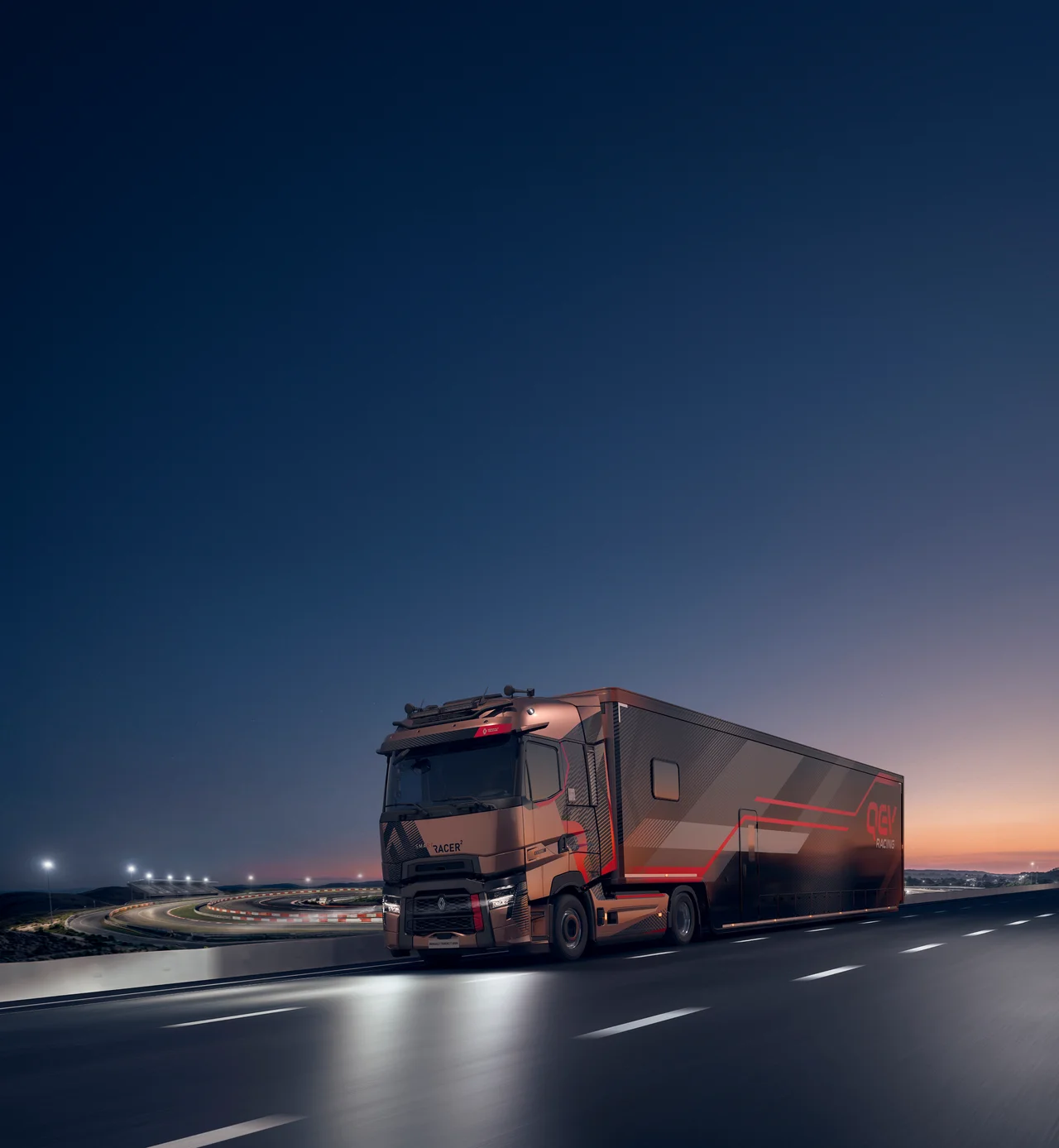
The Renault Trucks Smart Racer 2
A presentation that confirms the technical synergies within the Volvo Group, while maintaining a few positioning subtleties between the two manufacturers. A new 13-litre engine, a latest-generation Optidriver gearbox and more onboard intelligence to improve the energy efficiency of Renault Trucks T, T High, C and K models.
Faced with increasing pressure on operating costs and ever stronger environmental requirements, Renault Trucks continues to improve its diesel-powered models. The Lyon-based manufacturer is therefore unveiling a new driveline intended for its T, T High, C and K ranges, promising up to 4% reduction in fuel consumption and CO₂ emissions compared with the previous generation.
This development is based on the combination of a new DE13 R engine, a new generation Optidriver gearbox and a series of predictive technologies intended to optimise vehicle use in real operating conditions. “The decarbonisation of road transport relies on several complementary levers,” recalls Antoine Duclaux, President of Renault Trucks. “Alongside the acceleration of the development of our electric offering, we continue to improve the energy efficiency of our diesel-powered vehicles.”
Up to 540 hp and 2,800 Nm
At the heart of this new driveline, the DE13 R engine benefits from a profound technical evolution. Designed around new high-strength materials, it now delivers up to 540 hp and 2,800 Nm of torque. With this new inline six-cylinder engine, Renault Trucks notably announces a maximum combustion pressure increased to 250 bar as well as a new external high-pressure pump injection system intended to optimise energy efficiency. The Optibrake+ engine brake is now offered as standard and also sees its performance improved, an appreciable advantage on hilly or mountainous routes.
A Faster Optidriver
This new engine is paired with a new generation Optidriver gearbox whose shift strategies have been completely revised. According to Renault Trucks, gear changes are up to 20% faster and smoother than on the previous generation. An evolution that improves performance, driving comfort and energy efficiency at the same time.
The new driveline also relies on the Optivision+ predictive cruise control, capable of anticipating road gradients and infrastructure in order to adapt speed and gear changes. Another notable new feature: the Predictive Engine Stop Start system. During coasting phases via the Optiroll function, the engine can now be automatically switched off when conditions allow before restarting instantly whenever necessary. New features which are, moreover, not without reminding us of those of its Volvo cousin.
Driver Comfort Also on the Agenda
Beyond the fuel savings, Renault Trucks is also placing emphasis on driving comfort. The smoothness of the new engine, combined with the speed of gear changes, helps reduce noise and vibrations felt on board. The vehicles also benefit from the Smart Steering with Driver Assist system, which helps maintain lane position while automatically adapting the safety distance to the vehicle ahead. Finally, the DE13 R engine complies with the new NNR3 acoustic standard, further reducing the vehicle’s noise footprint.
TruckStop Analysis: A Fully Assumed Group Strategy
Behind this technical evolution also lies a well-known industrial strategy in the heavy truck world. Like Daimler Truck with Mercedes-Benz, Freightliner and other group brands, like Traton with Scania, MAN and International, or Paccar with DAF, Peterbilt and Kenworth, the Volvo Group continues the pooling of its technological developments between Volvo Trucks, Renault Trucks and also Mack Trucks in the United States.
This new driveline is therefore directly the result of investments made at group level. An unavoidable industrial logic that makes it possible to reduce development costs while accelerating the deployment of innovations. But as is often the case within Volvo Group, the hierarchy between the brands is carefully preserved. Only a few days after the presentation of the new generation Volvo Trucks driveline, one detail did not escape industry observers: the maximum power announced at Renault Trucks reaches 540 hp while Volvo Trucks displays a version peaking at 560 hp with this new 13-litre engine.
Technically, the gap is small. Strategically, it is much more significant. Volvo thus continues to display its positioning as the group’s premium and technological brand, while Renault Trucks retains an offering perfectly suited to the needs of the European long-haul market.
A probably deliberate choice that allows Volvo to symbolically maintain its status as the technological locomotive of the group. An elegant way of reminding us that although developments are now largely shared, leadership remains firmly established in Gothenburg. Yet one reality remains very much ours: this latest generation diesel engine is indeed the result of genuine Franco-Swedish collaboration, and Renault Trucks’ engine engineers know a thing or two about the subject.
For transport operators, however, the essential point lies elsewhere: this new driveline promises very real fuel savings at a time when every litre counts more than ever. Now it remains to move from theory to practice.
But already knowing the performance of the current generation, it is fair to say that we are eager to get behind the wheel of the 2027 Renault Trucks models to verify whether the promise of a 4% gain is delivered. See you very soon behind the wheel of the Smart Racer 2!