TruckStop Exclusive: In Sweden
A Test Like No Other

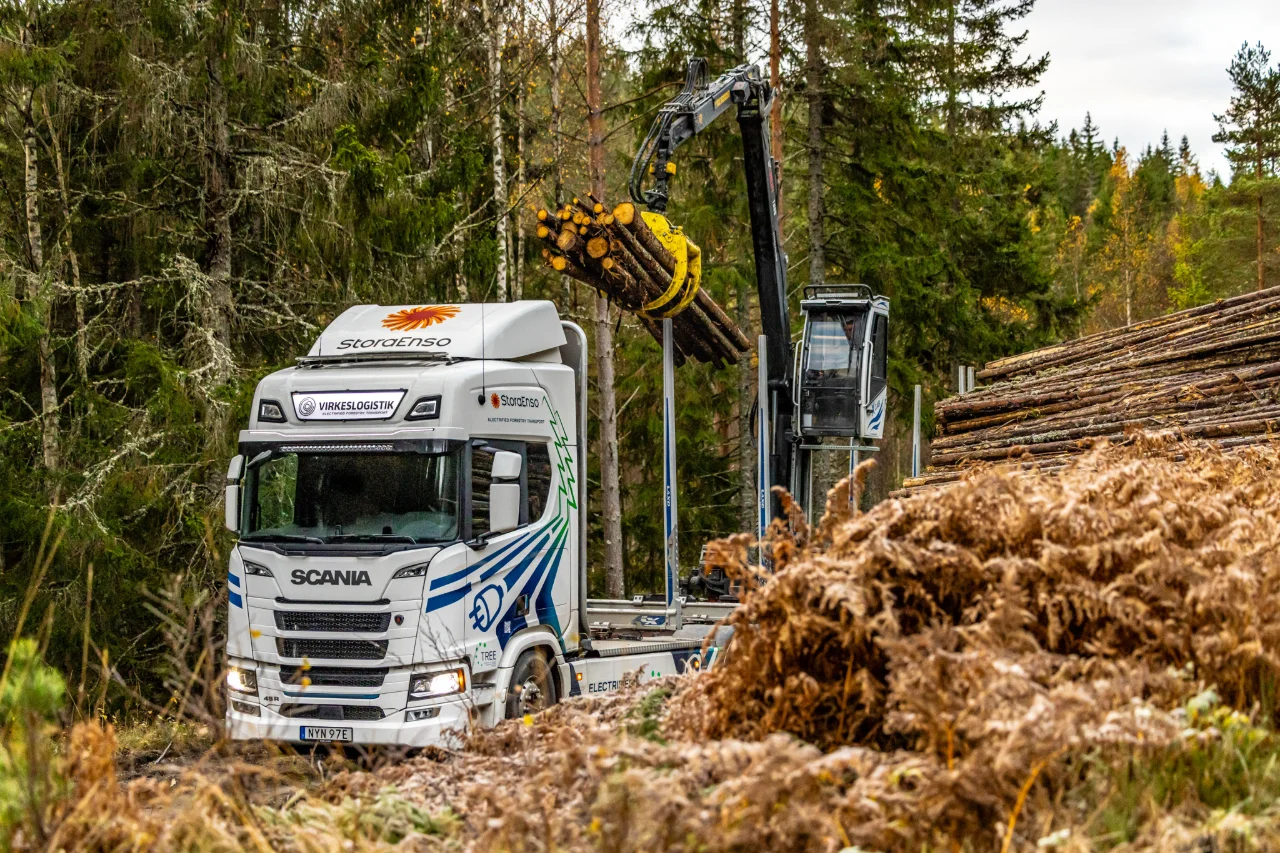
For this new field test, TruckStop takes you to the very north of Europe, in the heart of the Swedish forests. With this exceptional test drive, we are really going to break the codes and, above all, challenge certain preconceived ideas. Let us take a look at today’s truck, which displays impressive figures, with a little 25.25 metres in length and, above all, more than 64 tonnes on the scale. You understood it, a truck intended for the transport of round timber, a machine designed for Scandinavian forest tracks. On the grille and on the doors are indications that seem surreal; it is indeed an electric truck. Yes, you read that correctly: a timber combination running on electricity and yet, in the collective imagination, the electric truck remains often associated with urban distribution, refuse collection trucks or regional shuttle services. Here, we are talking about a heavy road combination, intended to load wood in the middle of the forest to supply Swedish paper mills. Suffice it to say that the scenery changes radically.
And for TruckStop, it is a rare privilege: to experience from the inside a working day with Robert, a Swedish driver for whom this is everyday life, and to discover whether electricity can really hold its own in such a demanding profession.
A 45R Built for Heavy Work

The truck in our test is therefore a Scania 45R. At Scania, the number 45 corresponds to the electric power: 450 kW. Translated into our usual language, this represents more than 600 horsepower. It is currently the Swedish manufacturer’s top-of-the-range electric model.
But what is most impressive is the dimensions of the combination. Here, in Sweden, the rules are not the same as at home. The truck-and-trailer combination measures 25.25 metres, for an authorised mass of 64 tonnes. In fact, once loaded, we will even be slightly above that because here electric trucks are entitled to an additional 2 tonnes.
On the door, one detail immediately catches the eye: the charging socket. This timber truck does indeed run on batteries, with more than 600 kWh on board.
As far as architecture is concerned, Scania keeps a logic close to that of the combustion-engine truck. There is no e-axle here, but a motor-gearbox unit installed in the centre of the chassis, with a driveshaft that drives rear axles of the same type as on a diesel truck (here xxx). The transmission has six gears on paper, even if, as often during my Scania electric tests, I have never really seen this famous sixth gear appear on the dashboard.
A Night Departure in the Swedish Woods

The day starts early. Very early, as is often the case in the forestry sector. It is still dark when we set off. Robert is behind the wheel for the first kilometres. As always with this type of company test, I like to observe before driving because it is preferable to learn from the one who knows his profession perfectly, his roads, his habits and above all the pitfalls of his job.
As always with this type of truck, we leave empty towards the forest. The first sensations are immediate: the silence is impressive. On board, everything happens with an almost disconcerting smoothness. No mechanical rumble, no perceptible gear changes, no vibration, the machine runs perfectly and even the needle of the electric consumption indicator does not move much.
The day slowly rises over the lakes and the fir trees. The images speak for themselves: we are crossing a postcard setting, believe me, for the enthusiast that I am, here I am in a dream. The roads are calm, wide and easy to drive on, and even though we already meet several timber trucks, empty in one direction and loaded in the other, honestly, in terms of traffic, it is really quiet around here. Here, the truck is king because it is the one that supplies the region’s many pulp mills. In Sweden, wood is not a secondary sector as it is for us; it is a major industry and nobody forgets that the truck is one of its essential links.
Short Range, but Adapted to the Job

On paper, the range can be surprising because Robert explains to me that one trip represents around 200 kilometres and, above all, that with a full charge, the truck can only make one! With this weight and this route, the margin will be limited because for one rotation into the forest and a return to the factory, the truck sometimes comes back with just 5% battery remaining. Seen from France, that may seem very little, but here the reasoning is different because the factories and worksites are all located at short distances. The truck does not set off to cross the country. It performs regular rotations between the forest harvesting areas and the local factories, the route is known, repetitive and controlled because there are several drivers per truck in order to supply the factories continuously.
Another major and essential point compared with what we have at home is that the charging infrastructure follows. This is the big difference compared with what we know at home: heavy truck charging stations are present, accessible and designed for trucks. No need to uncouple in order to plug into a car charging station. Here, transport companies have organised themselves, sometimes in cooperatives, to create their own private infrastructures.
This is perhaps one of the major lessons of this test: electricity works when the ecosystem exists around it.
Heading Towards the Forest Tracks

After the main roads, we gradually leave the main routes to go deeper into the forest. The roads become narrower, but remain surprisingly easy to drive on. Swedish forest tracks have very little in common with some of the tracks we know in France. Here, they are wide, compacted and maintained. We drive at 40 or 50 km/h (and sometimes more) on gravel that almost serves as asphalt.
Empty, the 25.25-metre combination is handled with surprising ease. The trailer follows the rigid truck very well. This is one of the advantages of this type of truck-and-trailer combination: despite the length, the combination remains logical in its trajectories. Obviously, you have to anticipate more than with our 18 metres at home, but honestly, it works.
Loading in the Heart of the Forest

Having arrived at the loading area, Robert takes the crane. The wood is stacked in piles a little over five metres long. With the length of the combination, the loading has to be organised methodically. Robert moves his trolley forward to position the logs, then reverses in order to load a new pile. Just like at home, but in an XL version. You immediately feel the driver’s experience and, to be clear, the equipment is top-notch and the working conditions go with it. Here, no unnecessary talk, the work is precise, regular and without any unnecessary movements. The quantities of wood are impressive. The Swedish logging plans are vast, organised and calibrated for a highly structured industry. This is not a small isolated logging area at the end of a track. Here, everything seems designed to feed a continuous flow towards the paper mills.
At 64 Tonnes, Electricity Surprises

Once loaded in less than 30 minutes, I look at the electric consumption and this phase has used approximately 2% of our capacity. Nothing to get stressed about, we are going to be able to return, but this time loaded! It is my turn to take the wheel and let me tell you that here the test takes on another dimension.
On the forest tracks, at more than 60 tonnes, the electric Scania impresses with its smoothness. The torque arrives immediately, but without brutality. There is no interruption of traction, no jerking, no sensation of wheel spin caused by a badly placed gear change. This is one of the great advantages of electricity in this type of use. On a forest track, especially in delicate conditions, continuity of traction is an asset. You modulate the accelerator and the truck moves forward, calmly, with remarkable smoothness.
Robert tells me that he has not yet driven this truck on snow. He is curious to see what it will be like. As for me, after several electric tests in Scandinavia, particularly in Norway, I am rather confident. The absence of a clutch and the linearity of the torque can really help to get out of complicated situations and, having driven on snow with such machines, I know that it works.
Fast Tracks, but Ones That Demand Respect

One should not be mistaken: even if the Swedish tracks are beautiful, we are still behind the wheel of a heavy combination. The trailer alone weighs nearly 38 tonnes. The rigid truck is around 27 tonnes. The whole thing requires finesse. The full suspension of the rigid truck provides real comfort, but it also lets you feel some body movements. In sequences of bends, you have to remain smooth in your movements. No unnecessary steering inputs. No brutal corrections. The truck is very healthy, but physics remains physics and those who haul timber understand what I am talking about.
On the climbs, you can clearly feel the 60 tonnes. On certain inclines, the speed drops to 30 km/h, sometimes less. But what stands out is the way the truck manages the effort. It downshifts, accelerates again, shifts back up through the gears, but without ever breaking the movement. You sometimes hear a slight transmission whistle, but you feel almost nothing inside the cab.
Energy Recovery, a Driving Tool

On the downhill sections, I find the usual retarder control, but here, it is obviously not a conventional retarder. The lever controls energy recovery through the inversion of the electric motors. As soon as we start going downhill, the needle swings in the other direction. The truck recharges. On the rolling tracks, the system becomes a real driving tool. It allows you to control the speed while recovering part of the energy spent on the previous climb.
Of course, the relief of this Swedish region has nothing in common with the Alps. We do not recover huge amounts of energy. But in use, every slowdown counts. And above all, the feeling of control is excellent.
Real Working Comfort

The R cab remains very classic in its atmosphere. In Sweden, you actually see very few S cabs on this type of mission. Drivers rarely sleep in the truck. The rotations are relatively short and the vehicle often works continuously with several drivers. On board, we find the Scania environment that we know well. The dashboard is still the previous generation, without the new digital instrument cluster. The controls are in their place, the buttons as well, and the multimedia system does not feel unfamiliar. The only real difference comes from the instrumentation linked to energy: consumption, recovery and battery level. For the rest, it is a pure Scania. And that is also what makes the electric truck easy to accept: the driver does not find himself in a completely foreign environment.
On the Road, a Flying Carpet

After the tracks, we get back onto the tarmac. There, the truck almost becomes a flying carpet. At more than 60 tonnes, the smoothness remains astonishing. On the Swedish national roads, between 70 and 80 km/h depending on the areas, the Scania keeps going without any apparent effort.
You can hear the gears shifting, but you do not feel them. This is where the electric truck marks its greatest difference compared with diesel. There is none of that yo-yo effect that can be felt with a heavy combination when the transmission briefly cuts traction in order to engage a gear. Here, everything is linear. Even when passing through villages, the accelerations are remarkably smooth. You modulate the accelerator and the combination moves off again without brutality, without vibration and without noise.
I am a lover of the V8, everyone knows that. But we have to be honest: this 45R is a bit like the V8 of electric trucks.
Facing the 770 Diesel

One detail given by Robert sums up the truck’s performance quite well. On certain hills, he sometimes drives alongside colleagues equipped with Scania 770 diesel trucks. With an equivalent load, they reach the top at the same speed. That is anything but insignificant. On paper, the 45R develops the equivalent of a little more than 600 horsepower (612 to be exact). Yet, thanks to the torque available immediately and the continuity of traction, it keeps pace with the biggest V8 in the range in this precise exercise.
The difference, obviously, lies elsewhere: the 770 diesel does not have only 200 or 250 kilometres of range. There lies the whole complexity of the subject. In terms of driving pleasure and performance, the electric truck is already at the level. In terms of operating range, it remains dependent on the use and on the infrastructure.
The Real Issue: Infrastructure

This Swedish test confirms one thing: the electric truck is not only a matter of the truck. It is a matter of system.
Here, heavy truck charging stations are numerous. Charging points can be found at reasonable distances, sometimes every 30 or 50 kilometres depending on the areas. Transport operators have organised themselves. Manufacturers are supporting the movement. Industrial customers have integrated these constraints and, above all, are ready to pay the price of the investment.
In France, let us be clear, we are still a long way from that, even if the new aid schemes are beginning to change the situation. Today, it is impossible to ask a transport operator to pay more for his truck, to put up with lower range, without suitable infrastructure and without economic valorisation of the decarbonised service; development will remain complicated. According to the admission of the big boss of the Griffin brand, our leaders have neglected certain points and this is going to slow down development.
Cost Remains an Obstacle
Even in Sweden, the TCO of an electric truck remains higher than that of a diesel. Robert’s boss mentioned a difference of around 15 to 20%. And someone has to pay for that increase. This is where the environmental discourse collides with economic reality.
Customers want clean transport, but not necessarily to pay more for it. Transport operators want to invest, but not weaken their company. Manufacturers offer solutions, but they cannot solve the energy issue on their own.
In France, the subject is even more sensitive. We have significant electricity production, notably nuclear, but the price of electricity does not always make it possible to create a sufficiently clear advantage to accelerate the transition. If we really want to see more electric trucks on our roads, this issue will have to be dealt with seriously.
A Different Relationship with the Truck
Another striking element: the Swedes’ relationship with the truck. On the forest tracks as well as on the small roads, motorists understand the size of the vehicle. They reverse, move aside and let it pass. You can feel that the truck is part of the economic and social landscape. Here, it supplies factories, supermarkets, exports and the timber industry. It is not considered solely as a nuisance or an inconvenience.
This difference in perception feels good. And I am going to be direct with you, but when you love trucks like I do, you cannot help but appreciate this Nordic culture where heavy, long, well-maintained and often magnificent combinations travel through breathtaking landscapes.
Arrival at the Factory

The rotation ends at a pulp mill. Here, activity never stops. The trucks run seven days a week, 24 hours a day. Several drivers take turns on the same vehicles in order to ensure a continuous flow. Before unloading, we pass under a camera gantry at a maximum speed of 4 km/h.
I had never seen that before, but the system films the load, measures the timber and calculates the transported volume. The data appears directly on Robert’s computer. It is on this basis that the owner of the timber will be paid, while the transport operator will be remunerated according to the load. Everything is automated, precise and efficient. Once again, we change dimension; we are far from the sawmills in my countryside.
TruckStop Verdict

So, what is this electric Scania 45R worth as a Swedish timber truck? Honestly, it amazed me. Not because it solves all the problems. That would be false and, even if a few internet haters still have not understood what we are trying to demonstrate, we have to remain realistic.
The range remains limited, the operating cost remains higher and the economic equation depends enormously on the available infrastructure.
Whatever the case, behind the wheel, I cannot tell you that this type of product is not good because that would be lying to you. In the field, behind the wheel, in real work, the truck works and it even works very well.
At 66 tonnes (actual), on tracks, on roads, uphill, downhill, through villages or on express roads, it offers remarkable smoothness, traction and fluidity. It does not yet replace every diesel use. But in this Swedish context, with known rotations, suitable charging stations and an organised industry, it proves that electricity can leave the city centres and go to work deep in the woods.
And that, believe me or not, you had to come here to believe it.
An Exclusive Experience That Will Remain in the Memory
This test will remain a special moment for me. Because the setting was exceptional. Because the equipment was extraordinary. Because the experience was authentic. And because it shows that road transport is evolving far beyond preconceived ideas.
Thank you to Robert for his welcome, to Scania for this opportunity, and to you for following these TruckStop tests that allow us to go and find the truck where it truly lives: in the field.
Have a safe journey, be careful, and see you very soon on TruckStop.fr, or download the application. It is free and, above all, it gives you access to all our content, the articles, the videos and now the podcasts.
Text: Fabien Calvet Photo: Fred Boyadjian