Scania 40 R Electric
On paper, an electric truck, everyone talks about it. On the road, it is another story. And that is precisely where TruckStop tests make sense. Because between technical sheets, well-polished speeches and real life with 40 tonnes, elevation, wind, village crossings and a stopwatch, there is often a world. For this new field test, we took the wheel of the Scania 40 R Electric on our Occitanie route. A real feedback experience, with concrete data, figures, feeling, and above all a simple question: does it really work?
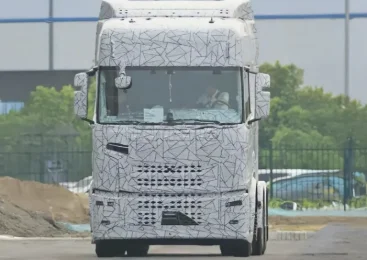
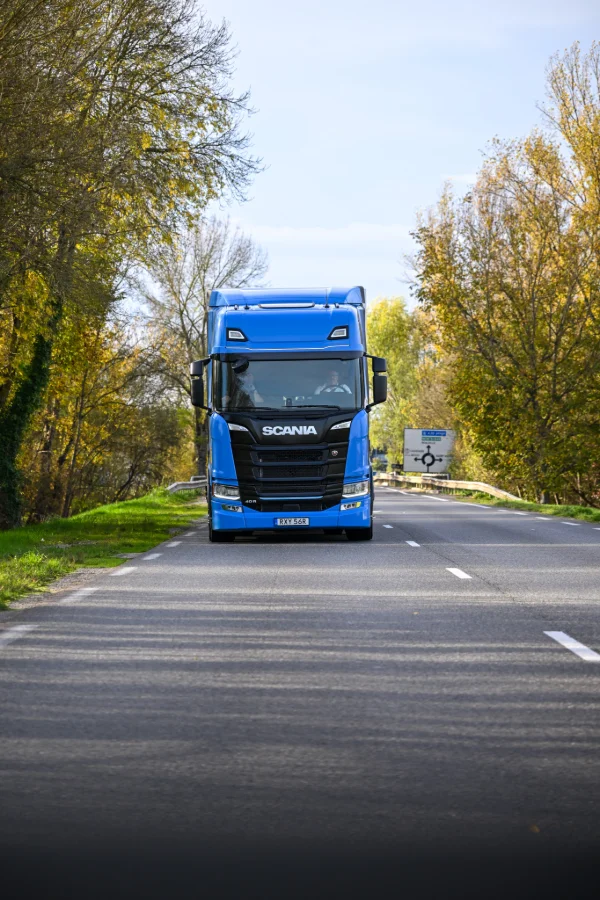
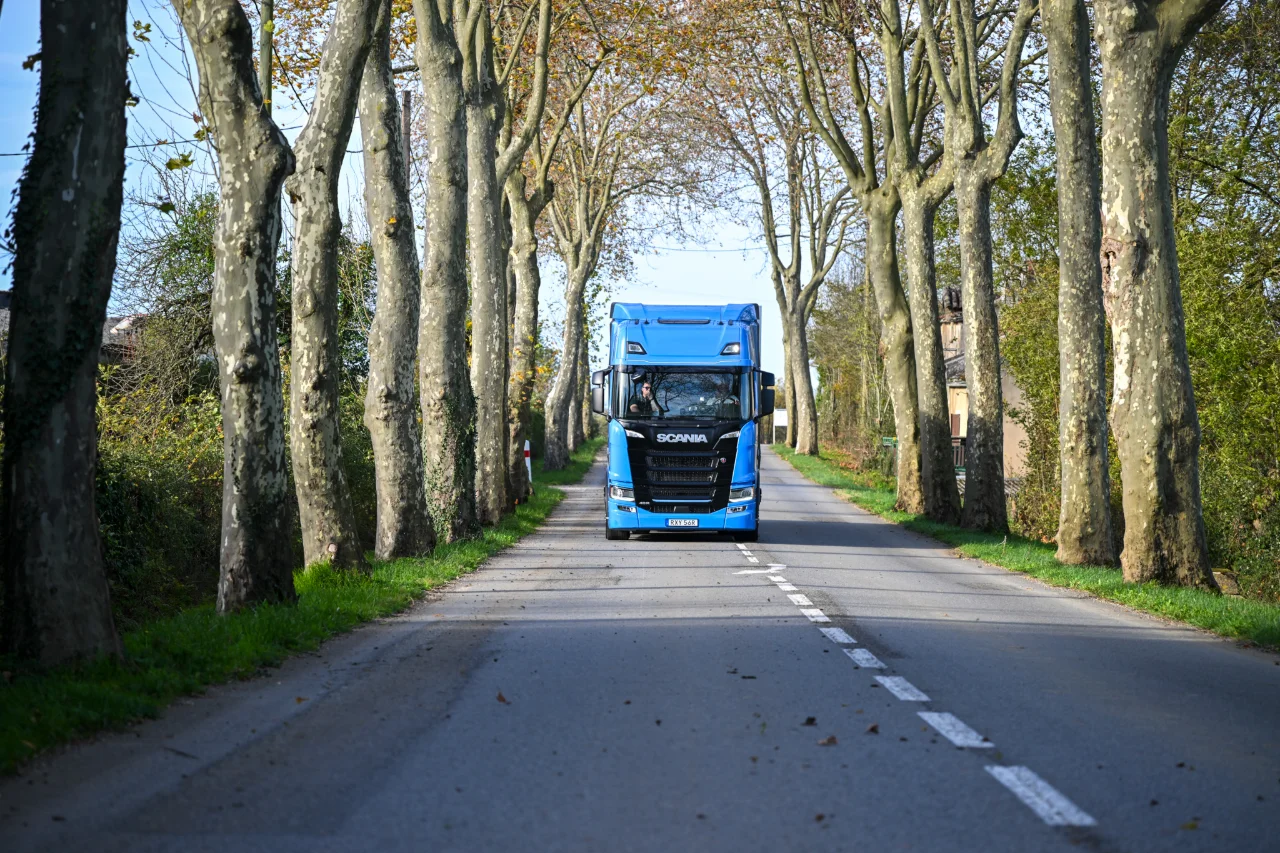
From the outside, no revolution. You immediately recognize a Scania. Same silhouette, same R cab, same brand DNA. You have to look for the small “40 R” badge to understand that this is not a classic gas or diesel model. And that is precisely one of the strengths of this truck: it does not try to break the codes, it reassures, it remains identifiable: we are indeed with a Scania!
A new powertrain, and this time you really feel it

This new Scania 40 R Electric is not just another variant in the range. It introduces a new technical logic at Scania. Gone are the previous configurations with multiple electric motors and a six-speed gearbox. Here, we move to a new powertrain called EM C1-4.
In short, we have a single electro-machine transmission unit, with four gears. Only four. And honestly, it is good news. Because on the previous 40R model, you quickly realized that the six gears were sometimes more theoretical than useful. In real conditions, the last ratio was rarely used. Here, the system seems better dimensioned, more coherent, more natural in use.
The announced power is 400 kW, around 540 hp. On paper, this may seem standard. In reality, it is not at all. Because a 540 electric does not feel like a 540 diesel. The push is immediate, linear, without interruption, and above all much more impressive than what the spec sheet suggests. And that is something I realize from the very first meters of our route.
On board, we are in a Scania, and that is not a flaw

Before hitting the road and even talking about performance, we need to talk about the cab. Because the one reading this article, before signing an order, wants to know where they will spend their days. On this point, Scania has chosen continuity. And in my opinion, it is the right choice because an R is a safe value.
First observation: we find the R cab, which personally I still prefer to the S. Yes, there is a small tunnel, yes, the floor is not flat, but in return we keep a driving position we know, a familiar environment, a logical layout, and ultimately a setup that remains extremely efficient, especially on regional roads. The interior volume is good, the ergonomics too, and with the new-generation Smart Dash, Scania has clearly updated its digital environment. The dashboard is more modern, more readable, more pleasant. The electric sun visor finally appears. Storage is well thought out, the fridge is there, small drawers too. We are truly in a new-generation Scania, not in a prototype built around a trend.
The bunk remains correct, without being the best on the market. There is better elsewhere, it is true. But it does the job, especially for a truck not intended for pure long-haul. Here, we are clearly in a regional logic, heavy distribution, defined missions. And for that, the setup works.
Our test model, well equipped, added leather upholstery, well-finished seats, and even a particularly refined sound system. Detail? Not really. In an electric truck, where engine noise disappears, sound quality on board takes on another dimension. And on this point, this 40 R had something to pleasantly surprise.
First hill, first uppercut

As often on the Occitanie route, it starts strong. Barely leaving Eurocentre in Toulouse, we hit the big climb towards Montauban. No momentum, no ideal launch phase, we merge and climb. And there, first slap.
The truck climbs to 75 km/h, then 85 km/h at the top, with an ease that is almost shocking when you still remember the reactions of a loaded diesel in the same conditions. Let’s be clear: to do as well with a combustion engine, you already need a big engine. A 600, a 700 hp well awake. And still.
Here, everything happens without noise, without violence, without feeling of effort. It pushes, simply, for a long time and above all cleanly. And that is where electric immediately marks its territory: in performance smoothness. You may know, in theory, that an electric motor delivers full torque very early, but experiencing it behind the wheel of a 40-ton combination is something else. The truck never searches for power, it has it instantly!
On the highway, it glides. And a lot

On stage 1, between Toulouse and Caussade, the terrain is not necessarily the most favorable for electric. It is relatively flat, so you consume without really recovering. Few long descents, few regeneration phases, it is a section that uses energy without offering much in return. And yet, the result is already very good. At 85 km/h, on flat ground, at 40 tonnes, the Scania stabilizes around 100 to 101 kWh/100 km.
Another striking point: inertia. This 40 R glides with surprising ease. As soon as a slight downhill appears, consumption drops to zero. And this free-rolling feeling is much more marked than in diesel. Normal: fewer mechanical frictions, less parasitic inertia, less natural resistance. Result, the truck rolls “for free” whenever it can. And that, in use, changes the perception of the road a lot.
Silence: marketing argument or real advantage?

We have talked so much about the silence of electric vehicles that it almost becomes a cliché. Yet, on a heavy truck, it is a real subject.
In this Scania, silence is not limited to “we don’t hear the engine”. In fact, we rediscover the whole driving environment. Wind, tires, external noises, insulation details. And since the Scania cab is already among the good ones in diesel, in electric we reach a very high level of acoustic comfort.
In villages, it takes on another dimension. People turn around. Not because the truck makes noise, precisely, but because it doesn’t. And when you know how poorly heavy trucks are sometimes accepted in these areas, this argument is not anecdotal.
We can debate engines, costs, charging, politics. But in terms of noise pollution, there is no comparison. The electric truck changes the game.
Stage 2, the one that tells the truth

If stage 1 allows you to take the temperature, it is stage 2 that truly judges the truck. Between Caussade, Septfonds, Caylus and Rodez, we get into the tough part. Elevation, roundabouts, village crossings, climbs, descents, technical driving. Here, the figures make sense because the terrain separates the good from the less good. And here, this Scania 40 R Electric impresses even more. In roundabouts, manual regeneration management almost becomes a game. You pull the stalk, you slow down while recharging, you let it roll, you set off again at the right pace. It’s smooth, intuitive, and honestly enjoyable once you understand how it works. Be careful though: unlike some competitors, the Scania does not do everything by itself off the highway. It does not manage anticipation of roundabouts or interurban zones as extensively as Mercedes for example. Here, it is still the driver who must read the road and act. Some will see it as a drawback. Others, myself included, will appreciate keeping control. What is certain is that if you drive cleanly, the result follows.
In the hills around Caylus, the truck climbs to 80 km/h without hesitation, comes back down while recovering energy, then climbs again with the energy it has just regained. My reference section of the route remains the passage through Caylus. Precisely in the long descent leading into the village, where some modern diesels without a secondary retarder can make you sweat, the 40 R brings remarkable serenity. Set at 45 km/h, it holds perfectly, without stress, while recharging its batteries massively.
The only real regret at this stage is the display of recovered kW. Scania remains too stingy with detailed data. We have battery percentages, range estimates, but not the precise detail of energy consumed and regenerated per section. For an average user, this may not be dramatic. For the tester that I am, I’ll be honest, it’s frustrating. Volvo does better on this point. And to seriously compare vehicles, we miss this data.
Results that speak for themselves

Despite this lack of detail, the real-world results are perfectly clear. At the end of stage 2, over 121 km far more demanding than the first section, the truck shows an average of 158 kWh/100 km. Said like that, the figure may seem high. But placed back in the context of elevation, weight, pace and above all timing, it becomes very interesting. Because the time, itself, is excellent. Really excellent.
On this stage 2 alone, the electric Scania is about 10 minutes faster than a gas-powered Scania previously tested on the same route. Ten minutes. That is not a detail. It means the truck is not only pleasant or “virtuous”. It is also formidably efficient. It keeps the pace, it even very clearly outperforms certain alternative powertrains in real conditions. At the end of this second part, there is still 48% battery left. In other words, half the route is done, with still enough to seriously consider the rest without charging. The bet starts to become credible.
Stage 3: where electric convinces everyone

After a break with our friend Pierre Combemale from LCR Events, it’s time to head back. And it is stage 3 that will finally break a few preconceived ideas. This last section, more flowing on the N88, is very hilly. It is an ideal playground for a well-designed electric truck and let’s be clear once again, here, our Scania showcases its inertia and regeneration potential like rarely.
On the climb back to Rodez, on long hills, the truck stays at 80 km/h with impressive ease. Then, on successive slight inclines and descents, it glides, cuts consumption, regains momentum, recharges, and starts again. Several times, you really feel like you are driving free kilometers, behind the wheel I am genuinely surprised.
In the Albi area, an even more spectacular phenomenon: after a favorable hilly sequence, the truck returns exactly to the same remaining range level as about fifty kilometers earlier. In other words, what was consumed uphill has largely been recovered downhill. In diesel, you can go downhill without consuming, but in electric, you go downhill while putting energy back into the tank. And that, concretely, is not marketing. It is real-world feedback.
Result: stage 3 drops to 84.6 kWh/100 km. Yes, 84.6. At 40 tonnes. On a real route. And here, you understand how much usage and topography change everything in the world of electric trucks.
The stopwatch settles the debate

At the end of the test, the figures are clear. The Scania 40 R Electric completes the Occitanie route in 4h50. To put it simply: it crushed the time. Average speeds are high, very high even for a truck of this category. On stage 2, we are around 68 km/h average. On stage 3, we reach 74 km/h. For a 40-ton combination, on this type of route, this is serious performance.
Overall consumption stands at 112.7 kWh/100 km. And the arrival is made with still 18% battery and around 100 km of remaining range, after 360 km covered. Clearly, the real potential of the truck in this type of use exceeds 450 km even at 40 tonnes.
So no, we are not talking here about a truck that will go long-haul every day like a diesel. That is not the point. On the other hand, for regional use, heavy distribution, well-defined inter-factory shuttles or certain specialized activities, we are indeed dealing with a credible tool.
Strengths: there are many

What stands out first is driving comfort. The Scania 40 R Electric is an easy, smooth, efficient and relaxing truck. The acceleration is remarkable. Hill restarts are impressive. The silence on board really changes the working day—and that’s coming from a big V8 enthusiast. The electric steering brings very appreciable smoothness, especially in maneuvering and in crossings.
Another major strength: continuity with the thermal world. You don’t get into something unfamiliar. You get into a Scania. And that clearly helps acceptance. Driving position, ergonomics, usage logic, everything remains familiar. For a driver switching from diesel to electric, the transition is much less abrupt than with some competitors.
Finally, the efficiency of the new powertrain must be highlighted. The choice of four gears seems relevant. Gear changes are almost imperceptible most of the time. You only really feel the transmission in very specific cases: under heavy load, at low speed, during strong acceleration. The rest of the time, the system operates with great smoothness.
Weaknesses: there are also some

Because a TruckStop test is not advertising, we must also say what is not right.
The first criticism concerns data display. On a truck of this generation, we would like a more precise level of information on energy consumed and recovered. Simple battery percentages are not enough to properly analyze operation.
The second point concerns off-highway management. The Scania leaves more responsibility to the driver than some competitors, notably Mercedes and now Volvo with predictive interurban systems. This is not necessarily a bad thing, but it requires more involvement. And depending on the driver’s level, the final result may vary significantly.

The TruckStop verdict

At the end of the day, we must be honest: this Scania 40 R Electric is a real good surprise. And even more than that.
It is not an electric truck looking for excuses. It is not a product “interesting for later”. It is already a real working truck, with real efficiency, real performance, and a driving experience that can convince many skeptics.
Yes, there are still questions. Yes, not everyone will switch tomorrow. Yes, infrastructure and energy costs will still make the difference. But on pure technical aspects, on the road, in terms of feeling and results, the message is clear: Scania has reached a new level. This new 40 R Electric is not just an electric Scania. It is, quite simply, a really good Scania.
And that, for a driver, an operator or a business owner looking at both numbers and steering wheel, is probably the most important thing.
TruckStop test results – Occitanie route
The Scania 40 R Electric completes the route in 4h50.
Overall average consumption: 112.7 kWh/100 km.
Stage 1: 101.5 kWh/100 km.
Stage 2: 158 kWh/100 km.
Stage 3: 84.6 kWh/100 km.
Remaining range at arrival: around 100 km, with 18% battery.
In summary
A credible regional truck, efficient, pleasant to drive, very strong in hilly terrain and frankly impressive in real conditions. Not perfect, not universal, but clearly in the game. And even, at times, ahead.
Text: Fabien Calvet Photos: Fabien and Basile