IVECO and Toyota Prepare a Hydrogen S-eWay with More Than 900 km of Range
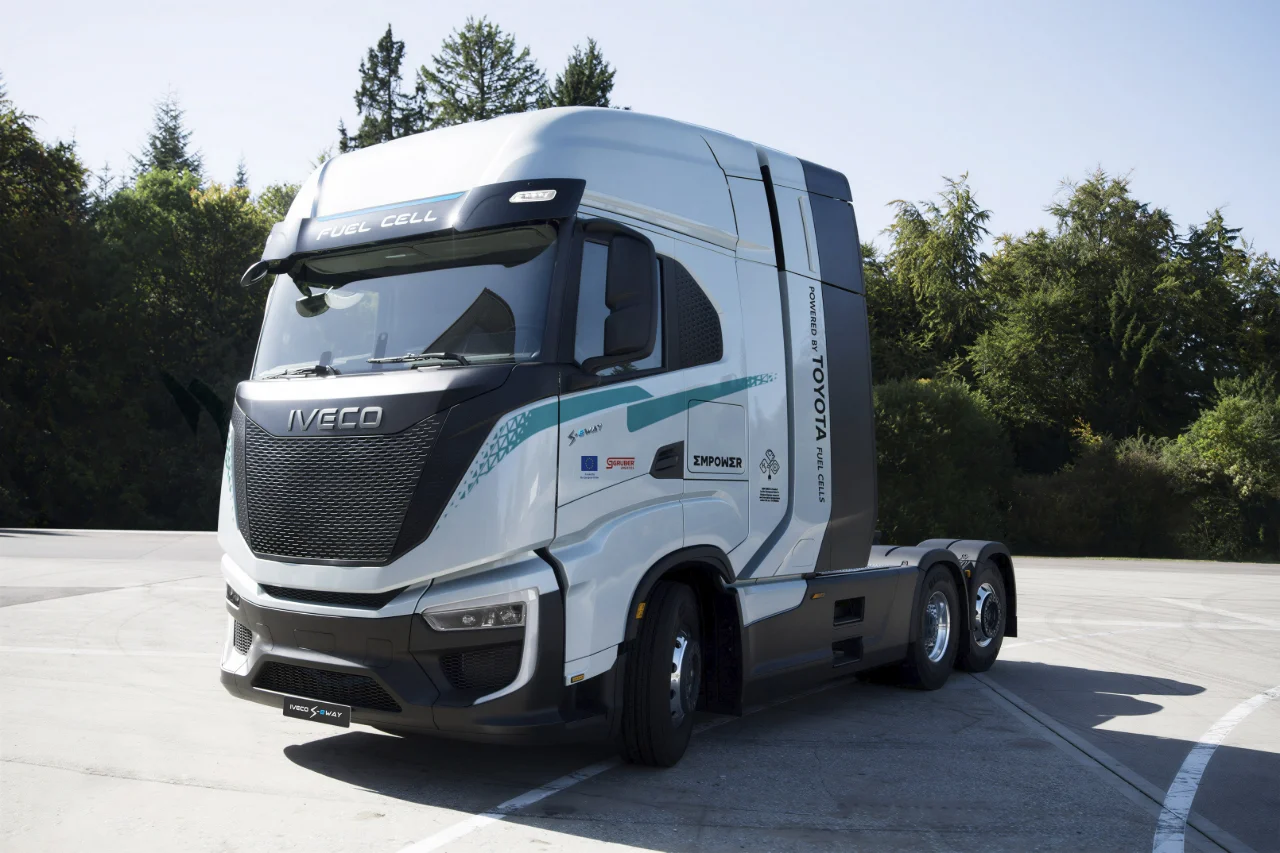
Developed as part of the European EMPOWER programme, the future IVECO S-eWay Fuel Cell promises more than 900 km of range and an operating life of over 25,000 hours. The first road tests are announced for 2027.
IVECO is continuing its work on the hydrogen-powered truck, this time with Toyota. The Italian manufacturer will be responsible for the vehicle’s development, powertrain integration and validation. Toyota, for its part, will provide its third-generation fuel-cell system.
This cooperation is part of the EMPOWER project, funded by the Horizon Europe programme. The project brings together several industrial and scientific partners around the development of battery-electric and hydrogen-electric heavy-duty trucks intended for long-distance transport.
A 300 kW Fuel Cell
The future IVECO S-eWay Fuel Cell will receive a Toyota fuel-cell system delivering a total output of 300 kW. Hydrogen will supply the fuel cells, which will produce the electricity required to propel the truck.
IVECO announces a range of more than 900 km, a figure that could make this technology compatible with certain long-distance missions for which weight, charging time or battery capacity remain limiting factors.
The manufacturer also promises an operating life of more than 25,000 hours. This longevity will be a decisive factor in bringing the fuel cell closer to the economic requirements of intensive road transport.
Half as Many Batteries
This new generation is expected to benefit from the lessons learned with the first IVECO hydrogen trucks involved in the European H2Haul programme.
Compared with these vehicles, the new S-eWay Fuel Cell will benefit from a simplified architecture, reduced weight and more efficient energy management. The capacity of its batteries can therefore be halved.
A fuel cell does not completely eliminate the need to carry batteries. These are used in particular to provide additional power, recover braking energy and smooth the operation of the system. Reducing their capacity should nevertheless make it possible to contain the vehicle’s weight, its cost and the quantity of raw materials used.
Road Tests in the First Half of 2027
Validation operations will begin in the fourth quarter of 2026. The first road tests are scheduled for the first half of 2027, under conditions representative of transport operators’ daily activities.
The project will have to verify the truck’s range, reliability, energy efficiency and availability during demanding missions. The results will also be used to assess the feasibility of future industrialisation.
This is because this is not yet an announcement of commercialisation. For the time being, the new S-eWay Fuel Cell remains a development vehicle that will have to demonstrate its technical and economic relevance in the field.
IVECO Maintains a Multi-Energy Approach
IVECO will also participate in the EMPOWER programme with a fully battery-electric demonstration truck. The manufacturer is thus confirming its decision not to rely on a single technology.
Battery-electric power currently appears to be best suited to predictable routes, regular returns to the depot and distances compatible with planned charging. The fuel cell, for its part, could find its place in certain intensive or long-distance operations, provided that decarbonised hydrogen is available at an acceptable price and that the distribution network develops.
On paper, the performance announced by IVECO and Toyota is promising. With a 300 kW fuel cell, more than 900 km of range and a service life exceeding 25,000 hours, this future S-eWay appears to be moving closer to the needs of road transport. The next step will be to confirm these figures during testing, and then to resolve the eternal question of hydrogen: at what price and where can it be refuelled?