50 ans de l’IToY – 1994 Volvo FH
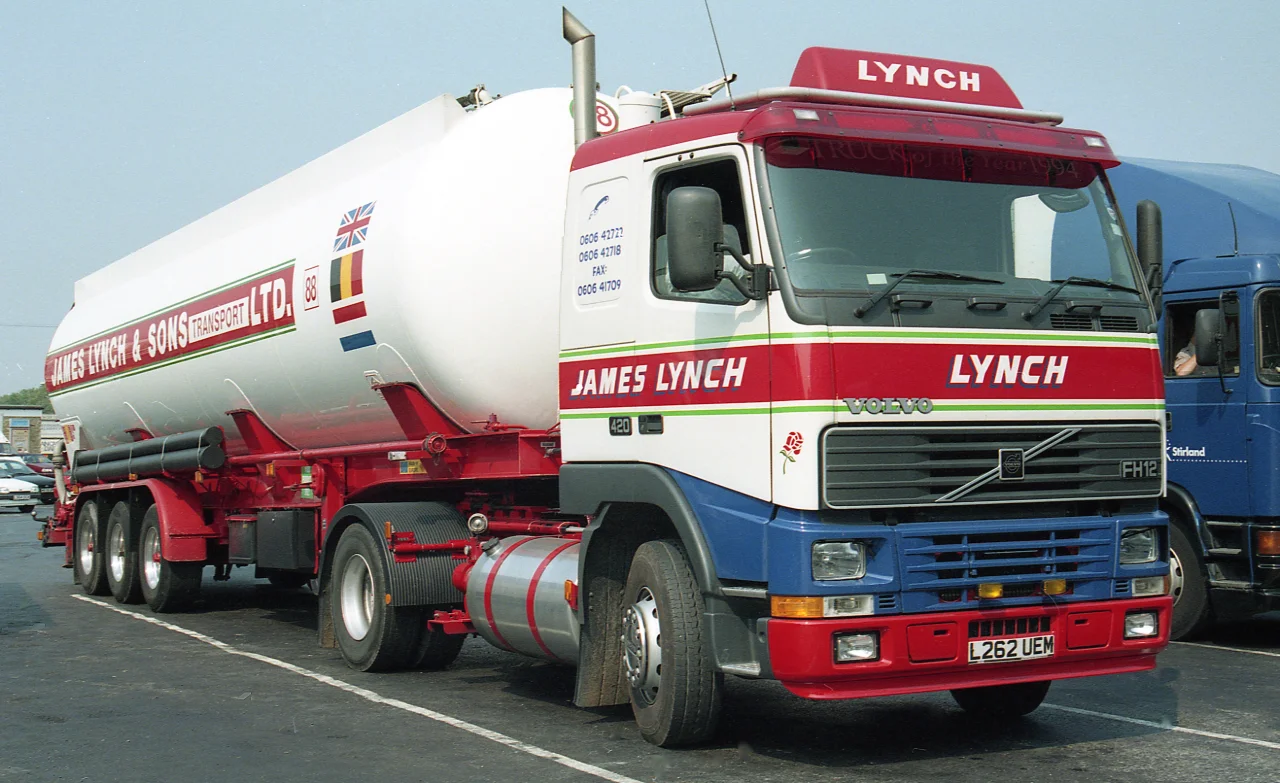
The Volvo FH earned the Swedish manufacturer an unprecedented fourth win, dashing Iveco’s hopes of a three-in-a-row triumph in 1994.
When Volvo announced the new FH range in September 1993, the odds on another win for Gothenburg would have been short, and, true to form, the FH secured 74 votes against 46 for Iveco’s EuroStar flagship, and 18 for the DAF 75/85 Series.
The all-new family of heavy trucks featured innovative engineering, high safety and driver comfort standards, and the kind of performance and operational factors beloved by the judges and operators alike.
When the vehicles were formerly launched, they already seemed quite familiar such was the extent of the pre-production testing of a design brief which was finalised by 1988.
The FH was built on a new, wider, chassis constructed of an alloy of high-yield steel chosen for its stability without the traditional “spring” of a conventional high tensile steel, with deeper and thicker pressings for heavier applications. A new “S spring” parabolic suspension was introduced for single-drive axles, improving the ride from steel suspensions, but traditional multi-leaf or air-suspension was also offered.
The new 12-litre D12A engine was a ground-breaking development, designed with future environmental standards in mind, and featuring very high pressure electronically-controlled unit injectors. In order to further develop the combustion chamber, an overhead camshaft was introduced, breaking the Volvo tradition of having individual cylinder heads on larger engines, which meant introducing a new cylinder head casting – the most complex undertaken at the Volvo foundry. The engines, rated at 340hp, 380hp and 420hp, had 4 valves per cylinder and generous cooling capacity, with forged steel piston crowns to accept the highest pressure and thermal loads. The FH range also included the FH16, and whilst the bigger truck didn’t receive a brand-new engine, the 16-litre lump evolved into the D16A with electronic fuel management and a new 520hp rating, alongside a 470hp version.
Two new 14-speed gearboxes were introduced with the SR 1900 14-speed available in the FH12 420, and the SRO 2400 in the FH16 520. All FH12s were offered with the option of the electronically-controlled Geartronic system.
The FH’s all-new cab also drew much praise, and was developed from a brief that the design must be suitable for a variety of operations, not just long-haul European work. In keeping with this, the cab was high-mounted to allow an underfloor radiator big enough for higher powered engines, and to accommodate air intake trunking to leave a clean back-of-cab for bodying rigid vehicles. Accordingly, a flat floor was discounted, but the high-roof Globetrotter cab offered more space than the standard sleeper or day cab for those that needed it. The cab was made of zinc-coated steel and had three trim levels – standard, C or CD level, which boasted leather upholstery.
In hindsight, some Trucks of the Year appear more important than others, and the FH, like 1991’s EuroCargo, was strong enough to establish a brand name that continues to the present day.
Text : Will Shiers Photos : Richard Stanier