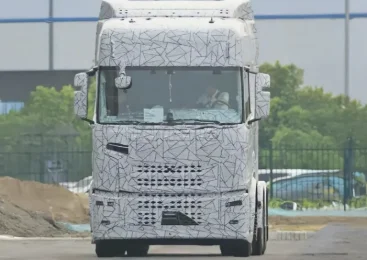
The new Volvo FH Electric trucks put to the test by TruckStop.
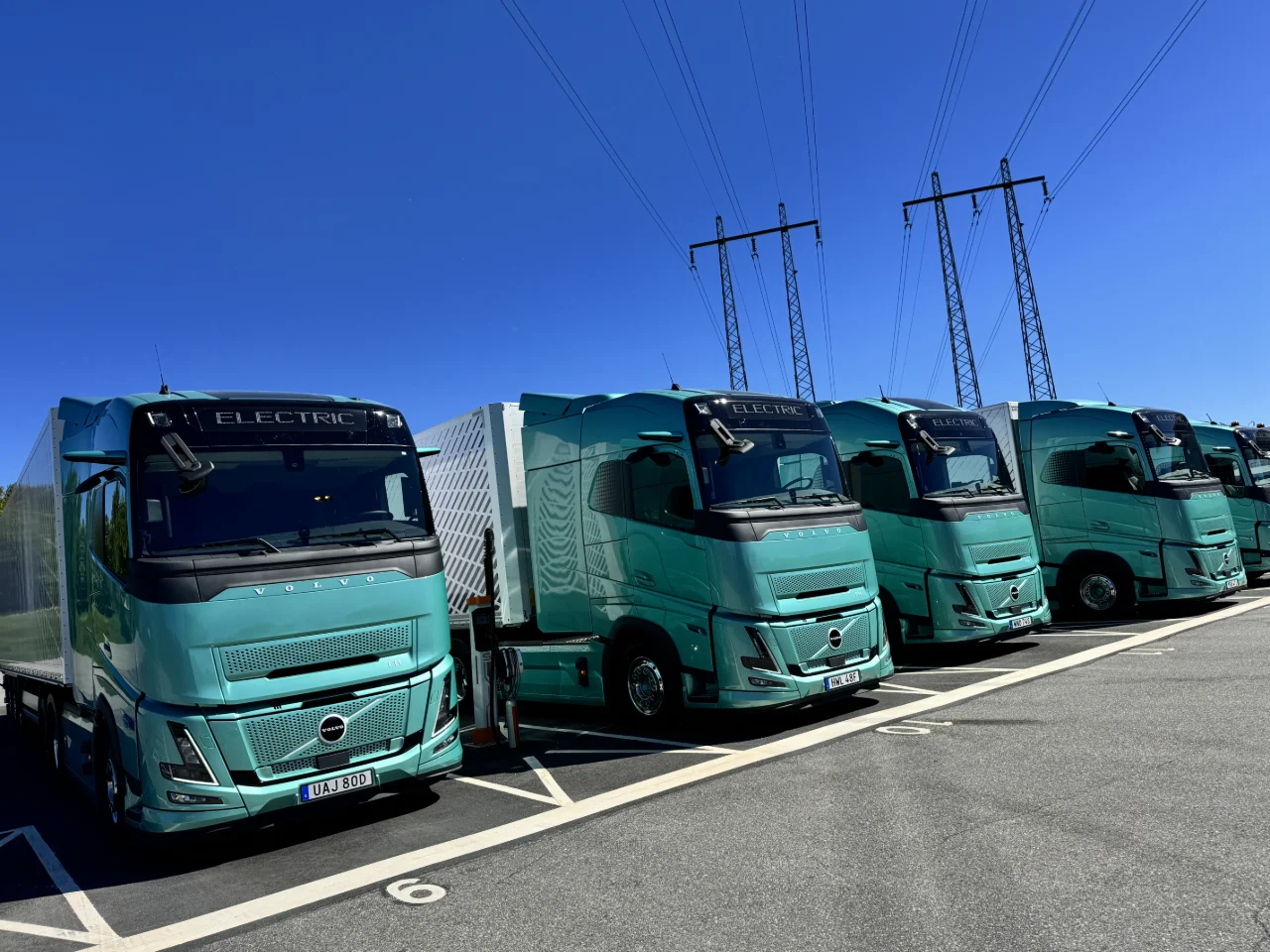
On the agenda: a 25.25 m, 60-tonne combination with the brand-new motor-transmission unit paired with a traditional axle, followed by a long-haul FH Aero equipped with the new e-axle. Two philosophies, two uses, but the same impression: Volvo’s electric truck has just changed dimension.
For this test, I am far beyond a simple first drive. With this first run, we are going to discover the very latest technological advances from the Swedish giant. This time, Volvo Trucks did not make us drive around a roundabout or take us for a ten-minute ride on a closed track. Direction Gothenburg, on Swedish roads, with real trucks, real loads, real traffic conditions and enough kilometres to form a serious opinion.
On the programme, two very different vehicles. On one side, a 25.25 m Scandinavian-style 6x2 combination, loaded to around 60 tonnes, equipped with an electric driveline featuring a motor-transmission unit and a traditional axle. On the other, the new long-distance FH Aero Electric, also a 6x2, but this time equipped with Volvo’s new e-axle, with battery capacity reaching up to 780 kWh and a claimed range exceeding 700 km.
Let’s say it straight away: we are changing category compared with the FH Electric we knew until now. It is true that Volvo was among the first to offer an operational electric FH and that it greatly contributed to the development of the concept. But the first generations were still based on an architecture very close to diesel, with an I-Shift gearbox and several electric motors grafted in place of the diesel engine. Here, you can feel that the product has reached maturity. Volvo Trucks is no longer simply running an electric truck; the Swedes are now building a true electric range, with different technical solutions depending on the mission, much like what we already know from Mercedes-Benz.
First test: 25.25 m, 60 tonnes and an almost disconcerting ease!

The first truck takes the form of a 25.25 m Scandinavian combination. On paper, the machine can be impressive: a 6x2 rigid truck, a dolly, a trailer, all weighing around 60 tonnes. In your mind, you naturally expect to have to deal with inertia, size and weight. Then you hit the road. And there, the first impression is almost unsettling.
Under acceleration, the truck moves off with incredible ease. No brutality, no strange feeling, but an immediate and linear thrust typical of electric trucks. With an output of 540 kW, around 730 hp, it obviously does not lack resources. The electric torque, available instantly, erases a large part of the sensation of mass. Of course, on steep climbs, you can feel that the truck is working because I am still moving 60 tonnes, but let’s be clear, there is never that feeling of interruption, dead time or laborious recovery. And that is precisely where this new driveline marks significant progress.
On this version, Volvo retains an architecture with a motor-transmission unit associated with traditional axles. This choice is not insignificant. It allows great integration versatility, particularly for complex configurations, rigid trucks, 6x2 and 6x4 layouts, regional applications, long combinations or uses requiring specific architectures such as construction trucks. It is probably the solution that will make the most sense for many transport operators because it adapts to a wide range of missions.
The major innovation comes from the transmission. The previous logic built around the 12-speed I-Shift with three electric motors has been abandoned. Here, Volvo uses an 8-speed gearbox. And honestly, the result is stunning. The shifts are remarkably smooth. You feel virtually no jolts, no interruption in traction, no hesitation. Even with a combination like mine today, long and heavy, the transmission works with a fluidity that gives the impression everything happens naturally.
It is another way of driving. You no longer listen to engine speed, you no longer feel load interruptions, you simply follow the movement. As during a previous test with another manufacturer, the use of electricity for these machines proves that it works (find the video on our application). Of course, I can already hear some people telling me that it lacks the noise, the vibrations, that mechanical diesel presence. I understand that very well. I am personally attached to the combustion engine. But saying this truck is unpleasant to drive would be false. It would even be completely dishonest.
Electricity does not do everything, but here it changes a lot

What strikes you is the ease. With a combination of this size, you might expect something more intimidating. Yet electric power almost makes the truck more accessible. There is no need to think about the right gear, engine inertia or ideal revs. The truck manages, anticipates, regenerates and accelerates again, especially since Volvo’s new Pilot Assist software is truly outstanding. With it as an assistant, the driver remains focused on the trajectory, vehicle dimensions and traffic.
On the roads around Gothenburg, with hilly sections, village crossings and faster stretches, the combination remains surprisingly natural. Swedish infrastructure is obviously adapted to these EMS combinations, and that changes everything. But even in roundabouts or on secondary roads, the truck remains stable and predictable.
Comfort also contributes greatly to this impression. The tested rigid truck was equipped with full air suspension. The result: you almost feel like you are travelling in a premium coach. No engine vibrations, very little unwanted noise, remarkable damping and that conveyor-belt feeling that perfectly suits electric operation. On this point, it is difficult to criticise.
The camera mirror system also deserves mention. I know some drivers remain reluctant towards these systems. But with 25.25 m behind you, the cameras’ ability to follow the trailer through corners and clearly show the rear of the combination becomes a real advantage. On this type of configuration, it is not a gadget. It is a driving tool, and once you are used to it, not having it quickly becomes something you miss.
Volvo safety still very much present

Volvo remains Volvo. Safety is everywhere, sometimes even in a rather spectacular way. During the test, the truck detected a 30 km/h zone near a school. Whether the accelerator pedal was pressed or not, it was impossible to exceed the permitted speed. The vehicle knew where it was and automatically adapted its behaviour. Believe me, the first time it happens, it is really strange behind the wheel because at first you think your truck has broken down. Some will see this as overly intrusive assistance. That is a legitimate debate. But in a sensitive area, with a 60-tonne vehicle, it is difficult to deny the value of such a system. In terms of safety, this ability to prevent human error can genuinely make the difference.
Pilot Assist and the lane-keeping systems also confirm Volvo Trucks’ progress. For a long time, Mercedes-Benz was the benchmark in predictive cruise control and road anticipation, notably with a system capable of reading terrain, bends, roundabouts and speed limits with great precision. The Swedish manufacturer is now at the same level. The truck anticipates what is coming, adapts its speed, corrects its trajectory and provides a real feeling of control without completely destroying the driving sensation.
You may or may not like this increase in driving aids. But on a heavy, long and silent combination, they contribute to making driving safer and less tiring, and I can tell you that seeing a 60-tonne machine arrive in almost complete silence can surprise more than one person.
Regeneration: learning to drive differently

From a driving perspective, I repeat it often, but behind the wheel of an electric vehicle, it is not simply a matter of pressing the pedal and waiting for it to move. You must also learn how to recover energy. On these new FHs, regeneration is clearly at the heart of the experience. The driver can use the retarder stalk just as they would with a traditional retarder, but Volvo adds an interesting function: “tap to brake”. A simple press of the brake pedal activates one level of regenerative braking, a second press increases the intensity. This avoids constantly using the stalk and makes driving more intuitive.
On the dashboard, the charge and regeneration display is clear. Under acceleration, you immediately see consumption rise. Going downhill or braking, the needle moves in the opposite direction. It is simple, visual and effective. Above all, it reminds you that the driver remains a key factor in range performance. With poor driving, your truck will display excessive consumption; with an “electric-style” driving approach, you will recover battery charge.
Second test: the long-distance FH Aero Electric enters the game

After the 25.25 m combination, the scenery changes with the long-distance FH Aero Electric. Here, the objective is no longer only versatility or heavy regional applications. Volvo is clearly targeting long-haul transport. And in this field, the Swedish manufacturer arrives with an important weapon: the new e-axle.
This 6x2 tractor is immediately recognisable by its very long wheelbase. Behind the cab, the space occupied by large fairings is not there for style. It serves to conceal and optimise an architecture imposed by battery integration. With up to 780 kWh on board, space is required. That is what allows Volvo to claim more than 700 km of range under suitable conditions.
The additional rear axle is not there by chance either. It addresses axle load constraints, particularly to avoid exceeding limits on the drive axle. It is not necessarily the most glamorous element of the truck because, frankly, we would have liked to see a real Scandinavian-style tag axle. But once again, we are not here for looks; we are here to comply with axle load constraints when using an e-axle.
Under the right foot, the long-distance FH Aero Electric develops 460 kW, more than 620 hp. Once again, the figures are serious. But the real innovation is not only in the power. It is in the architecture.
The Volvo e-axle: the real technical breakthrough

With the e-axle, Volvo moves a large part of the driveline to the rear axle. We are no longer talking about a front-mounted motor-transmission unit with conventional axles, but about an architecture specifically designed for electric propulsion. Mercedes-Benz opened the way with the eActros 600. Volvo now arrives with its own solution which, on paper, is very close to the eActros.
With this configuration, the difference behind the wheel is clear because the silence is even more impressive. All electric trucks are already quiet. But with the e-axle, even more mechanical noise sources are removed from the front. The cab becomes almost isolated from the operation of the driveline. At 42 tonnes on open roads, the impression is that of a perfectly refined truck.
The transmission here has 6 gears, compared with 8 on the motor-transmission version. This choice is coherent but still different from competitors, who generally offer transmissions with fewer gears. On a vehicle intended for long-distance transport, requirements are different. There is less need to multiply short ratios to manage complex situations or very heavy configurations. On this point, Volvo wins once again because here too, shifts occur without noticeable interruption. The truck accelerates linearly, without hesitation. At 42 tonnes, I almost feel like I am driving a parcel delivery vehicle. It is probably even smoother than the first vehicle tested. The e-axle provides a very pleasant feeling of continuity.
700 km of range: a change of dimension

Until now, heavy electric trucks in Volvo’s range were often associated with operating ranges of 300 to 400 km. That was already sufficient for many regional missions but still limited when talking seriously about long-distance transport. With this FH Aero Electric capable of claiming more than 700 km, the discussion changes.
We can now imagine long-haul routes, shuttle services, interregional distribution, full day routes or relay operations with fast charging. For some uses, a full working day becomes possible with a single charge. For others, a well-timed stop will allow enough energy to continue the mission.
Charging is also progressing. The first Volvo generations supported more modest charging powers. Now, the manufacturer announces significantly greater fast-charging capability, with the possibility of reaching 400 kW and eventually up to 700 kW when Megawatt Charging System (MCS) infrastructure becomes available (perhaps one day). This changes the economic equation because if the truck can recharge quickly, it can operate more intensively, and it becomes easy to imagine double crews allowing the truck to run day and night. In parcel delivery, this could quickly make sense and, with current government incentives, TCO is starting to become very attractive.
This is where electric transport leaves activist discourse and enters transport reality. Purchase incentives, energy costs fixed by many suppliers and charging contracts can now tip certain projects in favour of electrification. From the moment we are no longer talking only about a green image but about money, attitudes should evolve much faster. Of course, transport still needs to be paid at its true value, but that is politics, and here I only talk about road tests!
The battle with Mercedes has begun

It must be said clearly: with this long-distance FH Aero Electric, Volvo Trucks is positioning itself directly against the Mercedes-Benz eActros 600. Until now, Mercedes had an obvious advantage thanks to its e-axle, long-distance range and ability to offer a true electric truck designed from the outset for long-haul operations.
Volvo has now reached that level. The e-axle is here, the claimed range exceeds 700 km, charging capability has progressed significantly and Pilot Assist reaches a very high level of anticipation. The battle is becoming serious.
That does not mean everything is settled. The real judge will be daily operation: actual consumption, charging station availability, electricity costs, winter behaviour, battery ageing, residual value and the ability to maintain operating schedules. But based on this road test, the Swedish giant clearly shows that it is not here simply to follow the movement. It is here to reclaim a leadership position.
My impression: difficult to criticise for the sake of criticism

Conclusion: Volvo changes the level of the game

Even though I struggle to keep it short because there is so much to say, let’s quickly summarise this new generation of FH Electric. You have understood it: Volvo Trucks is not simply improving its existing offer. The manufacturer is redefining its electric range around two complementary architectures. The motor-transmission unit with traditional axles provides versatility and adaptability. The e-axle opens the door to long-distance electric transport with more than 700 km of claimed range and fast charging finally matching the ambitions of the market.
However, electric trucks have not yet won every battle because there are still many issues on the table, including charging access and electricity prices. But I must still be clear: with these new Volvo FH Electric trucks, the Vikings have clearly gained credibility.
Text: Fabien Calvet Photos: Fabien Calvet and Volvo Trucks