Volvo Trucks enters a new electric era
You already know it, but the heavy electric truck has progressed with a form of compromise. Existing platforms were electrified, architectures originally designed for diesel were adapted, and the limits of the exercise were accepted, more or less. With its new product offensive, Volvo Trucks clearly wants to turn this page. The Swedish manufacturer, a pioneer in the commercialization of heavy electric trucks, is now moving to a new stage: that of vehicles designed from the outset to fully take advantage of an electric powertrain.
The announcement is far from insignificant. On one hand, Volvo unveils an FH Aero Electric capable of reaching up to 700 km of range, a real competitor to the current reference, the eActros 600 from Mercedes. On the other, the new-generation FH, FM and FMX Electric gain in versatility, traction and comfort, with ranges that can reach up to 470 km. But beyond the figures, it is indeed the technical philosophy that is changing.
From adapted electric to fully embraced electric

Volvo was one of the first manufacturers to truly believe in the heavy electric truck, not as a technological showcase, but as a marketable product. While some were still observing the market cautiously, the Swede took an early position, multiplying deployments, operational feedback and real-world applications. This head start allowed it to establish itself as one of the major faces of electromobility in transport.
But the first heavy electric trucks still remained marked by the logic of compromise. They still reused, in their overall design, part of the architectures inherited from combustion engines. In short, one could sometimes feel a high-level industrial retrofit, rather than a vehicle born electric with the use of existing components such as the famous I-Shift transmission.
With this new generation, Volvo clearly shifts gears. The manufacturer no longer only offers “electrified” trucks. It now presents models designed around electric power, with all that this implies in terms of integration, component layout, performance and usage.
The FH Aero Electric, symbol of this shift

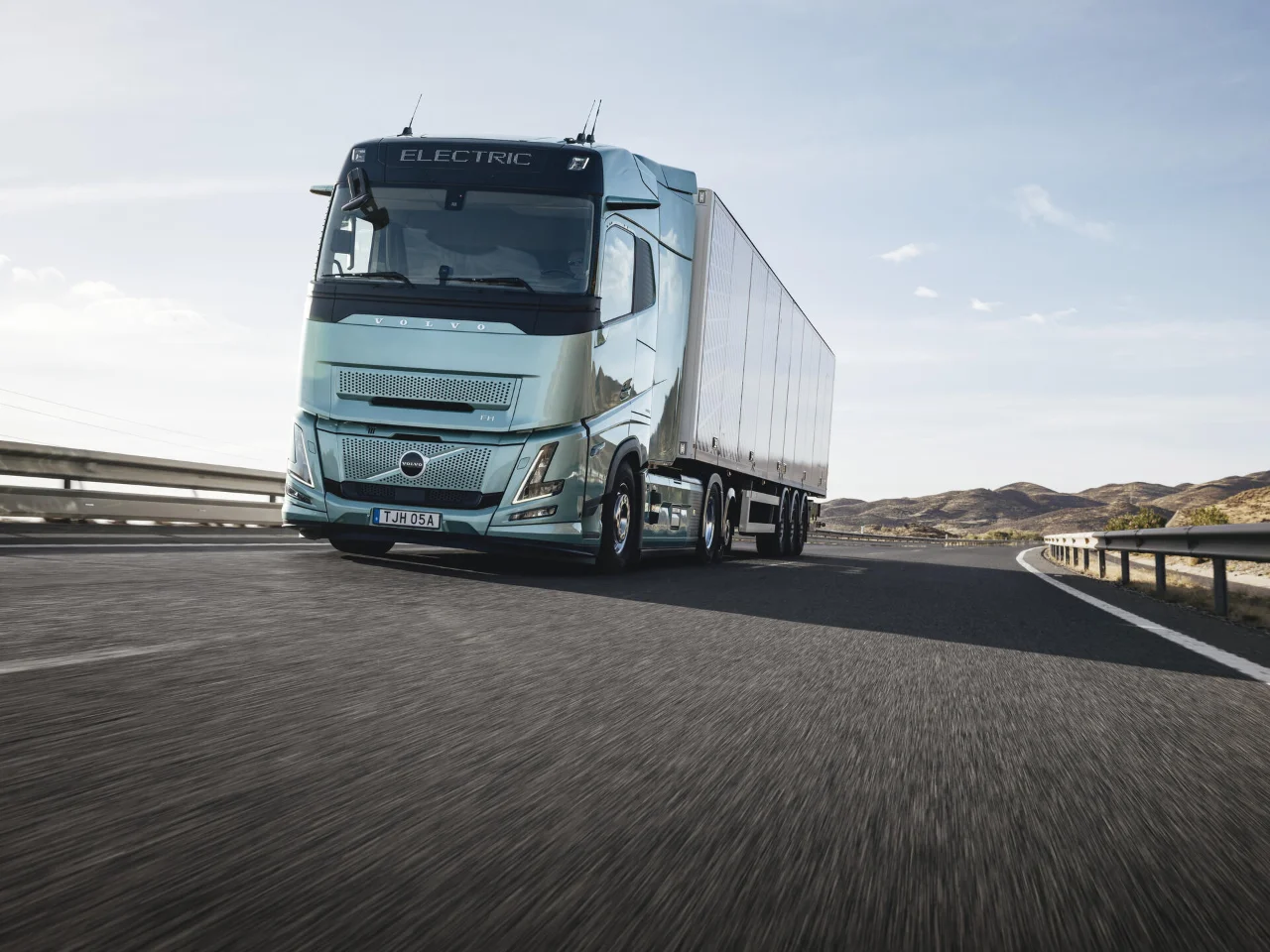
The best example of this evolution is undoubtedly the Volvo FH Aero Electric. With its e-axle, Volvo deeply modifies the vehicle architecture. By integrating the electric motors and the gearbox into the rear axle, the manufacturer frees up space in the chassis to carry more batteries. And it is precisely this approach that changes the game.
Here, electric is no longer a powertrain that one tries to fit into an existing architecture. It becomes, on the contrary, the starting point of the design. Result: a range announced up to 700 km, without major compromise on payload, with a vehicle capable of targeting heavy regional transport as well as long distance.
This is a major change. Until now, one of the limits of the electric truck remained its ability to go beyond urban or traditional regional missions. Volvo wants to show that it is now possible to go further, much further, while maintaining a level of productivity close to diesel. On this point stay connected because at TruckStop we like challenges, you will see we have a scoop for you in the coming days.
The other strong point is compatibility with MCS charging, which would allow going from 20 to 80% in around 50 minutes. In other words, charging is beginning to enter the operational time of transport, notably during regulatory breaks. And here again, we leave the experimental logic to enter a professional approach.
A new generation of FH, FM and FMX designed for the field
The same logic is found on the new Volvo FH, FM and FMX Electric. Volvo did not just announce more range or more power. The manufacturer above all highlights a new powertrain designed for more varied and more demanding uses.
This is particularly visible on so-called “bodybuilder” applications. Concrete mixers, tippers, lifting arms, waste collection: all professions where electrification was still facing real technical constraints. With a power take-off integrated into the gearbox, Volvo now makes it possible to power vehicle equipment without resorting to a separate engine or auxiliary module. Here again, one feels the difference between a truck adapted to electric and a truck truly designed for it.
The message is clear: electric must no longer be reserved for the simplest missions. It must be able to extend to a much wider range of operations, including the heaviest and most complex.
With up to 470 km of range, power reaching 540 kW, high towing capacities and multiple configuration possibilities, Volvo clearly intends to expand the scope of its electric trucks. The FMX, in particular, shows that the manufacturer no longer wants to leave diesel the monopoly of difficult environments or construction uses.
A transmission that says a lot about product maturity
Another interesting element: Volvo fully embraces the use of a multi-speed gearbox on its new electric models. While many still associate electric vehicles with absolute mechanical simplicity, the manufacturer chooses a more elaborate technical solution to optimize performance, wheel torque and driving comfort.
The new FH, FM and FMX Electric thus receive an eight-speed powershift gearbox, while the FH Aero Electric e-axle adopts a six-speed transmission. The objective is twofold: to offer smooth gear changes under load and to guarantee better efficiency in very varied situations.
This choice also reflects a reality: the heavy electric truck is entering a phase of sophistication. It is no longer just about making a truck run without exhaust emissions. It is about building a credible, versatile working tool, capable of competing with diesel on the field of productivity.
Volvo facing a structuring competition
This new offensive comes at a key moment. The heavy electric truck market is no longer at the stage of simple announcements. Offers are multiplying, players are gaining strength and competition is organizing itself. Mercedes-Benz Trucks, Scania, Renault Trucks, MAN as well as new specialized entrants are now advancing with increasingly credible products. Also watch out for the Chinese who are starting to show up.
In this context, Volvo could no longer be satisfied with its pioneer status. It had to demonstrate that it was still capable of evolving its offer, responding to new market standards and keeping a lead.
With this new range, the Swedish manufacturer shows precisely that it has understood the new phase that is opening. The time is no longer just to be first. The time is to offer electric trucks capable of competing on all the criteria that matter: range, payload, charging time, versatility, comfort, equipment integration and operating profitability.
A new step for the heavy electric truck
By renewing all of its heavy electric models, Volvo Trucks therefore sends a strong signal. Yes, the manufacturer was among the first to seriously commercialize electric trucks. But above all, it now wants to prove that it knows how to bring this technology into a new industrial maturity.
The time of electric vehicles designed as somewhat separate alternatives seems to be slowly fading away. With these new FH, FM, FMX and FH Aero Electric, Volvo claims another ambition: to make the electric truck a true professional truck, designed as such from the blank page.
And this is perhaps the main novelty. More than the record range or ultra-fast charging, what this new generation reveals is that electric is finally beginning to impose its own design logic. No longer by copying diesel. But by fully asserting what it can bring that is different.
Case to be followed in a few weeks behind the wheel of these new Volvo models!
Text: Fabien Calvet Photos: Volvo