Arctic Challenge
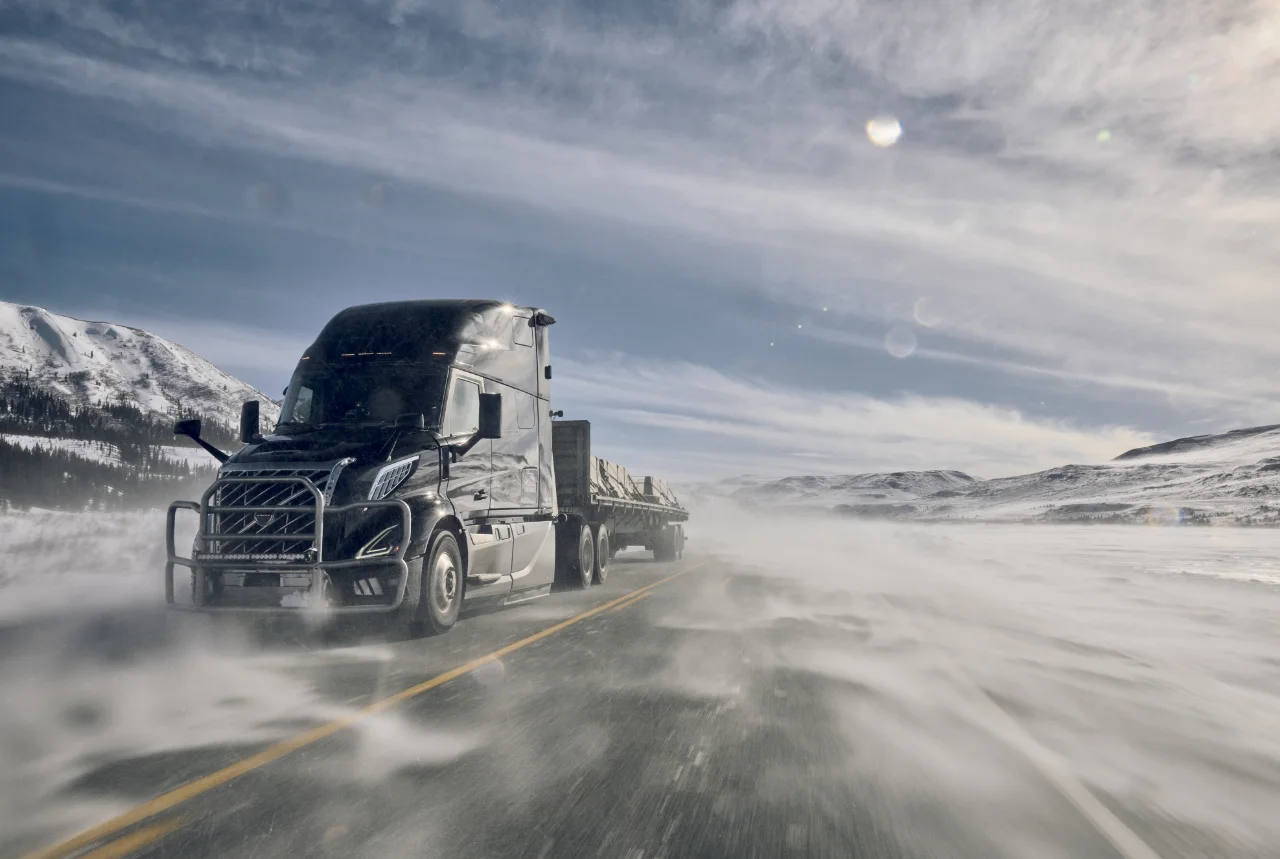
Volvo Trucks North America (VTNA), the American arm of the Volvo Group, continues the brand’s long-standing tradition of subjecting its vehicles to validation tests in extreme weather.
This latest campaign took place in Fairbanks, Alaska, where the new Class 8 VNL heavy-duty trucks faced the challenges of the Far North: temperatures down to –40°C, icy roads, snowstorms, freezing winds, and overnight outdoor parking without shelter.
All of this is done to validate the performance and driving comfort targets defined during the design phase, across the five biomes that characterize North America: urban environments, deserts, prairies, coastal forests, and Arctic tundra. These full-scale (and successful) tests ensure the trucks are ready for transcontinental transport missions exceeding 3,000 miles.
Professional drivers — many with decades of experience in Alaska’s harsh terrain — provide daily detailed feedback to the VTNA testing team. Combined with real-time performance data, this information allows specialists to fine-tune every aspect of the trucks, from powertrain responsiveness to onboard comfort.
A key test procedure, known as “cold soak,” involves leaving the truck outdoors overnight with the engine off, until all components reach subzero temperatures.
After 12 hours in such extreme conditions, engineers expect the vehicle to start and operate flawlessly — just as any driver would demand in real life.
Word from the head of testing
Arctic testing requires meticulous planning by engineers, who must collect and process vast amounts of data, cross-reference them with driver feedback, and turn the findings into concrete recommendations to improve the product and prevent potential failures.
In an exclusive interview, Matthew Taylor, Director of Reliability Testing at Volvo Trucks, explains:
“Extreme-condition testing is part of the Volvo Group’s global RT – Reliability Testing protocol. It requires a specific mileage to be covered within defined temperature ranges, with variations depending on geographic regions to account for real-world operating conditions. Everything relies on long, careful planning — sometimes weeks — to ensure complete data collection.
For example, we install specific sensors and communication channels on selected components such as the powertrain and cab. We use thermocouples, probes and accelerometers to measure noise, mechanical stress and vibration intensity. All data are sent to onboard loggers, while a modem transmits parameters to a remote server in real time.”
Monitoring cold starts
How exactly does the “cold soak” test work?
“It is a targeted test focused on powertrain components and is not carried out daily. As a prerequisite, drivers must finish their shift between 4 and 5 p.m.
There are two variants: the truck parked outside connected to an engine block heater (the most common real-world scenario), or without any external assistance. In the latter case, we check the temperature at which the ignition supercapacitor stops functioning, or when the lubricant becomes too thick to circulate. We also monitor misfires or irregular combustion that could increase hydrocarbon emissions and measure the activation time of the aftertreatment system.
The adoption of a supercapacitor on the new VNL is a real advantage for cold starts — it reduces start-up time without putting strain on the main battery.”
And what about cab comfort?

“The new heavy-duty trucks are equipped with cab cooling and heating systems tested in both winter and summer to maintain optimal temperature without engine idling. We place thermocouples in front of and behind the curtains, near the driver’s seat, and at air vents. As with other components, the collected data — combined with driver feedback — allow us to assess system effectiveness and detect issues such as air leaks caused by faulty seals.”
During testing, driver feedback is systematically cross-referenced with recorded data. Each truck is fitted with a data recorder, and each driver has a belt-mounted switch that triggers a special recording in case of anomaly, breakdown or warning alert. This device simplifies data interpretation and guides further investigation.
Global tests, local nuances

The United States presents climatic and geographical conditions different from Europe. How is this addressed?
“The reliability testing team operates globally with standardized protocols. However, we must account for local usage conditions, regulations and terrain. In North America, trucks face gradients not found in Europe — such as 6–7% grades over more than 24 km.
Speeds also differ (80–90 km/h in Europe versus up to 104 km/h in the U.S.), as do maximum authorized weights (36 tonnes in the U.S. versus 40–44 tonnes in Europe) and daily driving times (11 hours in America versus 9 hours in Europe). As a result, in a single day, a truck can travel from Denver, Colorado, to the Arizona desert, crossing completely different climate zones.”
Text: Gianenrico Griffini Photos: DR