Test in Occitanie: the new Scania R 500 put to the test
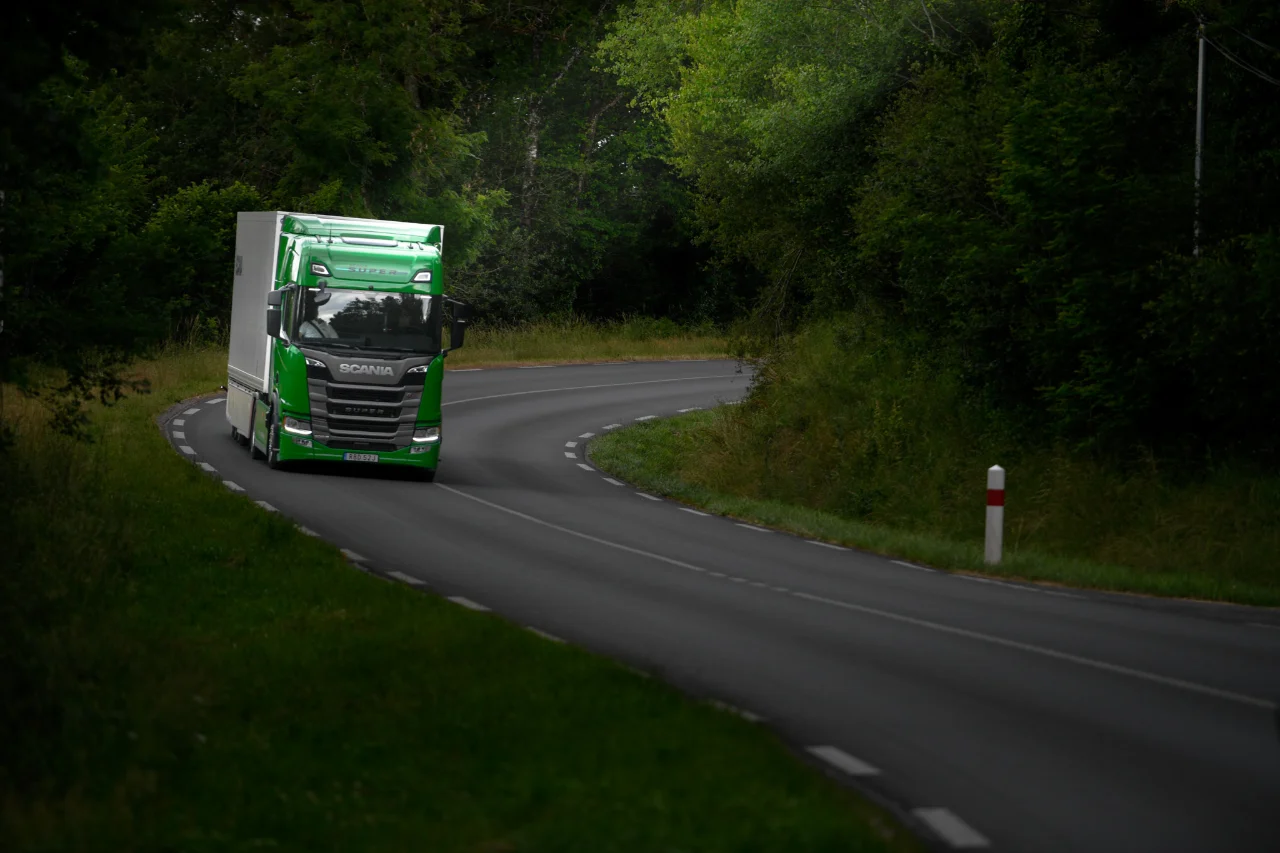
Occitanie has become our judge of peace. Three stages, three radically different profiles and a single objective: to put the truck to the test, without giving it any easy treatment. After the latest generations of DAF, MAN and Volvo, it is therefore the turn of the Scania R 500 to pass through our hands. And let’s say it immediately: the Swedish griffin has not lost its temperament.
A 500 R that remains a great classic

There is no need to introduce the 500 model at length since it is one of the best-selling in France. This 13-litre inline six-cylinder develops 500 hp and 2,650 Nm of torque, available from 900 rpm. A power unit that is now widely known within the TraTon Group, since this engine block is now used by MAN, Volkswagen in Brazil and even International in the USA.
Our truck is indeed equipped with the 12-speed gearbox plus overdrive, with that famous 13th gear which allows the engine speed to be lowered even further on rolling sections. At 85 km/h, the engine operates at very low revs and on our route, whenever the terrain allows it, the predictive system takes advantage of every opportunity to let the truck roll on its momentum by shifting into neutral. A system that has become essential on the latest generations of heavy trucks. A strategy that sometimes requires accepting a few speed variations, but which makes it possible to recover precious kilometres with zero fuel consumption.
Stage 1 – Toulouse-Caussade: the 500 R in its element

To begin our Occitanie test, we head towards Caussade from the road transport centre north of Toulouse, with a first stage that is mainly motorway-based. From the first climb, our 500 sets the tone. At 40 tonnes, it attacks the gradient at around 40 km/h and progressively climbs through the revs. The engine goes up to 1,400 rpm before changing gear, then immediately returns to its maximum torque range in order to work as little as possible. Frankly, I can assure you that the feeling is good; even though I don’t have 700 hp under my foot, my truck does not struggle. In the middle of the climb, in the most difficult part of the ascent, the engine retains enough response to maintain the pace. Once the summit is crossed, the gearbox quickly moves up through the gears and shifts into overdrive. It is impressive because once we reach our cruising speed of 85 km/h, the engine speed then drops to around 850 rpm.
This is where the work of the predictive system becomes particularly interesting. As it approaches a downhill false flat, the Scania anticipates, shifts into neutral and lets the truck build momentum. A few kilometres further on, the result can be seen directly at the pump, as the system is constantly improving. The figures speak for themselves on the first stage: less than 13 litres consumed, or around 22 l/100 km. I remind you that we are driving at 40 tonnes, so this figure is particularly convincing.
A particularly effective eco-roll strategy

On this first section, the Scania above all shows just how much electronic systems have changed the way of driving a truck. Here, the driver remains in control, but the electronics constantly optimise the acceleration, deceleration and coasting phases. On certain descents, the truck even accepts slightly exceeding the programmed speed before progressively returning to the set speed. The objective is simple: not to waste the available energy. I already know what some of you are going to say: yes, you are right, these modern trucks sometimes do a “yo-yo” with the speed management system and it is very unpleasant when you are following one and your truck does not do the same! It is true, and I agree, but one thing is clear: over an entire journey, this makes it possible to maintain a good commercial speed while reducing consumption. On this point, Scania has clearly made progress.
Stage 2 – Caussade-Rodez: where things get serious

For those who know the region, a radical change of scenery. After Caussade, head towards Rodez via small roads, villages, roundabouts and above all the famous climbs of Occitanie. This is where the truck really has to show its temperament and once again our 500 delivers. On the first climbs, it remains for a long time at maximum torque, around 1,100 to 1,300 rpm. The truck loses a few kilometres per hour, but never gives the impression of struggling. Admittedly, I am not behind the wheel of a V8 from the brand, but even if the 500 horsepower of my inline six does not make me dream, I have to admit that they still do the job, even at 40 tonnes. In this strategy and optimisation of engine speed, the transmission obviously plays a major role. Nothing to complain about regarding the famous 13th gear; it alternates between torque and power depending on the profile and knows how to downshift early enough to prevent the engine from collapsing. The driving pleasure is real.
Caylus: the judge of peace
You know it, you see it in all my videos, Caylus is my favourite section. And with it, a descent that allows us to check a point that bothers me on many recent trucks: the absence of a secondary retarder! And yes, even Scania is not exempt from the rule; the Brussels technocrats have got the better of common sense when it comes to safety. Like quite a few trucks tested recently, our 500 does not have a secondary hydraulic retarder. No Scania Retarder, which is nevertheless one of the best on the market; here, we will have to make do with the CRB (Compression Release Brake), in other words a decompression engine brake of the Jacob’s type.
I am going to be honest with you and even a little direct: yes, the system works. Very well, provided you approach the descent at the right speed and at 40 tonnes, it is better to reach the top of the descent at 45 km/h than at 70. Once properly engaged, the CRB allows the truck to maintain a perfectly controlled speed without touching the brake pedal. The descent is fairly short; we are not in the Alps and in the previous tests where we faced kilometres of elevation change. Here, it does the job, but you know my frankness, I am not here to say only good things.
The problem here is elsewhere: the noise. At a time when we are constantly being told about silent and “eco-friendly” electric trucks, believe me, you can hear the big Scania coming. We are not talking about the melody of the V8, but rather a good diesel engine purring to slow our combination and, of course, we are high in the rev range! And yes, it is mechanics, but at high revs, the engine screams. The slowing-down is effective, but significantly noisier than with a good hydraulic retarder. And on this point, there is no pretending: on board, it is not the same serenity and believe me, in the quiet village of Caylus, we do not go unnoticed, especially with our beautiful green truck!
And on the other side?

The second KissCool effect: the climb out of Caylus then allows us to check the engine’s behaviour and there, once again, I have a big smile on my face. Even though the hairpins are tight and the truck drops to 30 km/h in some corners, my 500 does not disappoint. The 40 tonnes are obviously felt, but once again, it shows what it has under the bonnet. The Super engine climbs through the revs when it needs to in order to find maximum power, but in most cases it returns to maximum torque as soon as the gradient eases. Torque, power, torque, power: the strategy works perfectly, this engine is a real pleasure.
A small clarification: the driver must nevertheless take back control in the tight hairpins because the truck does not yet have the vision and cannot see the traffic around it. The system knows the terrain, but not yet enough of the exact road profile to know that a very tight bend is coming a few dozen metres further on with cars on your left. And this is precisely one of Scania’s choices: the electronics assist the driver, but do not completely take the controls away from them. Where the truck clearly does the job is on the final part of this second stage. The Aveyron plateaus allow us to see and, above all, appreciate the truck’s temperament. Never really struggling, my little 500 can boast of giving pleasure to whoever is behind its wheel. On arrival in Rodez, the verdict of this second stage is inevitably less flattering than the first stage because of the terrain, but if I compare it with others already tested on the same route, the Griffin is positioned rather well. Verdict: with the 52 litres consumed on stage 2, this gives us a solid 42 l/100 km. But be careful not to make the figures say what they do not say. This stage is by far the most demanding of our route. The climbs, descents, villages, hairpins and accelerations put the 40 tonnes to work. And despite this high consumption, the time remains good: 1 h 57 for the stage. If I look more closely at my onboard computer, I also notice that the Scania covered around 12 km in eco-roll, or nearly 10% of the stage without consuming a drop of fuel. This is probably one of the major lessons from this part of the route: the predictive system is working better and better on these new generations of trucks.
An R cab that is still just as pleasant

During the usual 45-minute break at LCR in Nuces, not far from Rodez, it is time for me to give you a quick tour of the cab of this R model, because in this area, the Scania remains one of the benchmarks. Personally, I am even going to be clear with you: the R cab is still my favourite for this type of regional use. Lower than the S, it offers a driving sensation closer to the ground and, above all, less body movement. If you are not a night-time trucker who spends 4h30 behind the wheel non-stop, the R, for regional and national work, is in my opinion an excellent compromise.
The ergonomics remain typically Scania: driving position, quality of materials, layout of the controls and now the Smart Dash (which finally works). The manufacturer has clearly caught up in terms of the interior atmosphere because this new model allows a choice of lighting ambience with several interior lighting adjustment options. Beyond this gadget (which does no harm), more seriously, the major evolution concerns the bunk. Scania has finally worked on what, in my eyes, was one of its weak points. Mattress, mattress topper and above all reclining backrest: a simple press now makes it possible to modify the position of the rear section. Finally, this is a success! It may only be a detail for some, but for someone who lives in their truck, it is a real good improvement. In short, I’ll keep it simple for you: the newest of the new is coming soon (at the IAA show in September), but this latest Scania model has become significantly more attractive inside than the previous one.
Stage 3 – Rodez-Toulouse: efficiency returns

Back on the road towards Albi and then Toulouse. This third stage is significantly more rolling than the second and allows our 500 to return to its preferred terrain. On the N88, the rolling hills follow one another. The predictive system does its job wonderfully: overdrive, neutral, acceleration, new gear… the truck exploits every movement of the terrain. And another trick is shared with us by Stéphane Canals, the Scania demonstrator, in order to save a few more drops of diesel. A small impulse on the accelerator can trigger the shift into neutral and allow the truck to glide for even longer. Simple, but devilishly effective. The kind of little “trick” that, accumulated over several hundred kilometres, eventually makes a difference.
On long descents, the CRB reaches its limits

The third stage also allows us to definitively answer our question regarding the engine brake. On long descents, the CRB does a large part of the work. But when it reaches its limits, the truck intervenes with the main brake. You then feel a few small braking interventions, identical to what we had already seen with Volvo with the “trailer brake”. Okay, don’t see me as a Retarder extremist: yes, the CRB works, but above all it confirms what I have always said: the best of both worlds remains the combination of the CRB and a hydraulic retarder in order to drive in 100% of cases with the serenity we know behind the wheel of a well-equipped Scania!
29 l/100 km: the verdict is in
After almost 360 kilometres of our Occitanie route, the figures are now known.
- Stage 1: 22 l/100 km
- Stage 2: 42 l/100 km
- Stage 3: 24 l/100 km
- Overall average: 29 l/100 km
The Scania R 500 therefore comes in below the symbolic 30 l/100 km mark on our reference route for our tests. Another point worth highlighting: it maintains a high commercial speed for this type of terrain. We never had the feeling of driving an underpowered truck or of having to suffer the terrain. The 500 moves forward, accelerates and climbs with enough temperament to make driving a mid-range truck enjoyable.
One last question I ask myself: the axle ratio: 2.31, really the best choice?
There is nevertheless one point on which I am more reserved: the 2.31 axle ratio, combined here with size 70 tyres. On motorways, this configuration is obviously excellent. The engine runs at very low speed and consumption benefits directly from this strategy. But our Occitanie route is not a motorway. There is some terrain, climbs, descents and technical sections. Personally, I think a shorter ratio, around 2.53, would have been even better suited to this type of use. We had also found this configuration on the MAN D30 tested previously. And it is precisely this same MAN that currently holds the fuel consumption record on this route. Of course, this choice of 2.31 axle ratio is not a criticism because this press test truck is a vehicle that must suit as many routes as possible, but it once again reminds us of the importance of the right truck configuration when ordering the vehicle. I remain clear on one point: the best truck is the one configured for its real playing field.
Our verdict for this Scania

At the end of this test, the Scania 500 R confirms one thing: modern diesel is far from having said its last word, and I say all the better!
With 500 hp and 2,650 Nm, it offers an excellent compromise between performance, consumption and driving pleasure. The powertrain is particularly well controlled and the eco-roll strategy makes it possible to achieve savings even during the smallest phases of inertia. The R cab remains, in our eyes, an excellent proposition for regional and national work, while the latest interior developments significantly improve living comfort on board.
The main regret ultimately concerns the configuration of our test vehicle. At 40 tonnes on such an uneven route, the hydraulic retarder would have given us greater peace of mind. The CRB does the job, but at the cost of high engine speed and a noise level that can quickly become tiring. And our second reservation concerns the axle ratio: 2.31 is excellent for rolling routes, but 2.53 would probably have been more relevant on our itinerary.
For the rest, it is difficult to find much fault with it. The R 500 is efficient, pleasant, predictable and above all still very “human” in the way it operates.
The electronics help the driver, but do not seek to take all the controls away from them.
And ultimately, perhaps this is what we will remember from this test: a modern truck, but one that still lets the driver drive.
Our verdict
👍 Very good: fuel consumption and the efficiency of the predictive system 👍 Very good: the temperament of the 500 hp engine combined with the 13-speed gearbox 👍 Good: the ergonomics and developments of the R cab 👍 Good: the particularly effective eco-roll ❌ Our regret: the absence of a hydraulic retarder
Text and photos: Fabien Calvet