The eActros 600: Mercedes’ big electric truck
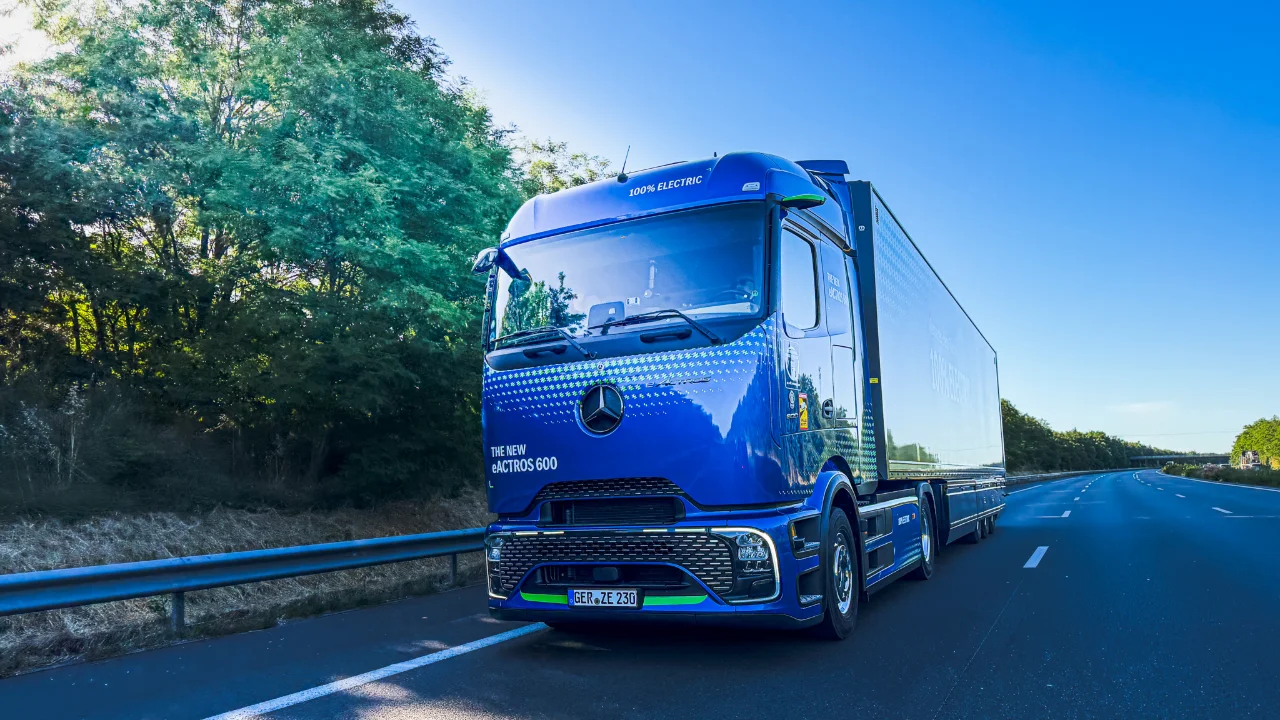
Power, driving comfort, electric capacity all points that we will be able to check out in real-world conditions. How will the leader of electric trucks perform against the competition?
To find out, we took our TruckStop Occitanie reference route again with the Mercedes-Benz eActros 600, elected Truck of the Year 2025. Three stages, 360 kilometres, 40 tonnes, motorways, national roads, elevation changes, the descent and climb of Caylus… and above all, no theory: only what I felt behind the wheel and the figures recorded during the test.
Let’s be clear before starting: after more than a year of TruckStop tests, we now have enough trucks that have covered this route to be able to compare them. Diesel, gas, electric: same road, same constraints, same driver. And unlike the beautiful brochures, the figures themselves do not tell stories.
The eActros 600: Mercedes’ big electric truck

You know it by now, the Mercedes-Benz Trucks eActros 600 is a bit like the one that kicked the hornet’s nest. With a design different from the competition, it has been a pioneer in terms of the versatility of the electric truck. The Benz, let’s be clear, is the one that made it possible to start doing all kinds of jobs with an electric truck.
In the different tests we have been able to carry out, we have each time found that, in terms of electricity consumption, this truck delivers particularly optimised results. There are several reasons for this, but the first one that stands out compared with the others is its design.
Under this new-generation Actros (ProCabin) cab are more than 620 kWh of LFP batteries, two electric motors integrated into the eAxle and a 4-speed transmission. This eAxle is indeed what makes all the difference from a design point of view. Gone is the truck as we knew it, with a traditional engine, gearbox and axle. Here, everything is grouped together in this electric axle, and this is precisely where the difference in consumption is made.
In terms of continuous power, 450 kW, or around 612 hp. And if Power mode is selected, maximum power rises to around 600 kW, or more than 800 hp. But let’s be clear: you do not make a good electric test with 800 horsepower. On the contrary, if you want to drain the battery, all you have to do is open the taps wide and ask for all the available power. The real interest of this truck lies elsewhere: in its ability to use every kWh intelligently.
On this point, while Mercedes announces around 500 kilometres of range, we will see that this figure is particularly cautious. Remember our very first test between France and Spain: at the time, I covered 505 kilometres and still had 22% left in the batteries.
First impression: it pulls… and it pulls hard

Departure from the Toulouse road centre. We are at 40 tonnes and the first difficulty arrives immediately with the long climb that allows us to join the motorway. I merge into traffic, accelerate firmly and, very quickly, the truck reaches 80 km/h.
What immediately stands out is not only the power, but the ease with which the truck moves. There is no gearbox searching for its gear, no interruption in power delivery, no dead time. Acceleration is linear and torque arrives immediately.
At the top of the first major climb, I am still around 70 km/h. The truck absolutely does not seem to be struggling, which is still just as surprising.
Further along this first, exclusively motorway stage, our truck seems to drive itself. Clearly, this is not where electric power shows its full potential. It is difficult to tell the difference compared with a diesel truck. Certainly, it is quiet, but let’s also be honest: modern diesel trucks hardly make any more noise at 85 km/h on the flat.
Here, as with all trucks today at a steady speed, you mainly have to let the machine do its job. At 85 km/h, the eActros is extremely smooth and knows perfectly how to coast whenever the opportunity arises. Yes, the star brand’s PPC system remains the most advanced on the market.
Even though our first stage between Toulouse and Caussade is easy, the first lesson from this test is clear: it seems that this Mercedes does not like wasting energy.
A familiar cab… with a few good surprises

I’m going to break with our usual habit and talk about the cab right from the start. We are in a Stream Cab, so not in the large Actros cab, which is unfortunately the best-selling one (personally, I really prefer the Big, or even the Mega!).
The environment is familiar, with this very Mercedes presentation, the screens, the controls and a finish that remains serious. The driving position, however, still does not completely convince me. The seat has improved, as has the steering column, but in my opinion Mercedes is still behind what is best today at Scania, Volvo, DAF or Renault Trucks.
On the other hand, the second-generation MirrorCam cameras are excellent. Once you get used to them, I even find their use particularly natural. The trailer view is precise, the wide angle is well positioned and, at night, the system provides genuine comfort. All that remains is to finally remove the front-view mirror and the kerb-side mirror, and replace the whole thing with an equivalent to DAF’s Corner View. Then we will be close to perfection.
On our demo model, Mercedes added several interesting storage solutions. The rear storage compartments, the space for shoes in the step (like Ford), the storage for gloves or small accessories in the door… In short, even though these are small details, these are precisely the small details that make the difference in a cab designed to be lived in every day.
As for the bunk, here again Benz thinks big, with a width of 90 cm, making it one of the most generous. Downside: during the day, it has to be raised to free up the working space, but in the evening, you find a real long-haul driver’s bunk again (bring on 2028 and the new cab standards).
First-stage result: 102.5 kWh/100 km
Let’s return to our first stage and, above all, to the results. Between Toulouse and Caussade, the meter shows 41 minutes of driving and 102.5 kWh/100 km. This is a very good figure, even though this first stage is not the most favourable to electric power, as it is mainly motorway with little elevation change. Why? Because there are relatively few opportunities for energy recovery.
If I take stock of these first kilometres, I can also see the eActros’ ability to genuinely coast. As soon as the terrain and traffic allow it, consumption drops to zero. The truck is carried by its inertia, without that feeling of resistance that you can have with a combustion vehicle or certain electric systems. With the eAxle, the feeling of smoothness is particularly significant.
At the end of this first stage, I still have around 90% battery and the computer tells me I have almost 560 km of range. Mercedes announces 500 km, another proof that Mercedes Trucks is genuinely modest when it comes to the range of its truck.
The PPC: when the truck knows the road better than I do

It is really on the second stage that the test becomes interesting. Caussade–Rodez, 121 kilometres of small roads, villages, roundabouts, climbs and descents. And above all, Caylus, our final judge.
The eActros has PPC, Predictive Powertrain Control, but as a new feature, Mercedes is going further: the system now uses GPS information. And there, I have to admit that I am blown away.
The truck no longer simply looks at what is happening in front of it. It knows where it is going, it knows that a roundabout is coming, that a descent is approaching and, above all, that a climb will follow. It can therefore anticipate its deceleration, choose to let the truck coast or, on the contrary, start regenerating before I even have to intervene.
At some roundabouts, I simply no longer touch the pedals. I keep my hands on the steering wheel, activate the indicator and the truck manages acceleration, deceleration and energy recovery.
We are clearly in a form of semi-autonomous driving. The driver remains essential, but their job is changing. And I have to say it: it is impressive and even a little frightening, because I can see tomorrow’s profession taking shape and, let’s be clear, it does not make me dream.
The Caylus climb: the final judge
After the first rolling hills of our Occitanie route, we arrive at Caylus, my favourite section. This is exactly why I built our Occitanie route. Here, it is impossible to cheat. You have to descend with 40 tonnes, then climb back up and therefore see what the truck has under the pedal.
But the most interesting thing is what happens before the descent. I arrive at the top before Caylus with around 81% battery. The descent is limited to 50 km/h. Personally, when loaded, I often prefer to descend at around 40–45 km/h on this type of section.
The truck had also anticipated the descent and began reducing its speed to approach the difficulty at the right speed. It slows down before the bend, drops to around 40 km/h, then gradually lets itself pick up speed again. I did not touch the brake pedal.
The precision of the system is simply incredible. I never feel in danger, the truck has an insane amount of engine braking and, above all, it recharges. This is the craziest thing about these electric trucks. Here, there is no secondary retarder, no decompression brake, no, it is the electric motors that do the job and, to top it all off, they take advantage of it to send energy back into the batteries.
Result: I will recover 3% at the bottom of the descent. You will tell me that three percent is anecdotal on a vehicle with more than 620 kWh. Yet this represents several dozen kWh. But beyond the figures, we now have to look at what happens next: the second Caylus effect!
The second Caylus effect, the climb
As a reminder, at the bottom of the village, we set off again almost from a standstill and immediately tackle the climb. Here, the 40 tonnes make themselves felt, there is no mystery in front of the obstacle. To understand, watch our video on YouTube or on our free application to download on your mobile.
To compare the system’s reactions, I deliberately drive the first part of the climb manually, then engage the PPC. Result: the automatic system practically reproduces what I have just done myself. It slows down in the hairpins, gradually regains speed and exploits the terrain with ease and, above all, smoothness.
There is no doubt that the 612 electric hp are really there, but this power is managed in an exemplary way so as not to melt the tyres. In one of the hairpins, I finally feel a gear change when the transmission shifts from second to third in the most difficult section. This is the only moment of the test where the transition is really noticeable, but let’s be honest, nothing like a combustion transmission.
Here, the system knows the profile of the road: it accelerates and releases when necessary. If I have to take stock, even though it is always difficult to say, under these operating conditions, I would choose this eActros without hesitation rather than any combustion-powered truck, regardless of its power.
Seriously, I’m not joking, but on this section, driving an electric truck remains something incomparable, and above all unbeatable because, in addition, I did not blow up the consumption figures. What I gained on the descent allowed me to climb with complete peace of mind. It’s magical!
On the second part of this stage, the route is more flowing. Even though we are still travelling on real country roads, we string together the rolling hills and, once again, the Mercedes gives us a fine demonstration of the efficiency of its PPC system. We climbed, descended, climbed again, braked, regenerated… And each descent made it possible to recover part of the energy consumed during the previous climb.
The second stage is naturally much more energy-intensive and we finish with a displayed consumption of around 150 kWh/100 km, but this figure must be looked at alongside that of the first stage. Over the first two stages as a whole, we are around 135 kWh/100 km.
Still looking at the figures, if I look at the total for this second stage, I can be pleased because we covered the 121 kilometres in 2 hours 01 despite difficult traffic (driving-school bus, licence-free cars, tractors and several slowdowns). For our route, that is a very good time.
Electricity likes rolling hills

This is probably one of the most important lessons from this test. We often imagine that electric power is mainly suited to flat roads or cities. If I base this on my first two stages, I would say exactly the opposite.
On a perfectly flat motorway, the truck consumes little, but it recovers practically nothing. On a hilly road, it consumes energy on the climbs… then recovers it on the descents. And the heavier the truck, the more interesting this recovery can become. Let’s see what happens on our third stage, which is generally quite flowing.
From Rodez to Albi: I recover kilometres while driving

Departure from Nuces at LCR Events after our mandatory break. The battery is around 59%. The announced range is approximately 360 km, so more than enough to reach our starting point from this morning.
I program the GPS towards Toulouse and the system calculates the route. It even tells me the elevation gain to come. The truck knows that we are going to descend, then climb again. It knows where the charging points are. It can therefore adapt its strategy.
On the N88, we find a succession of climbs and descents. And there, something continues to surprise me: the further I go, the more the range increases. I go from 47 to 48%, then 49%, then 50%. I obviously have not plugged the truck in, I am driving but, above all, I am descending.
The system lets the truck coast on favourable sections, then recovers energy whenever it can. This is one of the rare cases where you can genuinely say that a vehicle “puts fuel back into its tank” while driving, but here, the fuel is recovered energy. In Albi, I am still around 50% battery and the displayed range reaches around 330 to 340 km.
At the end of this final stage, the consumption figure makes your head spin. With 80 kWh/100 km, my truck blows away all the usual rules. Here, we broke all our records, allowing us to arrive at our starting point with another 35% energy reserve.
107.6 kWh/100 km over 360 kilometres
Back to Eurocentre, our starting point. We finish the three stages with an overall average consumption of 107.6 kWh/100 km.
To give you an idea, the Scania 40 R that we previously tested on this same route achieved around 112 kWh/100 km. So this is not just a good result for an electric truck. It is a result that can be directly compared with our previous tests, because that is exactly what we are looking for at TruckStop: putting trucks under the same conditions and looking at what the figures show.
On this route, the eActros 600 therefore takes a reference position in the electric truck segment.
What I really liked behind the wheel
After three stages, my feeling is quite clear. The eActros 600 is extremely easy to drive. It is powerful, quiet and very smooth. Here, the available power is more than sufficient at 40 tonnes and the electric torque makes acceleration particularly effective. Gear changes are almost imperceptible.
Another observation, already well ahead at Daimler: electronic assistance has become even more effective. The truck does a lot of the work for me and that is both its strength and perhaps its small weakness. I’ll be honest: it is very sanitised. We are driving less and less in the traditional sense of the term. I keep my hands on the steering wheel, but acceleration, deceleration, braking and energy management are increasingly handled by the machine.
For some drivers, this will be fantastic. For others, it may take away a little of the pleasure of driving. Personally, I prefer having the choice. And Mercedes precisely allows you to deactivate or adjust a large part of these functions.
Safety at the highest level
The truck’s other strong point is its safety. Active Brake Assist, pedestrian detection, Sideguard Assist, lane correction, radars and cameras: the truck constantly monitors its surroundings. I sometimes feel that the system will eventually drive without me, even though we are obviously not there yet. But it has to be recognised that these systems provide genuine peace of mind and, with an electric truck, the silence further reinforces this feeling. In the villages we travelled through during our test, the contrast is striking. Where a 40-tonne diesel combination mechanically imposes its acoustic presence, the eActros passes almost discreetly and I have to admit that in Caylus, it was a real demonstration.
Final topic: where do we recharge?
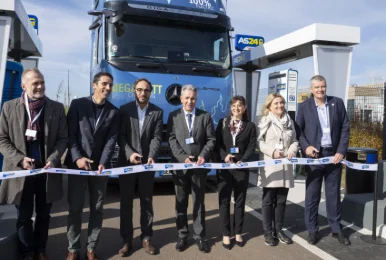
After this test, I am not going to tell you that the problem of electric power is solved. Charging remains the weak point for now. We have to be clear on this issue because the real subject remains infrastructure. We were lucky enough to be able to start and finish our route at Eurocentre, at the Arena station, where a charger dedicated to heavy-duty vehicles is now available. A 400 kW charger, accessible without uncoupling the trailer. And that is exactly what needs to be multiplied. Upon arrival, we are around 35% battery. We plug the truck in and Mercedes estimates that around one hour is needed to return to 100%.
Plugging in is ultimately disarmingly simple: card, connection, communication with the truck, locking the plug… and charging starts. During this time, the driver takes their break, can go and eat or take a shower. This is the organisation that now needs to be developed if you do long-haul work throughout the week. For others, the story is different because a truck that returns to the depot every evening, travels 300, 400 or 500 kilometres during the day and recharges during its break or at night ultimately does not need a motorway network every 100 kilometres.
In this case, do you really need an eActros 600?
Not necessarily. This is also what this test shows. Mercedes-Benz Trucks notably offers an eActros 400, with a lower battery capacity and therefore potentially better optimised weight. For regional operations, with shorter daily routes and a systematic return to the depot, it may be more relevant.
Before buying an electric truck, you therefore need to look at the truck’s actual work: daily kilometres, average weight, elevation change, temperature, return to the depot and charging possibilities. The right electric truck is not necessarily the one with the biggest battery. It is the one that matches the work you ask it to do.
TCO is finally becoming interesting
Another important development: the price. For a long time, the electric truck was economically difficult to defend against diesel. The situation is changing, particularly with the available subsidies, CEE schemes and various support measures that can significantly reduce the purchase-price gap. Mercedes also offers specific maintenance and support solutions.
And above all, you have to look at what disappears from the operating bill. No more diesel, no more AdBlue, no more particulate filter: basically, the end of a large part of our daily problems.
The eAxle combines the electric motor, transmission and axle in an assembly that is much simpler than a combustion powertrain. The battery obviously remains, representing the economic heart of the vehicle. Mercedes announces a warranty of up to 10 years or 1.2 million kilometres. I’m going to be blunt because I’m not one for beating around the bush: there is one thing that does not change and, quite the opposite, it is the tyres. They continue to work and, needless to say, the strain is even greater than with a diesel because the power and braking are so readily available.
Is electric power ready? Yes… but not everywhere

I will end this test with a deliberately simple conclusion. To the question “Does the eActros 600 work?”, the answer is: yes.
We have just demonstrated it over 360 kilometres, at 40 tonnes, with three completely different profiles. We did motorway driving at around 102.5 kWh/100 km, a hilly stage at around 150 kWh/100 km, then a third stage at only 80 kWh/100 km. The final average is 107.6 kWh/100 km.
And several times, I finished a descent with more energy than at the beginning of it. These are facts. This does not mean that electric power is suitable for everyone. Infrastructure remains insufficient, operating conditions are decisive and the economic calculation must be carried out on a case-by-case basis. But we must now stop considering these trucks as experimental prototypes.
My TruckStop verdict

I have already driven several eActros 600s and several generations of Actros. What really struck me this time was therefore not the discovery of electric power. It was the combination of power, energy recovery and, above all, predictive intelligence.
GPS now associated with PPC genuinely changes the way the truck uses its energy. The eActros 600 no longer simply reacts to the road: it anticipates it and, on our route, the result is spectacular.
I remain convinced that the switch to electric power cannot happen everywhere and immediately. But after this test, I am equally convinced of one thing: saying that electric trucks are not capable of working is no longer tenable.
The question is no longer really “does it work?”. The question is now: for which type of transport, with which route, what load and what infrastructure?
And that is where the debate finally becomes interesting. Because after spending several hours behind the wheel of the eActros 600, one thing is certain: this truck does not need speeches to convince. You simply have to get behind the wheel to truly understand.
So, to all the grumpy people who are quick to criticise on the internet, try a truck like this before giving an objective opinion! The figures speak for themselves.
Text: Fabien Calvet Photos: Nadège Cesse and Fabien Calvet