An inside look at a truck’s second industrial life.
We talk a lot about electric, hydrogen, biofuels… and that’s a good thing. But at Renault Trucks, the energy transition isn’t limited to a single technology. It also happens where you might not always expect it: in giving trucks a second life.
Head to Lyon, then Bourg-en-Bresse, for a deep dive into a unique industrial setup in France, entirely dedicated to refurbishing used vehicles. A pragmatic, hands-on approach and above all, remarkably effective.
Lyon: the beating heart of refurbished trucks
First stop on our visit: the used truck and refurbishment center in Lyon. Here, there is no tinkering, no approximation. This is clearly a manufacturer-driven operation, with processes, standards and quality requirements worthy of a production line.
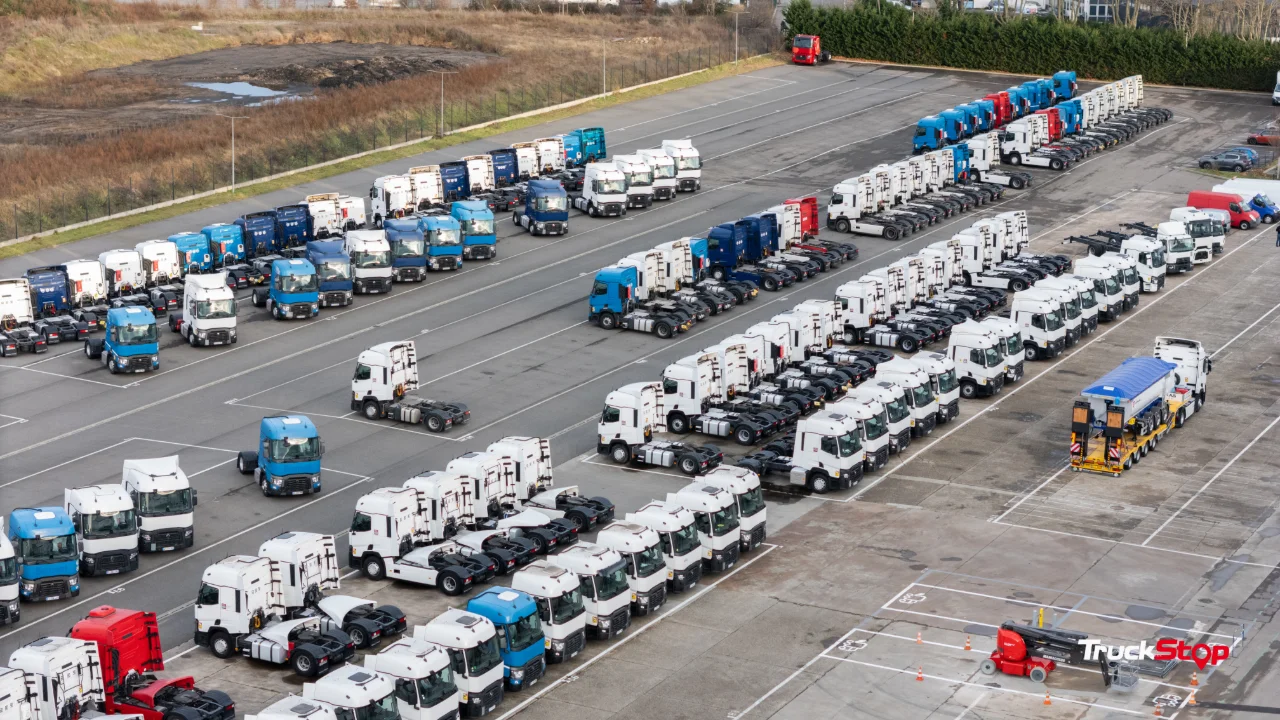
The site handles around 100 trucks per month, features ten mechanical service bays, one bay dedicated to quality control, and can accommodate up to 800 vehicles in its yard. The workflow is perfectly structured: appraisal, selection, refurbishment, inspection, washing, photo session… then online listing.

Everything is controlled, tracked and documented. The philosophy is clear: apply to heavy-duty trucks a model already familiar in other sectors a sort of “Back Market for trucks”, but with full OEM-level industrial rigor.
The goal? Extend vehicle lifespan, broaden the offering between traditional used trucks and fully refurbished units, and provide a credible alternative to new trucks at competitive pricing.
Circular economy: figures, not slogans
Here, circular economy is not marketing language. It is measurable. Each refurbished truck saves approximately 7 tonnes of CO₂. Why? Because steel structures are reused, many components are retained, and the consumption of raw materials and water is drastically reduced.
Refurbishment is also supported by the remanufacturing ecosystem, notably with the Limoges plant. Turbos, particulate filters and mechanical components are restored and reintroduced into new life cycles.
Repair. Reuse. Optimize. Simple. Logical. Effective.
In the workshop: mechanics first… and the future driver in mind

Washing, lighting, perception: the detail that changes everything
Before being offered for sale, every truck goes through a final wash phase. Exterior pressure wash and brushing, interior cleaning under strong lighting. Nothing is left to chance.
And this is where the transformation becomes visible. Once completed, the truck honestly looks new. The smell, the replaced components, the overall presentation, everything contributes to a genuine sense of quality.
You’re no longer buying “a used truck”. You’re investing in a refurbished truck reassuring, valuable, premium. Once again, the “Back Market for trucks” comparison feels justified.
Bourg-en-Bresse C11: when used becomes premium

Second stage of our visit: Bourg-en-Bresse. At the Renault Trucks plant, building C11 is a true center for customization and advanced transformations.
Here, around 6,000 trucks per year (new and used) pass through the paint facility. About fifty employees work in three shifts, with factory-level organization.
More than 1,000 color options are available, with access to prestigious manufacturer color bases of Porsche, Ferrari… nothing is off limits. The 01 Racing range, launched in 2021, is the perfect illustration.
Around ten dedicated colors, ultra-refined finishes, eye-catching details. The 200th unit has just been produced, sometimes with 250,000 to 400,000 km on the clock without it being visually noticeable.
For a full paint job, the cab is systematically removed. Not due to technical necessity, but for safety, ergonomics and quality reasons. The result: no trace of the previous color and a true “factory finish”, without impacting lead times on the contrary, as this is a fully industrialized environment with optimized processes.
Transform rather than discard

C11 is also the transformation kingdom. Conversion from 4x2 tractor to rigid truck. Chassis extension with one-by-one replacement of side members. New fasteners. Engine and gearbox retained.
The result is often cleaner than conventional chassis extensions involving cutting and welding.
These are factory transformations, fully traceable and documented. Watch our video on truckstop.fr, you might be surprised.
Another striking example: X-Road versions, giving a second life to buy-back road tractors by converting them into site-approach trucks. Increased ground clearance, hydraulics, repositioned tanks and all carried out to the same standards as a new vehicle.
Dethermify to recycle better

Factory standards, total traceability

What stands out throughout the visit is the obsession with detail and traceability.
Known vehicle history, documented transformations, updated aftermarket data… A tractor converted into a rigid truck remains perfectly identified within the systems. The new components used are equivalent to those fitted on the production line.
Even parts logistics are designed accordingly: internal warehouse, next-day supply, digital inventory management, ergonomic tooling to protect operators.
Here, there are no compromises neither on quality nor on working conditions.
Conclusion: used, but premium

In the end, Renault Trucks has built an impressive industrial ecosystem linking Lyon, Bourg-en-Bresse and Limoges. A coherent, measurable, credible system.
Refurbished is no longer a fallback solution and it is an intelligent, reliable and value-driven alternative.
We leave this visit convinced of one thing: when circular economy in heavy-duty transport is designed by a manufacturer and driven by field teams, it is not a narrative.
It is an industrial reality. And clearly, a pathway for the future of road freight transport.
Text: Fabien Calvet Photos: Fabien Calvet and Alexis Perbet