Behind the wheel of a five-star truck! ⭐️
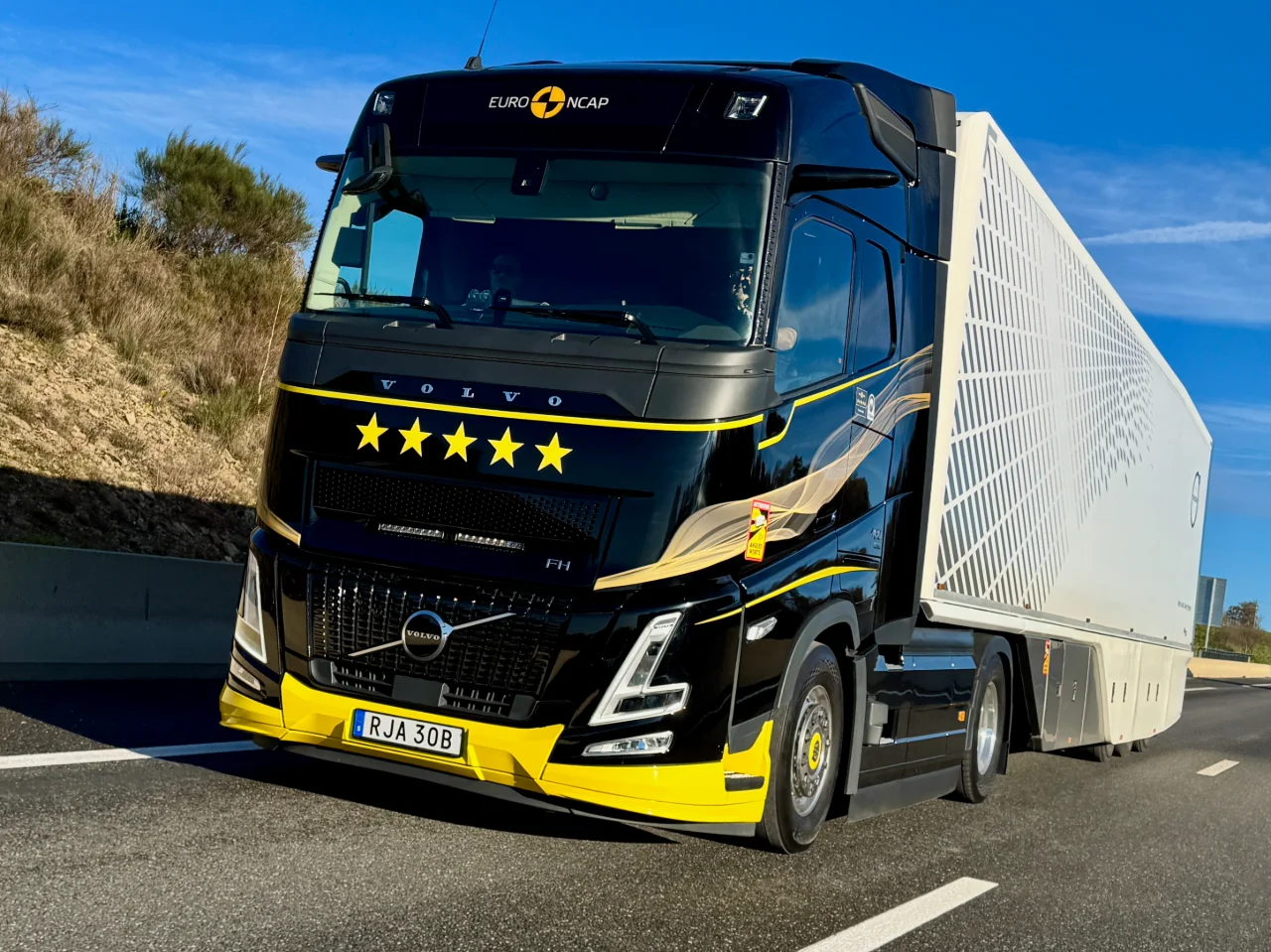
And clearly, it still has plenty to say. Today, Fabien Calvet takes the wheel of a Volvo FH Aero 460, a truck that, at first glance, seems very fleet-oriented… but actually hides quite a few interesting developments. New design, further optimizations, and above all a philosophy that remains true to Volvo’s DNA: efficiency, safety, and driving comfort.
All right, ignition on… fasten your seatbelts, it’s time to find out what this FH really has under the hood.
Before getting behind the wheel of this brand-new Volvo FH Aero in its 460 Turbo Compound version, let’s take a quick look at the design of our test vehicle. Five stars are on the agenda… but this time, they refer to the Euro NCAP rating, the most demanding European benchmark when it comes to vehicle safety. It’s worth noting that our Volvo is currently the only truck on the market to have achieved the maximum score.
While Volvo has long been synonymous with safety, the latest addition to its heavy-duty range once again proves that this value remains a true cornerstone of the Swedish brand’s DNA.
Inside the cab: unmistakably Volvo

Once settled inside the cab of this FH Aero, there are no surprises this is unmistakably a true Volvo. Let’s be direct and transparent: there’s no major revolution compared to previous generations. And honestly, that’s good news. A Volvo is well designed, logical, and drivers immediately find all the essentials of life on board, with perceived quality and ergonomics that remain benchmark standards.
Our test model here is a Globetrotter with a single bunk, but with a very high level of comfort equipment: coffee maker, microwave, leather upholstery, a quality mattress… everything you need to head out for a full week without hesitation.
You might not all have the chance to work for a boss who ticks every option box, but it’s worth knowing that these features are indeed available straight from the factory.
From a buyer’s perspective, choosing Volvo also remains a guarantee of strong resale value. Current used-truck prices clearly show that the FH is still a safe bet a secure long-term investment.
While the 460 may not be the most sought-after version (the 500 enjoys a solid reputation), its figures are enough to make you think twice, especially since the Turbo Compound version is far from being a lightweight contender.
A 460 full of surprises

Turbo Compound: what’s it actually for?

Let’s take a closer look at what the Turbo Compound system is actually used for. To keep it simple, without diving too deeply into technical explanations, it recovers part of the energy contained in the exhaust gases and converts it into mechanical force. Through a gear train, this force assists the rotation of the crankshaft.
In practical terms, on the D13 engine, this allows the truck to reach maximum torque much lower in the rev range and ultimately reduce fuel consumption. The result? You get the character of a much more powerful engine with “only” 460 hp in our test model.
So why was this system abandoned a few years ago? As you know, electronic applications have evolved tremendously. Today’s engine management systems bear no resemblance to those of fifteen or twenty years ago. The current level of precision and performance is simply exceptional, making it possible to fully exploit this kind of technology.
To put it clearly, achieving 2,600 Nm of maximum torque from a 460 hp engine is rare, if not impossible, without Turbo Compound.
That said, this system is not the truck’s only key asset. If the overall package works so well today, it’s because all the elements are perfectly aligned. And one of the biggest success factors undoubtedly lies in the major advances made in predictive cruise control and topography management systems.
Stage 1: Letting It Roll Free

On this first stage, there’s nothing particularly challenging about the route. We’re on the motorway, and there are clearly no major difficulties. The only real reference point at the start is the first climb after leaving the Toulouse Nord truck center.
We approach it at low speed, and within the first few meters, I notice that the truck pulls strongly from very low revs, a direct effect of the Turbo Compound system. Another observation at the top of this first ascent: the truck cuts throttle quite early and makes full use of its momentum. The rev counter stays at 500 rpm, our truck is now coasting. Volvo’s I-Roll system works flawlessly.
New on this truck, however, is something I’m experiencing for the first time: the “Stop & Go” system. What is it exactly? In simple terms, when the truck switches to coasting mode, instead of merely staying in neutral, it can go as far as shutting the engine off completely.

Yes, you read that right. The vehicle no longer simply rolls with the engine idling, it completely shuts the engine off when conditions allow (slight downhill gradient, stable speed, no immediate need for power). Momentum is then maximized, while the control units continuously monitor speed, topography, and distance to surrounding traffic. As soon as required, the engine automatically restarts and the transmission seamlessly re-engages drive without any jerk.
This precise energy management, made possible by advances in electronics and predictive strategies, significantly reduces fuel consumption on long-haul routes, without impacting safety or operational pace.
At first, it’s surprising, even unsettling. There’s a real sense of hesitation. And yet, it’s very difficult to detect exactly when the engine shuts off. The sensation is somewhat masked by the fact that the rev counter remains at 500 rpm, likely Volvo’s way of avoiding unnecessary concern for the driver.
Here’s a trick: display the oil pressure on the dashboard. When the pressure drops to zero, it means the engine is off. To get going again, there’s no need for a starter motor, the gearbox re-engages the optimal gear and drive returns without any noticeable interruption.
This refined use of coasting phases significantly reduces fuel consumption by limiting unnecessary engine operation while maintaining safety and driveline continuity. Believe me, the system is impressive.
At the end of this first stage, our truck posts very respectable figures, with an average fuel consumption of 23 l/100 km. Our Volvo ranks among the very best on this section.
Stage two raises the difficulty level

From the very start of the second stage, we face a succession of roundabouts and village crossings. At first, I decide to drive my own way, anticipating as much as possible to optimize fuel consumption: coasting before roundabouts and progressively getting back on the throttle on the exit, just as we all do.
Jonas, my Swedish demonstrator, then suggests switching on the new adaptive cruise control and letting the truck handle everything. I must admit that within the first few kilometers, I’m pleasantly surprised. Mercedes’ supremacy in this area is over: until now, only the brand with the three-pointed star had truly mastered interurban cruise control. Volvo is now stepping into the arena, and this new system delivers equivalent performance, anticipation, measured acceleration, braking when approaching roundabouts… The truck does the work; all you have to do is steer.
Of course, I can already hear your comments: what’s left for the driver? In reality, even if the execution is flawless, the reaction time remains slightly slower than that of a skilled human driver.
As with Mercedes, the system is very cautious and sometimes tends to overdo it, which can become frustrating in daily operation. The result? You might be tempted to switch back to manual control. Personally, I let it do its thing but I notice that we’re losing time compared to the competition. The stopwatch doesn’t lie. In Eco mode, the truck clearly prioritizes fuel consumption: acceleration is slow and certain climbs feel long. Let’s be honest, if you leave it in full auto, you’ll feel tempted to push it a little harder to pick up the pace.
Let’s talk about the Caylus section, a key moment of the route. It allows us to assess the vehicle’s braking capability on the long downhill stretch, and then its temperament on the uphill climb out of the village. On the descent, the truck isn’t equipped with a secondary retarder, only the VEB+ engine brake is available. This compression brake has already proven its worth, and on this stretch, it gets the job done.

The key is to start at the right speed otherwise, you’ll be forced to use the service brake. I set my speed, and the truck handles the rest. When the engine revs start climbing too high, the trailer brake kicks in to stabilize the whole combination and restore the effectiveness of the engine brake.
The result: I didn’t have to use the service brake at all. But let’s be honest, I would have felt more comfortable with a Voith retarder.
On the other hand, after leaving Caylus, things improve significantly. The Turbo Compound effect is immediately noticeable, with strong pull even at very low revs. It’s clear that the 2,600 Nm aren’t just figures on a spec sheet — they’re genuinely delivered to the wheels of this “small” 460.
During the final kilometers before reaching Rodez, I take a closer look at efficiency and fuel consumption.
The terrain’s topography doesn’t make things easy for the truck, and the hilly road profile sometimes puts the predictive cruise control system to the test. Personally, I find that in ECO mode our truck is too sluggish. It refuses to downshift to regain some punch, sticking instead to a very low-rev torque strategy. I’m not convinced this is the best compromise, especially since average speed clearly suffers climbing hills becomes a real struggle.
Upon arrival in Nuces, at the end of our second stage, average fuel consumption stands at 38 l/100 km, which isn’t that bad considering the area. However, time-wise, it’s a different story. Covering 121 kilometers in nearly two hours gives us an average speed of 62 km/h far from spectacular.
Now it’s time to see how the truck will perform on stage three.
Stage three brings the smile back!

After the mandatory break, we head back to Toulouse via the N88 toward Albi, then take the A68 toward the Pink City. As you know, this third stage is clearly a mix of motorway and national roads, although, to be fair, this part of the Aveyron department has evolved significantly in recent years.
Here, the truck once again makes use of freewheeling mode to see whether the “Stop & Go” system can still work its magic as it did during the first two stages. First observation: the phases during which the engine shuts off are now less frequent. Once again, this comes down to the topography. As mentioned earlier, we are often on downhill sections, meaning the truck needs to slow down, which requires the use of the engine brake. And yes, for the VEB+ to operate, the engine obviously needs to be running.
Under these conditions, the “Stop & Go” system simply becomes unusable.
It doesn’t really matter, I’d say, since during downhill phases the fuel injection is also cut off. In any case, it doesn’t significantly impact the overall average fuel consumption.
On this final section, I also notice just how effective our truck’s aerodynamics are. Here, I’m driving almost constantly between 80 and 90 km/h, the ideal playground for our Volvo Aero. The manufacturer claims a 3 to 5% improvement with this new cab, and in these conditions, I’m convinced we’re closer to 5%, given how effortlessly the truck seems to slice through the air.
By the time we reach our refueling point, it’s time to crunch the numbers. This third stage was merely a formality for the truck, and we’re coming in at under 24 l/100 km an excellent result!
Conclusion

At the end of this Occitanie route, the verdict is clear. With a total time of just over five hours to complete the entire journey and an average fuel consumption of around 30 l/100 km, this Volvo FH Aero 460 Turbo Compound delivers a solid, well-balanced performance that perfectly matches its philosophy.
Beyond the figures, what truly stands out is the level of comfort and safety. This is Volvo at its best: a relaxing cab, intuitive ergonomics, and a driving environment that immediately inspires confidence. On such a varied route, the truck never tires its driver and consistently maintains stable, reassuring road manners.
For me, the real turning point clearly comes from the new onboard technologies. Predictive cruise control that ranks among the very best, optimized coasting phases, ultra-precise engine strategies everything is designed to save fuel without compromising safety or driving smoothness. I must admit, I was genuinely surprised (almost shocked) the first few times I experienced the Stop & Go system. Seeing a truck completely shut off its engine while in motion takes some getting used to. And yet, after just a few kilometers, the system becomes so natural and seamless that most drivers will barely notice it anymore.
Ultimately, this FH Aero 460 TC doesn’t try to impress with sheer horsepower, but with its operational intelligence. A truck that prioritizes overall efficiency, capable of competing with more powerful models while maintaining controlled fuel consumption. Proof that today, in long-haul transport, performance is no longer measured solely in horsepower but in technology. In its 460 version, this FH clearly stands out as an ideal fleet truck. The only hope is that buyers tick as many options as possible when ordering, otherwise they risk ending up with an overly basic specification while Volvo offers, right from the factory, one of the finest cabins on the market.
Texte : Fabien Calvet Photos : Fabien Calvet et Nadège Cesse