WIESE and SAF-HOLLAND reinvent maneuverability for difficult access routes
A practical answer to real-world constraints
In timber transport, there is one reality that commercial brochures rarely mention: access. Narrow tracks, muddy roads, impossible crossings and off-camber maneuvers are part of everyday life, and those working in the sector know it all too well. On increasingly challenging sites, operators sometimes need to extract several dozen cubic meters of wood chips from isolated forest parcels. In these situations, maneuverability quickly becomes just as important as engine power. It is precisely on this issue that WIESE Fahrzeugbau and SAF-HOLLAND have decided to collaborate, developing a particularly interesting technical solution designed for the most demanding applications.
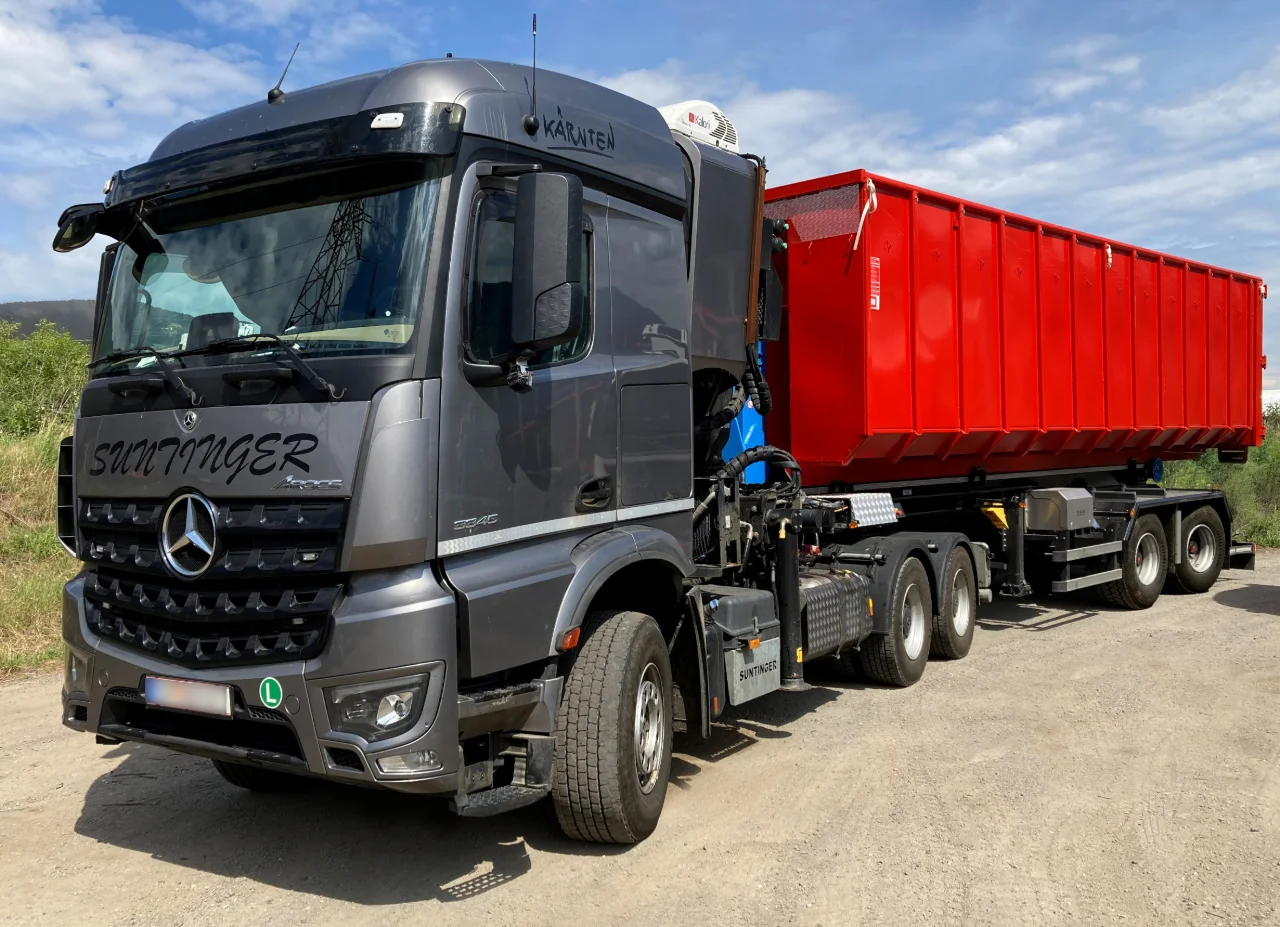
The concept is based on an unusual combination: a three-axle tractor coupled with a two-axle hook-lift trailer fitted with SAF forced-steering axles. Added to this is the VSE Advanced Steering electro-hydraulic system, which actively controls the trailer’s rear axles. On paper, this may sound like a technology reserved for highly specialized applications. In reality, it is exactly the kind of solution capable of completely transforming vehicle usability in environments where space is limited.
Two steering axles to completely change the behavior of the combination

The objective is simple: to allow the rear section of the trailer to follow the vehicle’s path precisely, even through very tight corners or during reverse maneuvers. Normally, on a conventional semi-trailer, fixed axles tend to cut corners aggressively and push the combination outward. In forestry, this often results in repeated steering corrections, tire scrubbing, damaged edges, or simply impossible passages—especially in mountainous terrain.
Here, both rear axles are actively controlled by SAF-HOLLAND’s steering system. Unlike passive systems often compared to a “shopping cart” principle, the wheels remain precisely steered both when driving forward and in reverse. The system continuously analyzes vehicle speed, steering angle and driving direction in order to instantly adjust axle orientation. Timber haulers will recognize the concept, as similar systems are already widely used for long-log transport.
Electro-hydraulic technology designed to remain easy to operate
All hydraulic and electronic management is directly integrated into the trailer, allowing the system to function without any complex mechanical connection to the truck. Power is supplied simply through a 24-volt connection from the tractor, and SAF-HOLLAND even offers an optional maintenance-free AGM battery system that recharges while driving.
This technical approach offers a major advantage: the system can be integrated relatively easily onto different types of trailers or specialized applications. This is therefore not just an isolated prototype, but a technology specifically designed for broader deployment across multiple sectors.
Technically, the VSE Advanced Steering system can manage up to three actively steered axles, with axle loads of up to 11 tonnes each. Depending on the chosen configuration, the system weighs between 160 and 470 kg. The entire package remains relatively compact and, most importantly, far easier to integrate than traditional mechanical steering systems.
The real advantage becomes obvious when reversing

In practice, the difference is immediately noticeable. On narrow forest roads, the trailer follows the vehicle’s movements precisely instead of “pushing” the entire combination outward. Maneuvers become significantly smoother, and steering corrections are greatly reduced.
This is particularly visible during reversing, often one of the most difficult aspects of operating this type of vehicle. The driver can maintain the intended trajectory much more easily, even in areas where available space is extremely limited. On tracks lined with trees or in temporary storage zones, this added precision represents not only a major time-saving benefit but also an important safety improvement.
Another direct advantage of active steering is the reduction of tire scrub in corners. Tires are subjected to less stress, reducing wear and also lowering rolling resistance. In operations where vehicles work daily on difficult terrain, this can quickly translate into meaningful economic savings.
A development validated directly in forestry operations
The vehicle was developed in collaboration with Austrian forestry operator Johannes Suntinger, who uses it daily on particularly challenging forest roads. After approximately two months of operation and nearly 2,000 kilometers driven on forest tracks, feedback has been extremely positive.
According to Suntinger, many roads are extremely narrow, and tight turns often present a major challenge with conventional combinations. Thanks to the two steering axles, the trailer follows the truck’s path precisely and makes difficult access routes much easier to negotiate.
This kind of real-world feedback is especially valuable, as it confirms that this technology is not merely a technical demonstration. It addresses a very concrete need encountered daily in specialized operations.
A solution that goes far beyond the forestry sector

Although this vehicle was developed specifically for forestry applications, SAF-HOLLAND sees much broader potential. Urban construction sites, public works, congested industrial zones, and certain specialized transport applications could all quickly benefit from this technology.
In any situation where maneuvering becomes complicated, active steering offers immediate advantages: fewer corrections, greater precision, and smoother operation. As access constraints continue to increase in city centers and on industrial sites, demand for more maneuverable vehicles is becoming more and more important.
And this is precisely where this type of solution could gain significant momentum in the years ahead.
A different vision of performance in specialized transport
This innovation also highlights an important shift in the heavy-duty vehicle world. Today, vehicle performance is no longer defined solely by fuel consumption or engine power. Its ability to work efficiently under difficult conditions has also become a true profitability factor.
In certain applications, saving time during maneuvers, reducing tire wear, and accessing difficult areas more easily can provide immediate economic benefits. In sectors such as forestry, where every minute lost on a forest track can quickly become costly, these gains make perfect sense.
Ultimately, this solution developed by WIESE and SAF-HOLLAND demonstrates that there is still room for genuine mechanical innovation in the world of specialized transport. Because a high-performing truck is not only one that consumes less fuel—it is also the one capable of going where others sometimes have no choice but to stop.
Text: Fabien Calvet Photos: SAF-HOLLAND