Paris – Berlin by electric truck: immersion with Milence
We often talk about electric trucks, and perhaps even too much sometimes for some of you. Range, batteries, power, driving comfort, weight, cost, acceptability… Everything is discussed. But on the ground, there is one question that always comes back before all the others: where do we recharge? Because today, that is the real question.
No need to overdo it, you already know it: today electric trucks are here, and all manufacturers offer them. Volvo, Renault, Mercedes-Benz, MAN, Scania and the others know how to make electric heavy trucks run, and before long the Chinese will also enter the game. For those who follow us, you know it, at TruckStop we have tested almost all of them except the IVECO, which is still a great mystery for me. You can find these tests in our videos, and you will see we have done every kind of terrain, with regional routes, on more demanding journeys, sometimes even in very severe weather conditions.
The electric truck is no longer a showroom model. It drives, it works, it delivers—today it is something spoken about in the present tense.
Yet one major issue remains: to move from the electric truck that “works” to the electric truck that can actually be “operated,” one essential building block is still missing: the infrastructure. And that is exactly the subject of this Paris–Berlin journey organized by Milence.
Milence, or when manufacturers put their hands on the plug

Milence, for those still discovering the name, is not a small operator that appeared out of nowhere. It is a joint venture created by three heavyweights of the heavy-duty world: Daimler Truck, the TRATON Group and the Volvo Group. In simple terms: Mercedes-Benz Trucks, MAN, Scania, Volvo Trucks and Renault Trucks are, directly or indirectly, around the table.
The objective is easy to understand, but much more complicated to implement: to develop a public charging network dedicated to electric trucks on the major European transport routes.
Dedicated to trucks, what does that mean? It means we stop pretending, as we had seen during some of our previous tests. We are not talking about a car charging station where you would have to arrive with a tractor-trailer, uncouple, maneuver, block three parking spaces, stretch a cable that is too short and hope nobody comes to complain.
We are talking about stations designed for full road combinations: wide access, logical circulation, charging without uncoupling, adapted parking spaces, available power, and on some sites, the facilities that come with it.
Because a driver charging for forty-five minutes or one hour is not just a cable plugged into a truck. It is a human being who must be able to drink a coffee, go to the toilet, eat, take a shower, sometimes wash his belongings. That is when we start talking about the reality of transport and not just nice speeches from people confined in offices.
Charging, the real key issue

On the electric tests we have already carried out, the observation was often the same. In regional operations, when you leave the depot, complete your route and come back to the depot in the evening, it can work. It can even work very well, provided the mission is properly sized. But for long-haul transport, for roaming operations, for someone who leaves from point A without necessarily returning to point A, the question changes completely. It is no longer enough to have a charger in the yard. You need a network. That is where Milence wants to enter the game. Its Power to Go Further Tour, between Paris and Berlin, aims precisely to demonstrate that a long-distance electric corridor is already possible. The announced journey covers around 1,000 km, with charging exclusively at Milence stations: Saint-Witz in France, Ghent and Maasmechelen in Belgium, Zwolle in the Netherlands, then Mogendorf, Kassel-Lohfelden and Vockerode in Germany. On paper, it is a line. On the ground, it is much more than that. It is the beginning of a network. And in transport, a network is what turns a good idea into a working tool.
Saint-Witz: plug in, and understand

The departure takes place north of Paris, at the Milence station in Saint-Witz. And there, immediately, you see the difference compared with improvised charging. You arrive with a road combination, you position yourself, you plug in. No need to uncouple. No need to make ten maneuvers. No need to wonder whether the truck will bother everyone else. The station is made for this. The procedure too is disarmingly simple. A card, a screen, a few instructions, the cable, the plug—and off you go. Those who still imagine charging as a mysterious operation will be disappointed: it is almost easier than filling with diesel. And as a bonus, there is no smell. The real change is time. You do not fill an electric truck the same way you fill a diesel tank, only a little longer. You therefore have to organize the break differently. But if charging takes place during a mandatory stop, if the power is available, if the site allows the driver to do something else during that time, the equation becomes much more interesting. That is what Milence is trying to demonstrate: Charging must not be a burden suffered, but an element integrated into operations.
The truck? A Volvo FH Aero Electric, but it is not the star

For this first stage, I take the wheel of a Volvo FH Aero Electric. A beautiful truck, familiar lines, Volvo environment, serious finish, silence on board, immediate torque. You find the FH DNA again, with that feeling of being in a familiar truck, not in a prototype—and you know it because we have already tested it on the road. This first-generation electric FH develops 490 kW, or around 666 horsepower, with three electric motors paired with the I-Shift gearbox. It is an architecture that allowed Volvo to be among the first to offer electric tractors in real operation. It is not yet the long-distance truck—but I am keeping that surprise for you, because I am going to Sweden in a few days, so the presentation should not be far away.
The new Volvo electric trucks will reshuffle the cards, but I will tell you more about that very soon. Let us return to our FH of the day. If, in terms of range, let us be clear, this first generation is not the champion of the category, the truck itself does the job. On the road, the FH is pleasant, smooth, powerful, easy. The predictive system works well, energy recovery quickly becomes a game, and the information available on board allows you to follow precisely what you consume and what you recover. But let us be clear: In this article, the subject is not to redo the complete Volvo test. The subject is what surrounds it. Because an electric truck, however successful it may be, is only worth what the ecosystem that allows it to work is worth.
Gand: charging enters industrial reality

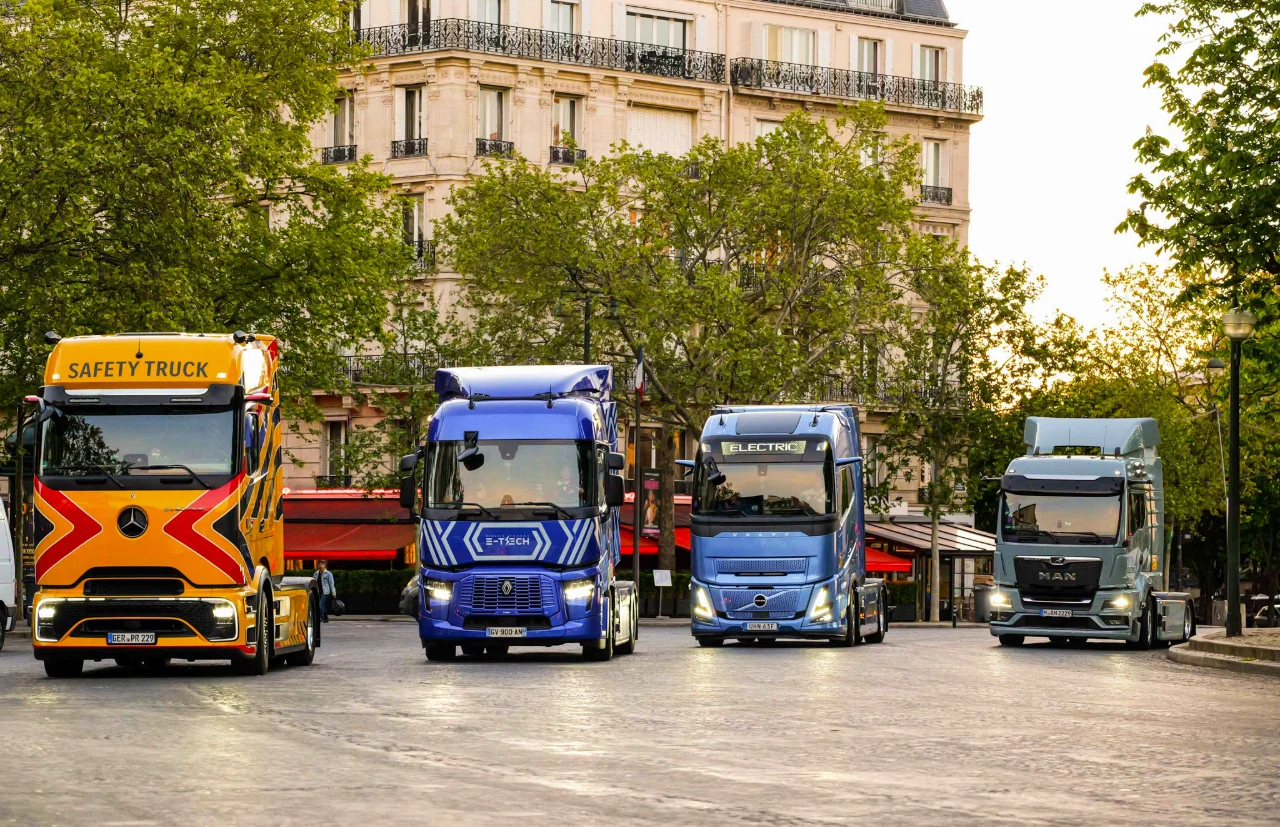
After the first stage toward Belgium, arrival in Ghent, near the Volvo factory. Once again, the symbol is strong. A Milence station installed near a major industrial site, open to everyone, and capable of welcoming several trucks. On site, four trucks from the convoy can position themselves and charge: Mercedes, Volvo, Renault, MAN. Each with its own characteristics, its own limits, its own accepted charging power.
And this is where we touch another essential point: not all electric trucks charge in the same way. Today, almost all vehicles still use CCS. Depending on the truck, the battery, the architecture, the actual power accepted varies. Some will take more. Others will limit earlier. And during this test, we were able to see the real differences live. Tomorrow, with MCS (Megawatt Charging System), we will move to another scale. And only the latest generations of trucks will be able to benefit from it. Milence is already announcing this transition. High-power charging already exists, and MCS is already available on certain European sites such as Antwerp, Zwolle and Landvetter. The objective is clear: To reduce downtime and make long-distance electric transport more credible.
Because in the end, everything is decided there. Staying two hours at a charging station is not viable for many operations. Charging strongly during a forty-five-minute break—now that is when things start to get serious.
The price of electricity, the other uncomfortable question

Charging is not only about a station and a cable. It is also about price.
And here, transport operators look at things very pragmatically. They do not only ask whether the truck can drive. They ask how much it costs per kilometre, how much it costs over a year, how much visibility they have over their energy costs, and whether the business model can stand up against diesel.
The Milence press release presents interesting figures: on this route, the estimated operating cost would be €0.995 per kilometre for electric, compared to around €1.00 per kilometre for diesel, according to the assumptions used. We are therefore looking at a comparable order of magnitude.
Obviously, these figures must be read with caution because we are talking here about Europe. They depend on electricity prices, tolls, taxes, the type of charging, the country crossed, the contract, and real operating conditions. But they show one thing: we are no longer in a purely ideological discussion. We have entered an economic discussion.
And that is far more interesting. A transport operator can hear about ecology, CO₂, Europe, and energy transition. But in the end, they still have to pay for their loans, their drivers, their energy, and their equipment. If electric becomes predictable, if the price can be contractualized, and if the costs become stable, then the subject becomes serious.
Corridors, not isolated charging stations

What Milence is building is not only stations. It is building charging corridors. The nuance is important. An isolated charging point can help out. A corridor allows planning. And in transport, planning is the foundation of everything. Milence announces 33 operational stations in eight countries, with several routes already under development: Paris–Amsterdam, Barcelona–Lyon–Paris, Antwerp–Stockholm, and Berlin–Stuttgart. The Paris–Berlin route fits into this logic.
We can discuss the pace, the number of charging stations, the still insufficient coverage, and the blank areas. It is also up to us to challenge political leaders who impose regulations without always considering the consequences. But we must also acknowledge that things are moving quickly because industrial players are changing the landscape. Two years ago, during a test between the Saint-Charles market in Perpignan and Rungis, charging sometimes felt like an expedition. You had to improvise, search, adapt, and lose time. Today, a Milence station exists right in front of Saint-Charles. That is not a detail. It is exactly the kind of change that can transform an operation.
Politicians must now follow
The second stage of the convoy leads toward Brussels. And there, the symbolism is obvious. Brussels is Europe. It is also where many of the rules, objectives, constraints, and support mechanisms are decided. The manufacturers have done their part: the trucks exist.
Operators like Milence are starting to do their part: the stations are arriving. But if we want to accelerate, public authorities will also need to follow. Electric grid connections, administrative procedures, permits, toll policies, taxation, investment support, and consistency between countries will matter just as much as the charging power displayed on the station.
We will not build a European heavy-duty charging network with procedures that take years. We will not achieve zero-emission long-distance transport if every country moves in its own direction. And we will not convince transport operators if infrastructure remains too uncertain.
That may be the most important message of this Paris–Berlin trip: the electric truck is no longer only a matter for manufacturers. It is a matter of ecosystem.
On the road, electric also changes the driving experience

Even if infrastructure remains the main subject, it is difficult not to say a word about the feeling behind the wheel.
On the motorway, at 88 or 90 km/h, let us be honest: a truck remains a truck. Diesel, gas, or electric, you move forward, stay in your lane, and manage traffic. But as soon as you approach urban areas, roundabouts, and entrances or exits from expressways, electric takes on another dimension. The silence, the smoothness, the absence of gear shifts, and the energy recovery all create a very different driving experience.
In the traffic jams of Brussels, another observation becomes obvious: when stopped, you consume almost nothing. No idling. No engine running for no reason. These are small gains, but over a day, small gains add up.
Weather matters too. Cold, wind, rain, and terrain all have an impact. But that is not specific to electric. A diesel truck also consumes more in poor conditions. The difference is that with electric, you monitor the range more closely because the charging network is still young. And that is precisely why the network must continue to grow.
Long-distance electric trucking is arriving faster than we think

The Volvo FH Aero Electric used during this journey already represents a first step. But the next generations will change the game. Volvo is announcing a new generation of electric FH trucks, with long-distance versions capable of targeting up to 700 km of range.
We are talking about architectures designed from the outset for electric: e-axles, more batteries, better integration, and higher charging capacities. Mercedes is advancing with its eActros 600. MAN is also offering highly modular solutions.
Renault Trucks continues its development and is also preparing to launch a new generation of long-distance electric trucks similar to its Swedish cousin. Finally, Scania is working on its own offers, with a concept similar to MAN.
Once again, we clearly see that industrial groups are optimizing research and development in order to move even faster toward the deployment of new trucks. In short, the market is getting ready for battle. Because this is only the beginning. And the upcoming arrival of Chinese manufacturers will change the game even more. Politicians wanted this transition, but did they really understand what is coming? You only need to look at BYD’s figures in the passenger car market to understand that a storm may soon hit the truck market as well. But that is another story.
Acceptance may come through real-world use

Let us return to electric trucks. And I know some people will get upset.
Every time we talk about electric, part of the comments section catches fire: “Never in a million years.” “It will never work.” “It is political.” “Long live diesel.” I hear them. And let us be clear: I am not an apostle of all-electric myself. I also drive diesel. I drive HVO. And I believe several solutions will coexist: electric, HVO, hydrogen, synthetic fuels, and perhaps others. But being passionate about trucks does not mean closing your eyes to what is coming.
It means observing, testing, understanding, criticizing when necessary, and acknowledging when something works. And what this Paris–Berlin trip shows is that electric is no longer just a showroom narrative. There are trucks. There are drivers. There are charging stations. There are routes. There are costs that are beginning to make sense. There are still limitations, of course. But above all, there is movement.
The real revolution will be invisible

In the end, the true revolution may not be the electric truck itself. It will be the infrastructure. The day a driver knows they can leave Paris and reach Brussels, Amsterdam, Berlin, Lyon, Barcelona, or Stockholm with adapted charging stations along the route, the conversation will completely change. Today, we ask: “Can we do it?” Tomorrow, we will ask: “Is it profitable for my mission?” And that is when electric transport will become mature.
Milence is not alone. And above all, it must not remain alone. There will need to be other operators. Other investments. Equipped depots. Shippers capable of offering charging during waiting times. Secure parking areas. Available electrical power. Simple regulations. And, ultimately, a grid capable of delivering the electricity, because that is another issue entirely. But what I saw on this Paris–Berlin trip was the beginning of a concrete answer to the question everyone has been asking for years:
Where do we recharge? The answer is not perfect yet. It is not everywhere. It is not yet sufficient for every mission. But yes, it exists. And for the electric truck, that may well be the first truly important turning point in its young career.
Text and photos: Fabien Calvet