Daimler Truck revives the hydrogen engine path with KEYOU
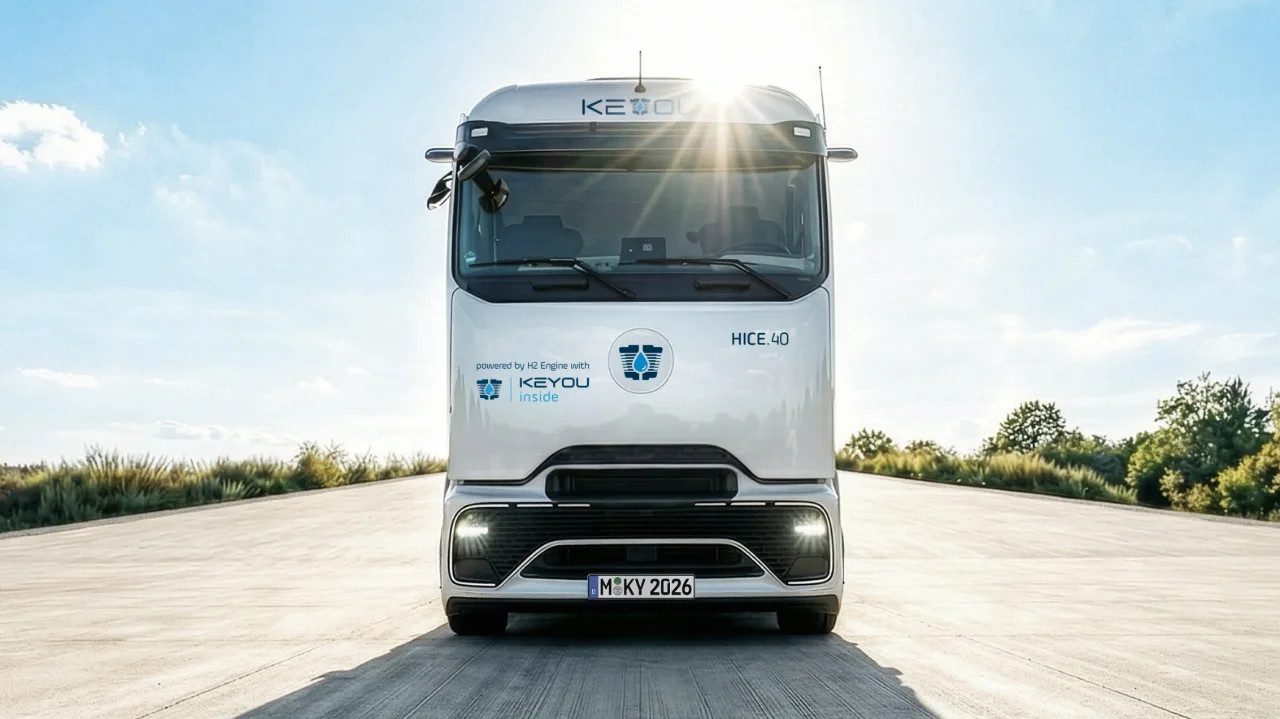
While most manufacturers’ communication on hydrogen has focused in recent years on fuel cell technology, Daimler Truck is bringing another technology back into the spotlight: the hydrogen-powered internal combustion engine.
The German manufacturer has just announced a strategic partnership with the Munich-based company KEYOU, a specialist in converting combustion engines to hydrogen. The objective: to commercialise hydrogen combustion engine trucks as early as 2027 in order to broaden the range of decarbonised solutions available for road freight transport.
The Mercedes-Benz Actros as a technical basis
Rather than developing a new dedicated platform, Daimler Truck is opting for a pragmatic approach. The future vehicles will use Mercedes-Benz Actros L 1848 tractor units equipped with the 12.8-litre OM 471 engine produced in Mannheim.
KEYOU will be responsible for converting these diesel powertrains to run on hydrogen. A strategy that allows the manufacturer to rely on proven components while reducing time to market.
For Daimler Truck, this cooperation also represents a way to accelerate the industrialisation of the technology without having to mobilise significant development resources on its own.
The KEYOU HICE.40 expected in 2027
The first concrete result of this alliance is the KEYOU HICE.40, a 40-tonne tractor unit scheduled for commercial launch from 2027.
According to the data communicated by KEYOU, the vehicle will develop up to 350 kW and will be able to travel up to 650 kilometres thanks to compressed hydrogen tanks operating at 350 bar. This range targets regional missions and certain long-haul applications.
Commercialisation will be handled by KEYOU, potentially in connection with the development of refuelling infrastructures supported by the German public authorities.
A third path between battery and fuel cell
With this announcement, Daimler Truck confirms its multi-energy strategy.
The manufacturer continues to focus on battery-electric trucks for the most predictable uses, while pursuing the development of hydrogen fuel cell technology for long-distance operations. The hydrogen combustion engine now complements this portfolio.
The interest of this technology lies in its relative simplicity. It makes it possible to retain an architecture close to current powertrains, reuse part of the existing industrial tools and limit the adaptations required on the vehicles. It also offers the advantage of preserving payload capacity thanks to the compact integration of the powertrain.
A bet on the growth of hydrogen
Beyond the technological aspect, Daimler Truck is sending a clear message to the market: hydrogen is not limited to fuel cells.
The manufacturer believes that the coexistence of several solutions will accelerate the decarbonisation of road transport while addressing the growing constraints of the European electricity grid. According to the group, the parallel development of electric and hydrogen infrastructures could offer greater flexibility to transport operators and shippers.
The challenge now is to convince transport operators. The success of this new generation of trucks will depend as much on the competitiveness of the vehicles as on the availability of low-carbon hydrogen at an acceptable cost and on a sufficiently dense distribution network.
One thing is certain: while many considered the hydrogen combustion engine to be a transitional technology, Daimler Truck and KEYOU intend to give it a genuine industrial dimension.