The Battle of the Titans
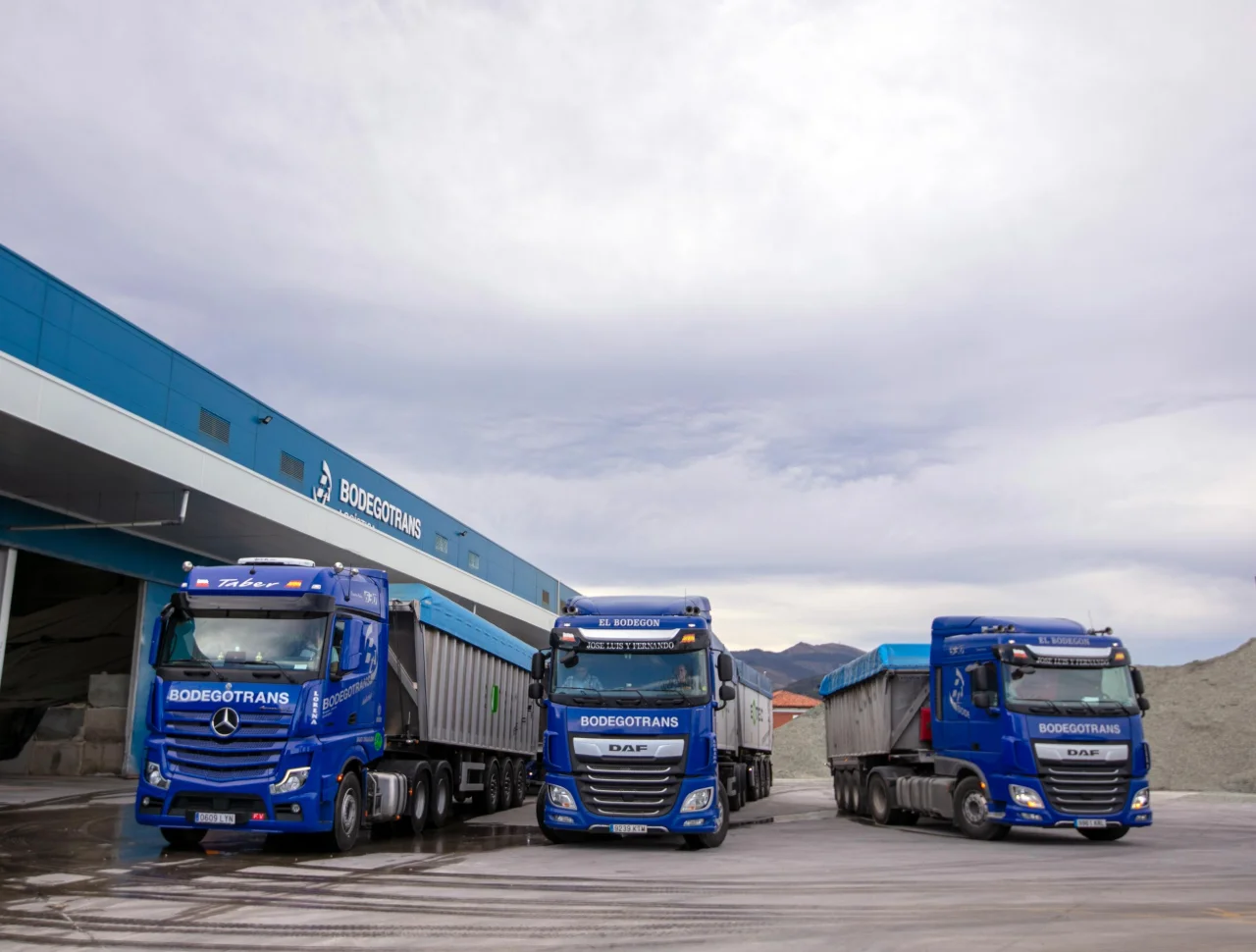
The resistance they have generated since their appearance on Spanish roads in 2016 notwithstanding, high-capacity trucks are now well established and are here to stay. Their efficiency, profitability and level of polluting emissions per unit of transported load are indisputable. With this field test, our Spanish colleagues highlight their qualities but also the disadvantages of each configuration. An example to reflect upon in France, where anti-truck lobbies are still opposed to these new solutions that could, in certain cases, optimise transport flows.

Since the appearance of the internal combustion engine, the progress of road transport has been unstoppable. The flexibility, speed and economy of the truck have also undergone technological development in all their aspects, to the point that, in the 1970s, they almost completely replaced another traditional means of transport such as the railway. At the same time, and as the reliability and power of diesel engines increased, load capacities followed a similar evolution. Whereas two-axle trucks were common in the 1930s, 1940s and 1950s, the 1960s saw the proliferation of rigid and articulated vehicles offering load capacities of 20 to 25 tonnes.
Mega trucks are the latest stage in this relentless race for efficiency, making them an even more profitable and functional tool for trade and industry.
Suitable infrastructure: this is one of the arguments most frequently put forward by opponents of “mega trucks”. However, this fear is unfounded. Spain has the largest motorway and expressway network in Europe. While Spain has around 17,000 kilometres of high-capacity infrastructure, Germany offers around 15,000 and France only 11,000.

But the advantage of the Spanish road network is not limited to its size: its topography is also highly favourable to the use of large combinations. The vast plains of Spain’s central plateau constitute ideal terrain for these trucks, apart from a few mountainous areas where their performance may be called into question. In short, Spain is an environment very well suited to these XXL trucks.
However, difficulties remain in logistics areas because warehouses, weighbridges, as well as loading and unloading areas, are not yet really designed for these giants. A point that can slow down operations, but it is only a matter of time before the logistics system and customers adapt, as has happened in other countries such as Scandinavia, which is very advanced on this issue.

Regarding the secondary road network, which is mainly used to access loading and unloading points, the situation is similar. Spanish national and regional roads, apart from a few black spots, are perfectly suited to this type of truck. The total length of the vehicle actually has a limited impact on its road use.
With these data in hand and given the positive economic prospects, it is not surprising that mega trucks have been successfully adopted in the Iberian Peninsula.
The configurations of these combinations vary in terms of axles (more than six), power (more than 500 hp) and towed vehicles. The maximum length is 25.25 metres for the mega trailer and 31.75 metres for the duo trailer, the latter having started its trials in 2017 and now being fully integrated. The gross combination weight is limited to 60 tonnes for the mega trailer and 70 tonnes for the duo trailer.

Another subject of debate is the fear that these new combinations will replace traditional trailers. However, this is not the case: many missions remain incompatible with their use, as has been observed in the countries where they are established. There are still far more conventional articulated trucks than “megas”. Large combinations will therefore be reserved for bulk freight transport, heavy loads and parcel shuttle services, but they will remain absent from the “last mile”.
We must not hinder progress. Just as today’s trailers did not make two- or three-axle trucks disappear, large combinations will only complement the offer for customers.
A demanding task. The driver’s workload is heavier than for a conventional truck, partly because of the lack of adaptation of logistics and loading points. The dimensions of the facilities force the driver to couple and uncouple several times in order to load and unload.
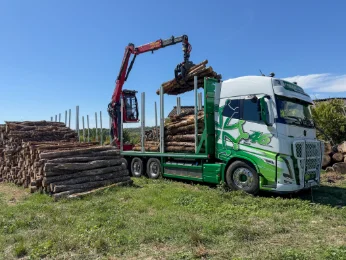
For this comparison, we used trucks equipped with tipping trailers from the company Bodegotrans, specialised in solid bulk transport.
Working with a duo trailer involves repetitive uncoupling and reassembly manoeuvres, which is very demanding for the driver. By contrast, the mega trailer, although complex, has a simpler system to operate.
The conventional vehicle, on the other hand, simplifies everything: it is enough to open the tarpaulin and release the safety mechanism to unload.
In summary, mega trucks offer undeniable efficiency but require a suitable environment and a qualified workforce.
The details of our test
The test was carried out on a 622 km route between Torrelavega (Cantabria) and Peñaranda de Bracamonte (Salamanca), and back, alternating motorways, national roads and serious gradients (up to 7%).
Exceptional Comparison: Duotrailer vs Megatrailer vs Conventional Tractor Unit
The duel of the giants of Spanish road transport in a full-scale test.
Since the experimentation of Duotrailers on Spanish roads in 2016, the debate has been raging: productivity gains, reduction of the carbon footprint, or a logistical monster that is difficult to handle?
To see things more clearly, TruckStop attended an exceptional comparative test organised by Bodegotrans, a key player in Iberian transport. The objective? To determine, with figures to support it and on a realistic route, which configuration offers the best overall performance, both economically and practically, without forgetting the human factor. Perhaps a future source of inspiration for France?
Three giants put to the test:
• ⛽ Mercedes Actros 2863 Duotrailer: 625 hp, 70 t GCW, 27 m combination • ⛽ B-Double Megatrailer with DAF XF530: 530 hp, 60 t GCW, 21 m combination • ⛽ Conventional DAF XF530 Tractor Unit: 530 hp, 40 t GCW, standard combination
The test ground: a 622 km round trip between Torrelavega (Cantabria) and Peñaranda de Bracamonte (Salamanca), including all road profiles: motorways, secondary roads, mountainous areas, several 7% gradients and urban sections. A demanding itinerary, designed to reveal the qualities – and defects – of each combination.
Duotrailer: The Titan of Long-Distance Freight

With its 70 tonnes at full load, this colossus with two semi-trailers is the champion of high-volume transport. It can carry up to 47 tonnes of cargo, almost twice as much as a conventional combination. It is the perfect tool for dense long-distance flows, with enormous potential in terms of decarbonisation if properly utilised.
Strengths
- Excellent stability even on descents or in tight corners
- Optimal traction thanks to its 625 horsepower
- Good road holding despite its length
- Reduction in the number of trips required for the same load
Weaknesses
- Complex manoeuvres, particularly at loading docks or in urban areas
- Requires highly qualified drivers trained for Duo combinations
- Longer loading times due to successive uncoupling operations
- Restricted access to certain roads or logistics platforms
Key Figures
- Average fuel consumption: 51.28 L/100 km
- Net profitability ratio: 7.45
- Average speed: 62.8 km/h
Megatrailer: The Balance Between Capacity and Agility

The Megatrailer, with its more compact configuration, focuses on manoeuvrability without sacrificing too much transport capacity. It allows the transport of 39 tonnes of payload while being easier to integrate into conventional logistics flows.
Strengths
- Good road holding, even in tight corners
- Easier to manoeuvre than the Duotrailer
- Ingenious retractable fifth wheel facilitating uncoupling
- Wider access to loading docks and platforms
Weaknesses
- Slightly heavier than the conventional tractor unit when empty
- Less suitable than the Duotrailer for ultra-dense flows
- Requires a driver familiar with the B-Double configuration
Key Figures
- Average fuel consumption: 47.43 L/100 km
- Net profitability ratio: 6.99
- Average speed: 63.2 km/h
Conventional Tractor Unit: The Historical Benchmark Still Efficient

In this comparison, the standard tractor unit shows that it has not said its last word. With its excellent power-to-weight ratio (13.25 hp/t), it proves to be particularly agile and economical. A true logistical chameleon.
Strengths
- Low fuel consumption and reduced carbon footprint
- Highest average speed of the test
- Great logistical flexibility
- Simplicity of operation and maintenance
Weaknesses
- Lower transport capacity (26.3 tonnes of payload)
- Higher logistics costs per transported tonne
- Less suitable for long-distance operations with tight flows
Key Figures
- Average fuel consumption: 34.16 L/100 km
- Net profitability ratio: 6.66
- Average speed: 64.2 km/h
The TruckStop Verdict: Giants with Very Distinct Profiles
Each configuration has its specific advantages:
- The Duotrailer is unbeatable in terms of raw performance per tonne, making it ideal for constant flows between platforms. However, it requires a well-established logistics organisation, suitable infrastructure and a highly qualified workforce.
- The Megatrailer represents an ideal compromise for transport operators seeking to optimise their payload-to-consumption ratio without disrupting their logistics operations. It can be integrated into many existing operations.
- The Conventional Tractor Unit remains the king of versatility, perfect for diversified routes, urban areas or intermodal missions. Its simplicity of use and reliability make it a safe bet.
In a context where the energy transition, access restrictions to city centres and economic competitiveness are redefining transport priorities, choosing the right combination becomes strategic.
And as we say at TruckStop: every road has its tool, every mission has its mount!
Text : Alberto Puerta, Fabien Calvet Photos : Juan Caraballo