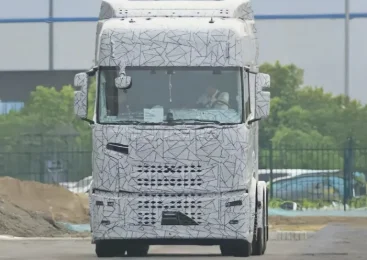
Mercedes puts construction trucks to the test without abandoning diesel
Forty-two degrees in Germany, dust, tipper trucks, concrete mixers and, above all, a fine selection of trucks to get behind the wheel of. Mercedes had clearly prepared a big day dedicated to its construction vehicles. Let’s be clear: no revolution, but tangible developments in both electric and diesel models. And one thing is certain: the three-pointed star has not lost its DNA in the construction sector.
Before starting these tests, I have to be honest with you: although we were here to get behind the wheel, we were not here to do trial driving. The ground was dry and the challenges were more than reasonable, a walk in the park for this type of truck. And I prefer to be clear: personally, I was a little frustrated that we did so little!
The eActros 400 expands its range of applications

Before leaving the tarmac, our first stop was in front of the eActros 400. We had already discovered it with the 2.30-metre cab designed for regional distribution. It is now available with the large ProCabin, known from the eActros 600. The philosophy remains simple: around 400 kWh of batteries, meaning less capacity and range than the eActros 600, but also less weight and a more accessible price. For parcel delivery, journeys between sites or routes with known charging points, this configuration may make sense. It also offers more possibilities for installing an electric power take-off, a hydraulic unit, a tipper body or other equipment. Mercedes is therefore building an electric range covering very different tasks, without locking customers into a specific cab or configuration.
Molsheim, French expertise in heavy transport
Another detour before the tests: the impressive SLT models based on the Actros or Arocs. Designed for exceptional loads, they can pull, push and accommodate up to five or six axles. And here, too, I’ll be clear: this is my favourite model in the three-pointed star range. The truck leaves the Mercedes factory in Wörth and then heads to Molsheim, where French expertise comes into play: adding axles, relocating tanks, cooling the hydraulic system and completely redesigning the rear section. Virtually everything can be adapted. The main limitation seems to be the size of your wallet. This bespoke work deserves a visit, which we will be making very soon, because I really want to show you this world of tailor-made solutions in a video.
The eArocs 400 moves onto the construction site

The real new feature of the day was the eArocs 400 in an 8x4 configuration, tested first as a tipper and then as a concrete mixer. Unlike the road-going eActros, it does not use an eAxle. Mercedes retains conventional drive axles, similar to those on the diesel versions, but replaces the combustion engine and its gearbox with an electric motor-gearbox unit supplied by equipment manufacturer ZF.
The combination works particularly well. The vehicle we tested delivered 380 kW, or just over 510 hp, with torque available immediately. The driving environment remains that of a conventional Arocs. The same seating position, the same controls and the same differential lock management. Only the dashboard information changes. A driver coming from a diesel model therefore does not have to relearn their job. With just three gears, the transmission makes you almost forget everything else. Second gear was sufficient for most of the test; first gear allows the truck to move forward very slowly. Gear changes are barely perceptible, and manoeuvres are smooth. Let’s be honest: in this exercise, the electric model is even smoother and more precise than a diesel equipped with a 12-speed gearbox. You control the truck with the accelerator, it moves forward to the nearest millimetre, and the torque comes in without any harshness. The only noise heard in the cab came almost entirely from the air conditioning, running at full power because of the heat.
Batteries positioned behind the cab
On this type of truck, Mercedes groups the battery packs behind the cab. This keeps them protected from obstacles, avoids reducing ground clearance and distributes their weight between the front axles of the 8x4. The sides of the chassis therefore remain available for the accessories required for bodywork installation. On the vehicle tested, the two packs weigh around three tonnes, to which the rack must be added. Once the diesel engine, gearbox and conventional transmission are removed from the equation, the actual loss of payload would be around two to two and a half tonnes.
This disadvantage exists, and there is no point denying it. But it also depends on regulations and the exemptions granted to electric vehicles. Until the rules are harmonised across Europe, manufacturers and hauliers will have an additional problem to manage. In France, however, rigid trucks of this type are allowed to exceed the legal 32-tonne limit.
A range suited to certain applications
Mercedes-Benz Trucks announces a range of around 250 km for the tipper and closer to 200 km for the concrete mixer, whose drum also consumes energy when operating. This is obviously not a long-haul truck. But let’s also be clear: how many tipper trucks and concrete mixers actually travel more than 200 km in a day when working around a city or a concrete batching plant? For these applications, particularly in urban areas, electric power can find its place. The concrete mixer illustrates one of its advantages: when stationary, there is no longer a diesel engine running for an hour to turn the drum. For the driver, local residents and construction teams, the silence changes working conditions.
Energy recuperation during braking also provides a benefit, although in the city you will not necessarily gain a great deal from it. On the other hand, there is nothing to prevent us from imagining charging points being installed one day at concrete batching plants or on large construction sites, making use of waiting periods. All this will need to be verified in real-world operation, but the solution makes sense.
The concrete mixer surprises at 32 tonnes

The concrete mixer version we tested weighed 32 tonnes on the scales. Paradoxically, it proved more comfortable than the lightly loaded tipper: these Arocs chassis are designed to work with weight, and their behaviour improves when they are operating at their intended weight. Mercedes adapts the axles to the task: hub reduction gears for the tipper, which is subjected to severe operating conditions, and conventional hypoid axles for the concrete mixer. Customers configure their vehicles according to their work, but here we did not really have the opportunity to put them through their paces.
Going uphill, despite the load, the eArocs makes progress with astonishing ease. For the sceptics, I must nevertheless say that electricity works wonders. Reversing up the slope, the pedal allows the movement to be controlled with exemplary precision. The MirrorCam system adds a programmable reference line: once the truck’s length has been recorded, you can position it to within a millimetre of a unloading area. I am one of those who sometimes remain sceptical about the accumulation of screens and driver assistance systems, but when technology provides such practical help, it would be dishonest to claim that it is useless.
The 6x2 with a steering axle: agile, but no magician
Mercedes then handed us the keys to a diesel Arocs 6x2 equipped with a multi-skip loader and a liftable, steering rear axle. Nothing groundbreaking here, just a fairly standard configuration. The purpose of the demonstration was to show the third steering axle, which reduces the turning circle. With this active steering axle, the truck retains almost the same turning circle as a 4x2. To prove the point, if I deliberately lock this axle, the turning circle increases by around two metres. Believe me, as someone who frequently drives a fairly similar truck, the difference is considerable and also reduces tyre wear.
Another point I must make clear: when it comes to traction, a 6x2 will never replace a 6x4 on difficult terrain. Traction remains its weak point in challenging conditions.
If you need more traction, you will therefore have to raise the axle to transfer the weight onto the drive axle. By using the automatic brake hold function, I was nevertheless able to get out smoothly from a situation in which the truck was spinning its wheels. The electronics do not turn it into a 6x4, but they help.
The TRC remains an impressive speciality

Another diesel truck, but running on XTL fuel, was a 530 hp Arocs 6x4 equipped with the Turbo Retarder Clutch, Mercedes’ famous TRC. This system is not new, as it has already been around for ten years, but it continues to be improved and remains formidable for exceptional-load transport, timber trucks and demanding construction work.
Installed between the engine and gearbox, the TRC replaces the mechanical clutch with a hydrodynamic system. On a slope, all you need to do is accelerate to move forwards or backwards, then release the pedal to stabilise the truck. No braking, no jerking and virtually no risk of putting excessive strain on the clutch. I was able to stop the truck halfway up a slope, engage reverse, pre-load the system and then set off in the opposite direction with astonishing ease. It is precise, smooth and almost unreal considering the weight being moved. The option is expensive, but for the professions that need it, its effectiveness is beyond question. Personally, I dream of having one in my forests.
From a genuine 6x6 to an almost luxurious construction truck
The 3348 6x6 we tested next operates in a different category. Here, there is no temporary hydraulic assistance on the front axle, but a genuine drive axle, a propeller shaft and a transfer gearbox. The first position engages the inter-axle differential lock, the second locks the rear axles, and the third genuinely turns the truck into a six-wheel-drive vehicle capable of going almost anywhere.
However, the terrain clearly did not allow us to explore its capabilities, and it is even pointless to provide such a truck without the right playground to test it. I would rather say so than pretend to have carried out an extreme test over three bumps. Nevertheless, we know that a genuine 6x6 remains irreplaceable when construction sites become challenging.
Finally, to round off these Arocs driving experiences, we discovered a different atmosphere with a special-edition Arocs 3253. Here, we find leather, carbon-fibre-style inserts, a refrigerator and an anthracite-grey finish. Almost a long-haul truck dressed for the construction site, with 530 hp under your foot to make you feel proud behind the wheel.
The Unimog: 80 years old and still indispensable

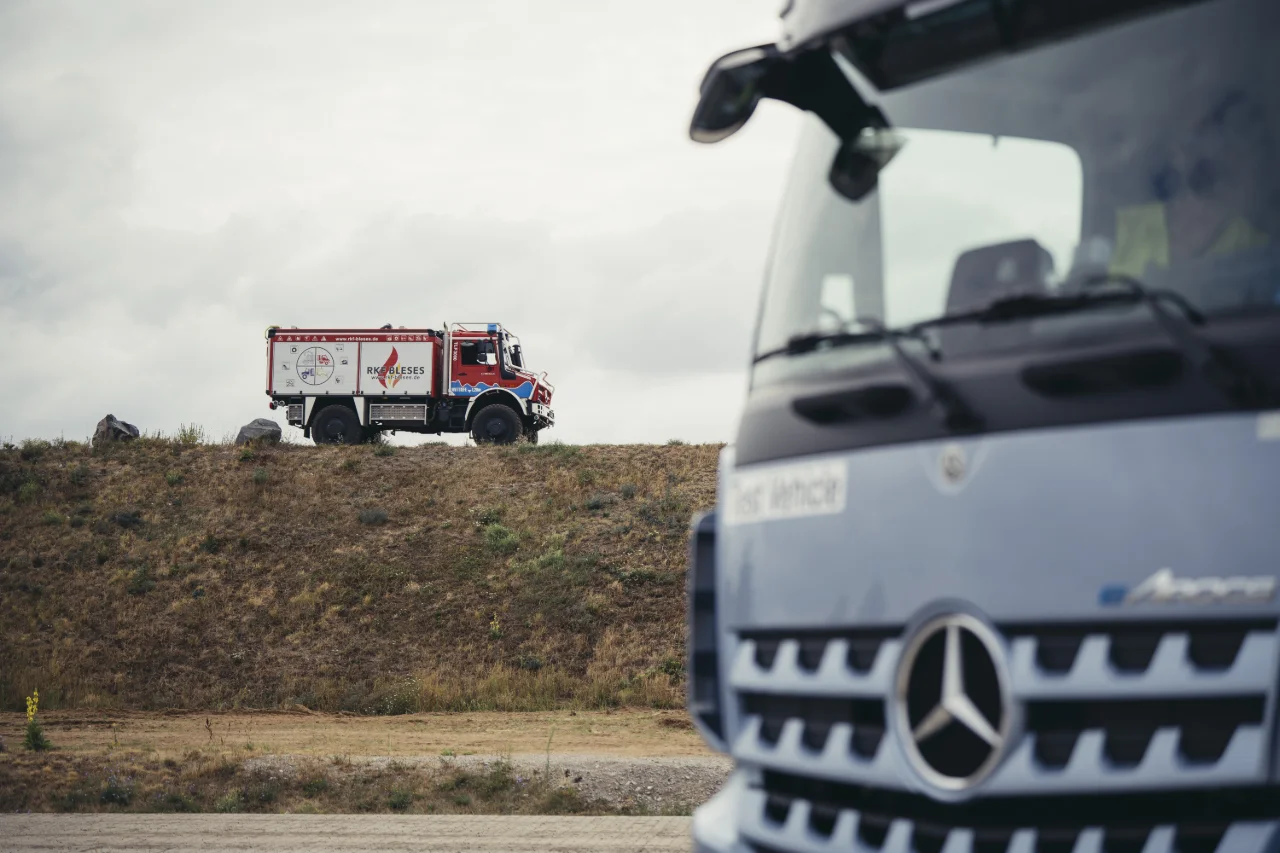
It was impossible to end this day without getting behind the wheel of a Unimog, which celebrates its 80th anniversary in 2026. It is also an opportunity to pay tribute to professional firefighters, volunteers and everyone involved in tackling the severe fires that occurred in France last summer. Whether as a forest-fire tanker or an emergency response vehicle, the Unimog remains a tool in a class of its own. Automatic engagement of the axles, electronic assistance systems and off-road capabilities: today's models have come a long way.
In France, it remains one of the mainstays of firefighting. Elsewhere in Europe, it can be found dealing with floods or carrying out specialised missions. After eight decades, it can still do almost anything.
Electric power is progressing, diesel continues to improve
What should we take away from this day? First of all, electrification is gradually making its way into the construction sector. It will not meet every operational need and still represents only a very small share of the market. Range, weight, price and infrastructure remain very real obstacles.
However, for certain urban operating cycles, particularly for tipper trucks or concrete mixers that regularly return to the same location, the proposition is becoming credible. The eArocs is not trying to reinvent the construction truck: it retains its controls, axles and operating principles, then replaces diesel with a particularly smooth electric powertrain.
At the same time, Mercedes continues to refine its combustion-engine solutions. Steering axles, differential locks, traction assistance, TRC and driving systems are becoming increasingly precise. Construction trucks are evolving into increasingly sophisticated tools, with the advantages and sometimes the constraints that this entails.
I have not become an electric-vehicle activist after this day. But I will not deny what I experienced behind the wheel either: the silence, smoothness, precision and immediate torque bring something new. The real verdict will come when these trucks are working daily for hauliers. TruckStop will, of course, be there to report on them without filters.
The full video report of these Mercedes tests is available on the TruckStop app, which can be downloaded free of charge to your smartphone. There, you will discover the vehicles in action, the manoeuvres, the technical explanations and my impressions directly from the field.
Text: Fabien Calvet Photos: Mohamed Belmokthar and Fabien Calvet