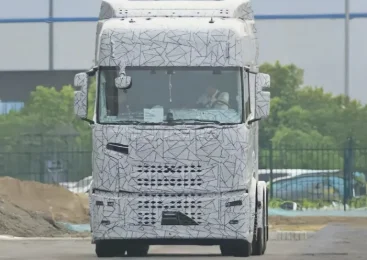
50 Years of ITOY – 2020 Mercedes-Benz Actros

Daimler announced the New Actros at the IAA Exhibition in Hanover in September 2018, ushering in the era of digital mirror cameras. The fifth generation of the Actros – known as the MP5 – had plenty of time to cement itself in the judge’s minds prior to being awarded the IToY award for 2020 at the Solutrans Exhibition in Lyon in November 2019.
In testimony to the enduring reputation of the Actros, the 2020 victory was the fifth time that the vehicle had triumphed, with each generation of Actros being voted as an IToY since the original version’s success in 1997. In 2020 the runners-up were the Iveco S-Way and Volvo’s FH with I-Save.
Despite the eight-year period since the Actros’s last IToY win, the model still looked modern in the contemporary scene, and the stylistic changes made for the new model were relatively minimal. Aside from the replacement of the conventional mirrors with MirrorCam, the headlamps were re-designed to feature a strip of LED daytime running lights above the main lamps.
The eleven cab variants spanned the CompactSpace M-cab up to the GigaSpace L-cab, and power was drawn from the 7.7-litre OM 936, 10.7-litre second generation OM 470, 12.8-litre second generation OM 471 and the 15.6-litre OM 473 which offered 18 power ratings over a span of 238hp to 625hp. The only new mechanical driveline component was the R440 rear axle with active lubrication system for lower friction losses.
In keeping with the Actros tradition, the MP5 was designed with the latest technology to minimise fuel consumption and total cost of ownership and maximise driver comfort and safety. The truck was the first in production to feature mirror cameras, and although conventional mirrors remained an option, the cameras offered improved visibility to the rear with digital panning and in the A-Pillar area, and were soon adopted as a feature across the industry. The aerodynamic benefits of the reduced protrusions were claimed to reduce fuel consumption by 1.3%.
The twin 386mm-deep camera screens were part of the “Multimedia Cockpit” which also comprised two 260mm diagonal screens, one replacing the conventional instrument cluster, and the other dedicated to the infotainment system, temperature and telephony. The screens could be navigated with touch-control buttons on the multi-function steering wheel. The optional interactive cockpit provided a larger screen with a navigation system and remote control of some vehicle functions by smart phone. A keyless starting system and a new electronic parking brake with holding function and automatic activation when the engine was stopped were also included.
Active Brake Assist 5 was the fifth generation of the driver assistance system and could carry out full stops in response to stationary and moving objects and pedestrians, and Predictive Powertrain Control became standard and was extended to include A and B roads. The system used route topography to recognise driving situations and monitor the truck’s kinetic energy.
The new Active Drive Assist system was offered on some New Actros variants, and this enhanced proximity control with active lane-assistance through enhanced radar and electrically-assisted steering. The new system achieved Level 2 Automation – where the vehicle can control steering and speed whilst a human driver remains responsible.