Rescuing a legend
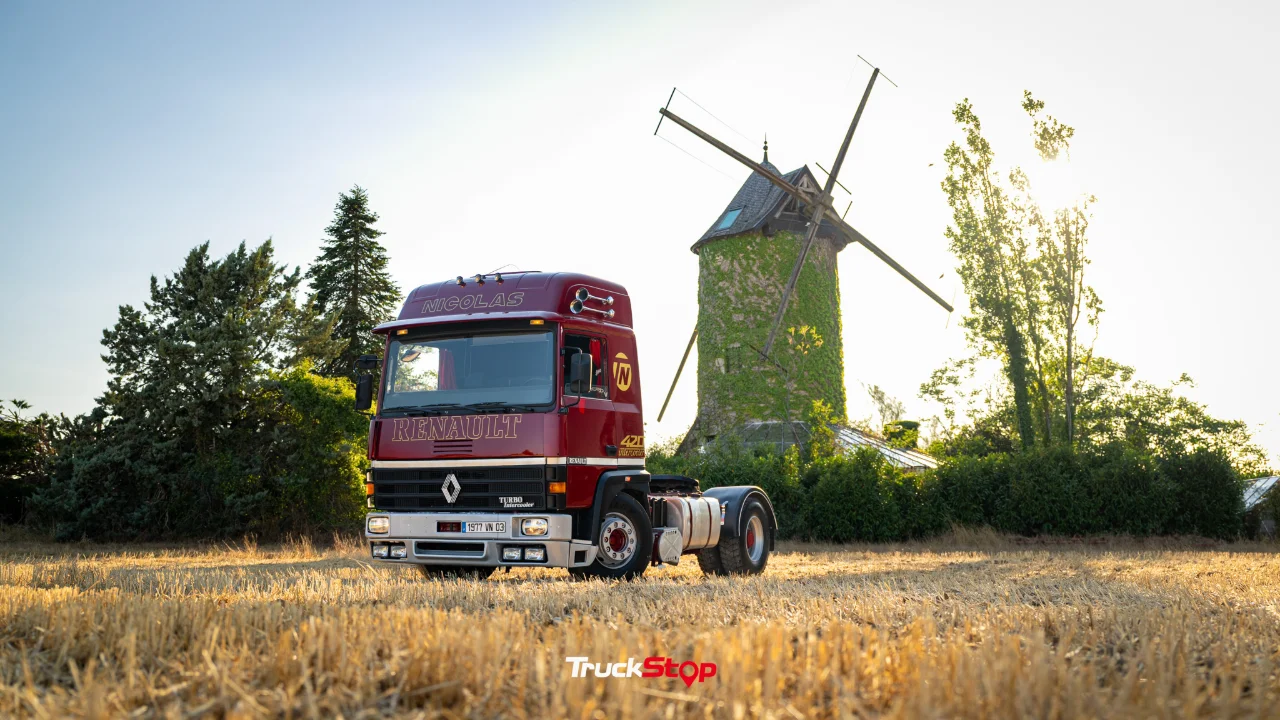
Recovered in June 2021 by a haulier from the Allier department and his father, it nevertheless regained all its former glory thanks to a restoration lasting around a year, carried out with Faurie Renault Trucks Moulins.
Behind its paintwork and historic Transports Nicolas livery now lies much more than an old truck: a piece of local road transport heritage.
It all began at a village festival, with a meeting between two men and one very simple question: what had become of the Renault R420 that once operated in the department?
At that moment, nobody could have imagined that the answer would lead to the complete preservation of a truck more than thirty years old. A vehicle marked by years of hard work, with corrosion caused by several years spent standing still. Yet this R420 had something more valuable than immaculate condition: a genuine history.
For Clément MICHARD, this restoration was not simply about bringing an old Renault back to life. It was about preserving a childhood memory, paying tribute to local transport and passing on part of French road transport know-how.
Transport as a family story

Before telling the story of the R420, we first need to look back at the journey of its new owner. After completing a vocational qualification and then a vocational baccalaureate in transport, he began his career as an employed driver. He drove for a haulier for two years before taking the next step in 2009, setting up his own business with his father.
His father’s presence is essential throughout the story. The restored truck was not a vehicle they happened to discover in an advert. It was a truck they already knew and had seen operating in the Allier. “When I was a kid and went out with my father, I already used to see this truck. For me, it represents a part of local transport that we have managed to preserve.”
The connection with the R420 was renewed several years later when they met an acquaintance of Clément’s father at a village festival. The conversation turned to the truck and what had become of it.
The vehicle was initially supposed to leave the region. Its owner ultimately chose to favour a local handover so that it would remain in the Allier. For the family, the opportunity was too good to miss. The R420 could continue its story where it had spent a large part of its working life.
A 1989 Renault R420 V8
The truck is a Renault R420 V8 first registered in 1989. Its exact history remains difficult to reconstruct in every detail, but the memories collected make it possible to retrace the main stages.
It is believed to have first worked as a tipper in the department before being taken over by a haulier nicknamed “Balou”. The Renault was then used for grain transport, but above all in the timber sector. It carried out forestry work and regularly operated as a logging truck.
This particularly demanding activity left its mark. The right-hand side of the cab was notably struck by a log, causing significant damage to the passenger side and the rear of the cab.
When it was launched, the R420 was one of those trucks that made a lasting impression. Its power, its V8 engine and its relative rarity in French fleets already gave it a special image.
“At the time, it was a bit like the equivalent of a Scania 730 or 770 V8 today. It was a truly beautiful vehicle and it was quite rare to see one in transport companies.”
This aura explains the reactions it still generates today. At truck gatherings, many visitors say they began their careers behind the wheel of this model or admired it during their youth.
Found at the back of a field

When the Renault was recovered in June 2021, it no longer looked much like the prestigious flagship of the late 1980s. The truck had been sitting idle in a field for around two or three years. Its bodywork bore the scars of a working life and the passenger side of the cab was very heavily damaged.
Inside, the situation was hardly more encouraging: straw had accumulated and animals had taken up residence. The seats, fabrics and various upholstered sections were badly deteriorated.
Yet beneath this tired appearance, the R420 had not completely given up.
“We fitted two new batteries, added some diesel and it started almost immediately.”
The awakening of the V8 confirmed that the truck deserved a second chance. At first, the family was already delighted simply to have recovered it and got it out of the field. Restoration was considered, but nobody yet imagined that it would begin so quickly or become such a major undertaking.
Nevertheless, the objective was established from the outset: keep the truck in the Allier, respect its history and bring pleasure to its former owner as well as everyone who had known it.
A simple estimate that launched the entire restoration
The Renault was entrusted to Faurie Renault Trucks Moulins, in Avermes. This choice was based on an already established relationship of trust. The team had previously produced several bodywork parts for other trucks belonging to the family, and Rémy, the painter, is a friend of Clément’s father.
Initially, the visit was mainly intended to obtain an estimate and assess the scale of the work required. But to accurately evaluate the condition of the chassis, cab and various components, dismantling became essential.
The owner, who regularly passed the workshop during his rounds, noticed one day that the R420 was no longer parked outside.
“I wondered where it had gone. In reality, they had started dismantling it so they could examine the chassis and prepare the estimate. When I arrived, the project was already well and truly underway!”
The Faurie Trucks team fully embraced the project. Restoring a 1989 R420 represented a rare opportunity to step away from everyday work and reconnect with bodywork methods that have become far less common. What was supposed to be an initial assessment therefore turned into a complete restoration.
Rebuilding a cab that can no longer be found

The most complex part involved the cab. The impact from the log had severely deformed the right-hand side, while the rear of the cab was also badly damaged.
On a more recent vehicle, the solution would probably have been to replace the affected components, or even the complete cab. But for this Renault, no replacement cab in satisfactory condition was available. The original therefore had to be saved.
The bodywork specialists rebuilt the passenger side and rear of the cab. The work also revealed significant corrosion damage. The wheel arches and the floor beneath the occupants’ feet were completely eaten away.
Each area had to be cut out, repaired or reshaped before it could regain its original strength and lines.
Among those involved was Tiago, who was an apprentice in the workshop at the time. He spent many hours working on the truck and discovered a different way of practising his trade, using different materials, different techniques and having to recreate what could no longer simply be ordered.
“The cab was really eaten away. As we couldn’t find another one, they rebuilt everything. For me, that was the most difficult part of the restoration.”
The hunt for original parts

Rebuilding the cab was only part of the challenge. The original colours also had to be found, missing parts identified and decisions made about which components could still be saved.
Restoring a Renault R420 proved particularly complicated. Some parts remain more readily available for the later Renault Major models, but components specific to this first generation have become extremely rare.
A large proportion of these vehicles left France at the end of their working lives to begin a second career, particularly in Africa. Parts stocks gradually ran out and trucks that could serve as donors have almost completely disappeared.
Under these circumstances, systematically replacing every damaged component was impossible. Some parts had to be heated, straightened, repaired and then repainted. Others were adapted or rebuilt using whatever remained.
The company’s mechanic played an essential role here.
“The more complicated it is, the more he likes it. He managed to recover many parts that could no longer be bought. We tried to save everything that could be saved.”
This difficulty gives the finished result even greater value. The truck is not simply a collection of new components assembled around an old registration document. It genuinely retains a large part of its original material and its history.
Nearly 600 hours of work
The restoration took around a year. It remains difficult to establish a perfectly precise total, but the owner recalls nearly 600 hours of accumulated work.
Bodywork, preparation, painting, mechanical work, searching for and recovering parts: the project required a wide range of skills.
Painting the chassis provided a clean foundation for the whole truck. The cab then regained its lines, colours and an appearance that had seemed unimaginable just a few months earlier, when the truck was still waiting in its field.
However, the owner does not try to present the R420 as a completely new vehicle.
“It worked, it suffered and it has a real history. Some parts were impossible to find and we had to save them as best we could. Perhaps a bodywork specialist would see faults that I don’t notice, but in my eyes, it is magnificent.”
This honesty is part of the project’s charm. The few imperfections are not hidden as faults. They bear witness to the limitations encountered and the work required to preserve a truck that many people would probably have abandoned.
An interior brought back from a very long way

The interior also required a complete rebuild. After several years sitting idle, it had become filled with straw and had served as shelter for animals. The fabrics were destroyed, the seats badly deteriorated and the upholstery could not be preserved in its existing condition.
The restoration was entrusted to Robin, who had already completed the interior of the family’s Scania 143.
The seats, upholstered panels and bunk were completely restored. One of the main difficulties was finding materials capable of respecting the atmosphere of the late 1980s.
The famous blue shade tending towards turquoise and the textiles used at the time can no longer be found in traditional catalogues. It was therefore necessary to search, compare and work with the few materials still available in order to recreate the original spirit without turning the interior into a modern interpretation.
“When you see where the interior started from and how few parts we had, Robin did an incredible job. He is someone who is genuinely passionate about his trade. I can only take my hat off to him.”
The result allows the R420 to regain a cab consistent with its era, right down to its colours and its very distinctive atmosphere.
The colours of Transports Nicolas

A restoration of this scale could not stop at simply repainting the cab. It was also necessary to choose the identity the Renault would carry in its new life.
The choice fell on the historic livery of Transports Nicolas, formerly based in Brioude.
This decoration is not merely aesthetic. It is a tribute to a company that left a deep mark on transport in the region and far beyond.
Transports Nicolas operated a large fleet and travelled throughout the European continent. Their trucks notably worked for Michelin, regularly travelled to the Nordic countries and were also present in Portugal.
“In our region, it was a real institution. They drove all over Europe.”
Behind the company name is also Michel Nicolas, a man who holds a special place in the journey of the R420’s owner.
“Michel is a transport bible for me. He taught me not only to look at today, but to think about tomorrow. He advises me in my company and in my projects. His experience is extraordinary and he is someone I admire enormously.”
The Renault therefore brings together two stories: that of a truck that worked for many years in the Allier and that of a major transport company from Brioude.
Its livery becomes a link between its owner’s personal memories and a professional heritage shared by an entire generation of drivers.
Preserving rather than replacing
When the owner first discovered the repainted chassis and cab, the emotion went far beyond the satisfaction of seeing a beautiful truck.
In front of him stood a vehicle that time, hard work and the elements seemed to have condemned. A truck that had been struck by a log, whose floor had been eaten away and whose interior had been abandoned to animals.
Despite everything, the V8 had restarted and a team had agreed to rebuild what could no longer be replaced.
“What I am most proud of is not simply having a beautiful truck. It is having given a second life to a vehicle that had worked, suffered and had a real history.”
This approach gives the project its full meaning. The R420 does not become a static object in a collection. It remains a witness to the reality of transport and the conditions in which these vehicles were used every day.
Two appearances at Magny-Cours

Since the restoration was completed, the Renault obviously no longer works on a daily basis. Nevertheless, it has already been presented twice at Magny-Cours.
There, it immediately attracts drivers who knew this generation of trucks. Some tell stories about their first kilometres behind the wheel of this model. Others simply remember the prestige that surrounded the R420 in the late 1980s.
The Transports Nicolas livery also generates many reactions. In central France, the name recalls an era when the company’s trucks from Brioude travelled throughout Europe.
For the owner, these conversations give the truck a new purpose. It no longer carries grain or timber, but it now carries memories.
Soon back on legendary roads and mountain passes?
Static truck gatherings are only a first step. The family would like to see the R420 genuinely return to the road as part of historic outings.
The plan would be to take part in runs dedicated to classic vehicles, travel along iconic routes and perhaps cross some legendary mountain passes.
A way of putting the truck back into its natural environment and allowing it, for a few kilometres, to relive what was once part of its everyday life.
This prospect is particularly close to the heart of the owner’s father. Having known the truck before its restoration, he could now enjoy it in a different way, far removed from the demands of professional transport.
“We would like to discover another side of truck gatherings. Not just display the truck, but take part in historic runs, travel along roads or legendary mountain passes that it might have driven every day in its time.”
Restoring a classic: passion is not always enough

With this experience behind him, the owner does not try to minimise the difficulties involved in a restoration.
Passion is obviously the starting point. Having mechanical or bodywork skills also makes it possible to carry out some of the work yourself. But costs can quickly become considerable.
Parts are rare and expensive. Paintwork, labour and mechanical work represent significant budgets. Even when a truck is only going to cover a few hundred kilometres a year, its mechanical condition cannot be neglected.
“It still has to be reliable enough to get to a show without smoking or leaking oil everywhere.”
Time is another difficulty. Searching for parts, finding the right professionals and following every stage can take several months, or even several years.
There is no shortage of ideas for future projects, however.
“I have loads of restorations in my head. It’s not the desire that’s lacking. It’s mainly the budget and the time!”
Our local know-how

Beyond the final result, this restoration is also a showcase for the women and men who made it possible.
The owner is particularly keen to highlight the work carried out by Faurie Renault Trucks Moulins. Rémy, Tiago, the bodywork specialists, painters and mechanics agreed to step outside their usual operations to bring back to life a vehicle whose parts and repair methods no longer feature in modern procedures.
Robin, for his part, recreated a complete interior while respecting the spirit and colours of the period.
They all contributed their skills, but also their passion.
“I am proud to showcase the know-how of Renault Trucks Moulins, our local know-how. We do not have to go to Holland to get quality restorations carried out by passionate people.”
After being pulled out of a field following several years of silence, the Renault R420 V8 can now tell its story to a new generation.
The story of a 1989 truck that carried grain and timber, endured hard work in the forests, then waited for someone to decide that it deserved better than to be forgotten.
Today, it proudly wears the colours of Transports Nicolas and continues to keep the memory of road transport in the Allier alive.
More than a restoration, it has become a link between a father and son, between yesterday’s professionals and those of today, and between the kilometres once travelled and those that still remain to be discovered.
Text and photos: AP Trade Vision