IAA Transportation 2026: At the Crossroads of Two Worlds
IAA Hanover is always about excess: endless halls, trucks everywhere and several days needed just to hope to see it all. For this new edition, European manufacturers are doubling down with their electric ranges, but the show also reminds us that diesel has not yet said its last word. Another equally striking observation: Asian manufacturers have taken another step forward. This time, their arrival on the European market seems imminent.
Mercedes-Benz: 130 Years of History at Home

Our visit begins on Sunday, before the show opens, with Daimler Truck’s Media Night. In Germany, Mercedes-Benz is playing at home, and it shows. The stand is imposing, the new products are numerous, and the manufacturer has chosen to celebrate its 130th anniversary without simply looking in the rear-view mirror.
To mark the anniversary of the first truck designed by Gottlieb Daimler, Mercedes is presenting a special edition limited to 400 units. It is available on both the diesel Actros L and the electric eActros 600. The ProCabin receives historical details, cardinal red touches, chrome elements and a specific interior. Frankly, this special edition looks great. It reminds us that amid all the debates about CO₂, batteries and regulations, a truck can still simply be a pleasure to look at.
The stand’s major electric new product is the eActros Lowliner. Available in 400 and 600 versions, this low-height tractor unit can pull a high-volume semi-trailer offering up to three metres of interior height without exceeding the regulatory overall height. It may not be the most glamorous truck at the show and, in France, this market is less developed than in Germany. But it meets a specific job requirement. To lower the chassis, Mercedes has redesigned the battery layout. Series production is due to start in 2027.
A little further on, the eArocs shows that the brand is also moving forward with electric technology. The NextGenH2, meanwhile, reminds us that Mercedes continues to explore hydrogen. We were lucky enough to discover its first few kilometres. It is not a solution that will fill the motorways tomorrow morning, but it is part of the work being undertaken for the years ahead.
For my part, I also found what I was looking for on the diesel side. With the new Powerliner, Mercedes is evolving its engines with new power ratings in the catalogue. With 550 hp, for example, for the OM 471 combined with the new transmission, the announced results indicate up to 4% lower diesel fuel consumption compared with a comparable vehicle from the previous generation. Promising figures that we will certainly check during a future test on our Occitanie route.
Before leaving Mercedes, I stop once again in front of an anniversary Unimog, because it too is part of the brand’s DNA.
MAN: An eTGX That I’m Falling For

At MAN, it is difficult to miss the heavy-duty construction truck with its Individual S preparation. With such a quarry truck displaying its 60 tonnes in the middle of the stand, it seems clear that MAN is embracing its diesel DNA.
But my favourite on this stand is the new eTGX. I’m going to be honest with you: among the front ends redesigned to take advantage of the new European rules on dimensions, this one is one of my favourites. The V-shaped design is more pronounced, the lines are smoother and the slight extension of the cab does not give the impression of having been added at the last minute. You immediately recognise a MAN, simply a more modern one.
The changes are not merely cosmetic. Aerodynamics have improved, energy recovery has also been enhanced, and the new batteries offer more usable energy. In 4x2 configuration with six packs, MAN announces up to 660 km of range. A 6x2 version with seven batteries is expected to reach 720 km. MCS charging power can rise to 750 kW, enough to recharge the vehicle in an increasingly shorter amount of time. These are obviously manufacturer figures: we will have to see what they deliver during a future real-world test to check whether the promises become reality!
Scania Dynamic: People Are Already Talking About the Looks!

The Scania stand is huge. You move from electric to diesel without any difficulty; you also vary the pleasures by going from a distribution truck to a heavy-haulage combination. Whatever the case, the new product is elsewhere: it is the official presentation of the new Scania Dynamic that attracts all the attention. The front end is more streamlined, the deflectors have been revised and the traditional mirrors finally give way to cameras. This evolution concerns both diesel and electric models. I know that the new design is making some people unhappy on social media, but it is also proof that a Scania never leaves anyone indifferent. Inside, the driver benefits from new equipment, a new atmosphere and, above all, a more comfortable sleeper berth.
On the electric side, Scania announces long-haul configurations offering up to 720 km of range. Once again, adding batteries extends the operating range. But you know me: I’m not going to leave the stand without telling you about my other favourite. A 770 hp V8 prepared for exceptional haulage, in 8x4 configuration, with its pushing hook and heavy-duty equipment. We are in a completely different dimension here! Scania knows how to build electric trucks, but the Griffin has not forgotten the machines that make enthusiasts’ hearts beat faster. Here, the King of the Road is still very much present.
Renault Trucks: The Return With a Real Range

Cocorico, Renault Trucks is back at IAA. And the French manufacturer has come with solutions for very different applications. We discovered the T E-Tech 780 at Solutrans. In Hanover, it confirms Renault’s strategy for electric long-haul transport. Its electric axle groups the main transmission components at the rear and frees up space in the chassis for the batteries. In 6x2 configuration, the tractor unit announces up to 660 km of range and a payload of up to 27.4 tonnes.
Alongside it, the T E-Tech 540 in 4x2 configuration retains a different architecture with a combined motor-transmission unit and a conventional axle. The latter has a more moderate battery capacity. It makes sense. Why buy, carry and recharge a huge battery if the truck mainly operates regional shuttles or routes between two factories? Renault is seeking to adapt the vehicle to the mission, and that is precisely what hauliers expect.
Diesel has not been forgotten, quite the opposite. The 2027 model-year T receives the new DE13 R engine and a revised Optidriver transmission. Up to 540 hp and 2,800 Nm are announced, with fuel consumption reductions of up to 4% compared with the previous generation. Once again, I’m waiting for the test on our Occitanie route before telling you what the truck is really worth.
And then there is this special edition displayed on the stand. I could not resist the urge to climb into the cab. The paintwork, upholstery, stitching, colour details and fittings: Renault Trucks’ teams have done a remarkable job. This is not simple show-truck dressing, it is a genuine high-end build. In my opinion, the 30 units of this special edition will find buyers quickly.
Volvo Receives the Award in Hanover

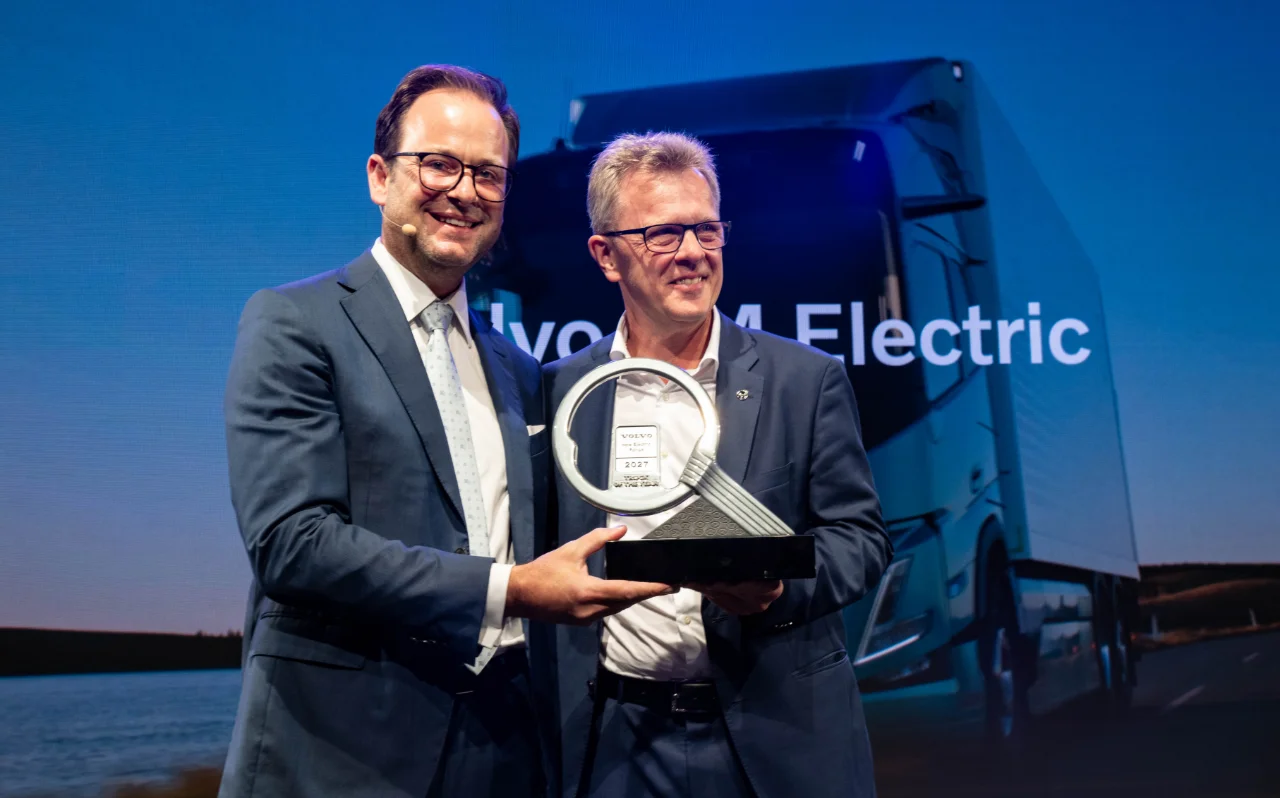
At Volvo Trucks, I start with the new electric range. And for good reason: it was during IAA that the manufacturer received the title of International Truck of the Year 2027. The 24 European jury members chose to reward a family of trucks — FH, FM, FMX and FH Aero Electric — rather than a single model. Improvements in range matter, but the versatility of the overall range also played a role in our choice.
This ceremony had a particular significance for me. TruckStop represents France on the ITOY jury and I have the honour of being vice-president of the organisation. This year, we were celebrating its 50th anniversary with a large stand bringing together around twenty historic trucks that had won awards over the decades. A true journey through the history of our profession, worthy of what remains, in my eyes, the most important distinction in the commercial vehicle industry.
On the Volvo stand, the FH Aero Electric with extended range announces up to 700 km on a single charge. But other architectures meet different jobs and payload constraints. That is what the title awarded in Hanover tells us: electric is gradually becoming a transport range, rather than simply a solution for a few urban routes.
I could not leave the stand without taking a look at the diesel versions, which still account for the majority of sales. A magnificent FH Aero equipped with the new D13 engine displayed up to 560 hp. Enough to place Volvo at Scania’s level in this category of 13-litre engines. And then there was this FH Aero 780 with an XXL cab: red chassis, beautiful preparation, remarkable silhouette. Difficult to walk past when you love trucks!
Volvo was also presenting its gas-powered solutions and working on a hydrogen-fuelled combustion engine. Once again, choice was at the heart of the stand. I remain convinced that, today, the energy mix is the only reasonable approach.
DAF: The Little Details That Change Everything

At DAF, there is no need to radically change the cab design. They are already among the most modern and spacious on the market. The manufacturer prefers to multiply useful developments, both in diesel and electric.
The XD, XF, XG and XG+ gain new axle configurations for specific applications. The XG and XG+ Electric expand a range whose XD and XF Electric had won the 2026 Truck of the Year title. On the stand, the “DAF Transport Efficiency” philosophy also translates into greater connectivity, predictive maintenance and greater attention to vehicle availability.
But sometimes it is the cab details that speak to me the most. In the cutaway cab displayed in Hanover, you can finally appreciate all the available space. DAF now offers a 90 cm-wide sleeper berth. Why deprive yourself of that space? The rear storage areas have also been redesigned to make it easier to accommodate the driver’s belongings. These are not the innovations that will make the most spectacular headlines, but those who live in their trucks will appreciate them.
I also spent some time looking at the mechanical components. Next to the imposing PACCAR MX-13, the electric motor-transmission assembly looks tiny. The manufacturer is also working on a hydrogen combustion engine. Before declaring that this solution is “the future”, we will obviously need to know the price of the fuel and the operating cost. But I like seeing a manufacturer study several possibilities instead of pretending that one has already won.
Ford Trucks: To Be Checked on the Road
Ford Trucks is continuing its progress with the F-MAX GEN2.0. New grille, camera mirrors, revised cab: the truck remains familiar, but continues to improve. Its 510 hp EcoTorque engine and Ford powertrain now deserve a full test. You know us: a technical data sheet, however appealing, will never replace a run on our Occitanie route.
The brand was also displaying the F-LINE range and an electric model. And then there was the truck in M-Sport Ford colours, competing in the World Rally Championship. It is not the most decisive announcement of the show, but it makes you want to stop at the stand. Trucking is also about image and passion.
A Stop at Michelin, ZF and in Our Memories
Going around IAA is not just about opening cab doors. At Michelin, a machine capable of automating tyre regrooving (NAZCA) caught my attention. Those who have already carried out this operation by hand know what I mean. Extending the life of a tyre while making workshop work easier: that is a concrete innovation.
At ZF, the TraXon Hybrid transmission received the Truck Innovation Award 2027. It integrates a hybridisation module into a heavy-duty vehicle transmission. Reducing consumption, assisting the combustion engine or enabling certain operating phases in electric mode: the idea is interesting. As always, the challenge remains to find an economic model that makes hauliers want to invest.
Before talking about the future and inviting you to visit the Chinese stands, I think it is essential to return to the exhibition dedicated to the 50th anniversary of the International Truck of the Year. Around twenty former winners were gathered in Hall 22: DAF XF, MAN F2000, several generations of Scania, Volvo FH and Renault Magnum. Standing in front of this beautifully restored Magnum, I stayed longer than expected. I had almost the same one in my company and seeing one again in this condition is like rediscovering a part of my own history. For an enthusiast, this stand alone was worth the long detour, because we must not forget where we come from before truly knowing where we want to go.
On the Other Side of the Aisles, China Has Shifted Up a Gear

After the Europeans, it is time for the Chinese manufacturers. And let’s be clear: we are no longer at IAA 2024. Two years ago, we sometimes had the impression that we were leafing through a full-scale catalogue. Lots of vehicles, lots of promises, but also lots of questions. Which ones would actually be sold in Europe? Who would provide servicing? Where would we find the parts?
This time, you can climb into the cabs, discuss networks, contracts, schedules and financing solutions. The commercial contacts are very real. With several brands, the marketing plan is already in place. They are no longer coming simply to take the market’s temperature.
Be careful, though: not all of them are at the same stage. Some still operate like start-ups and will have to prove that they can provide after-sales support. Others are genuine industrial giants, capable of investing, producing at scale and moving quickly. That is the difference we need to look at, without contempt but without naivety either.
Sany and SuperPanther: Already Designed for Europe

Sany is notably presenting a 4x2 electric tractor unit. The most important thing is not just its battery or power: it is the fact that this truck adopts a configuration designed for our market. Gone is the three-axle vehicle primarily intended for China and simply placed in Hanover to attract photographers.
The brand already has European experience in construction machinery and worksites. It is also highlighting service solutions for its future customers. Because a haulier does not buy only a price or a range figure: they buy the certainty that their truck will be able to get back on the road quickly when a problem occurs.
A few steps away, the SuperPanther eTopas 600 gives a different impression. Its lines are reminiscent of certain European trucks, as are several interior design choices. The electric axle, LFP batteries, sleeper berth, screens and storage areas: everything indicates that the manufacturer has studied what we expect from a long-haul truck and seems to have genuinely drawn inspiration from the best in the industry.
I’m going to be honest with you. When touching certain plastics and looking at some of the fit and finish, you can still see the gap with Mercedes, Scania, MAN or Volvo. But this is no longer a roughly finished truck, because the cab is liveable and the driving position is coherent. If the price is significantly lower and a serious network is behind it, some hauliers will have good reasons to take a closer look, especially as it is assembled in Europe, at the former Steyr plant foolishly abandoned by MAN.
Foton: We Are Entering Another World

The Foton stand deserves a stop. The group is presenting trucks with very aerodynamic, sometimes puzzling designs. Some models take the thinking around interior space very far. You move around the cab almost like in a small apartment, with a large sleeper berth, large screens and an organisation that does not resemble our habits.
Would I like to work every day in this very bright interior? Not sure. Some materials still feel a little too plastic, and I want to see how they will age after a few months of real life. But the idea deserves attention. Established manufacturers would be wrong to dismiss this kind of thinking out of hand. Take the Galaxus R9, a plug-in hybrid (PHEV) model: this one surprised me even more. You open the door and discover cream and chocolate tones, carefully finished upholstery and a wood-look floor. You could almost think you were in a small yacht cabin. The exterior styling will divide opinion, but inside, it becomes difficult to keep saying that all Chinese trucks are poorly finished.
Foton is also talking about a European arrival that would not rely solely on electric technology. Diesel is also part of its plans. Once again, the Chinese manufacturer wants to leave the choice to the customer; the market will dictate its rules.
BYD: The Truck Is Only Part of the Offering

With its cars and buses, BYD is no longer an unknown to Europeans. In Hanover, the brand is now asserting its ambitions in heavy-duty vehicles with the ETT 44, a 4x2 electric tractor unit developed for our market. A 651 kWh battery, up to 600 km of announced range and very high-power charging: on paper, it is playing in the big leagues.
The cab does not offer the volume of the largest European long-haul trucks. But when you look at the driving position, screens and materials, you can see that this is not a truck hastily adapted simply to fill a stand.
Perhaps the most interesting part lies in the discussion we had with Stella Li, BYD’s executive. Her speech is not limited to the vehicle. BYD wants to offer photovoltaic panels, storage batteries, charging stations, the truck and associated services. In other words, a complete solution for electrifying a haulier’s operation.
The prices, contracts and quality of service over time will obviously need to be examined. But when you see what BYD has already managed to build in other sectors, I would not take this offensive lightly.
Sinotruk: Already Has an Industrial Foot in Europe

Remember the name Sinotruk (China National Heavy Duty Truck Group) and that of its Sitrak brand. On board the electric tractor unit displayed in Hanover, several things surprised me: the atmosphere when you close the door, the presentation of the driving position, the refrigerator and, above all, this particularly wide sleeper berth. Some materials can be discussed, but calling a Chinese truck “low-end” would be to miss what this vehicle actually is.
More importantly, Sinotruk has started assembling trucks at Steyr Automotive in Austria, from sub-assemblies coming from China. The objective is to gradually carry out more operations locally. This does not resolve all the questions: the network, resale value and access to European purchase incentives for electric trucks still need clarification. But hauliers may soon have to include Sinotruk in their thinking when making a purchase.
Imagine what this could become with a genuine industrial presence and service agreements with networks such as G-Truck. From my point of view, yes, we are going to hear about Sinotruk very soon.
Moreover, like BYD, the group is not talking only about the truck. Energy production, storage and charging: Chinese manufacturers are seeking to control the entire electric ecosystem. Sinotruk is therefore not simply coming to find a few buyers. It is preparing its place on the European market.
FAW: The Stand That Challenged Me the Most

FAW may be the Chinese manufacturer that made me think the most. Its diesel models are not mock-ups: they are trucks developed with Europe firmly in mind. The brand is also displaying an electric tractor unit and a futuristic concept that can make you nervous.
Before talking about the future, let’s open the door of a CS. A small access step recalls solutions already seen on Scania trucks in the past. I sit down, close the door and the seat automatically returns to my driving position. When the door was opened, it had moved backwards to let me climb in. It may seem like a detail, but this is exactly the kind of detail that shows that a manufacturer has worked on its product.
Inside the cab, there is a large screen, storage areas, a strong sense of space and a sleeper berth that is anything but symbolic. Some plastics could of course be more appealing. FAW has not yet surpassed the best European cabs in every respect. But we are a long way from the cut-price truck that some people still imagine.
One of the other models presented goes even further. Transformed living space, a steering wheel capable of disappearing, a driver whose role would evolve with automation: this vision will not appeal to everyone. Personally, I am not in a hurry to see the steering wheel become an accessory. But this concept shows that FAW is not content with copying today’s truck. The group is also thinking about the next one.
What I Really Take Away from Hanover

When I return from IAA, I leave with two convictions.
The first: European manufacturers are far from having said their last word. Mercedes-Benz, MAN, Scania, Renault Trucks, Volvo, DAF and Ford are presenting well-developed trucks. They know the jobs, have strong networks and continue to make progress, both in electric and diesel technology. The award presented to Volvo during the show demonstrates the level reached by European electric ranges.
The second: the Chinese are no longer curious visitors. Their trucks have become more European, finish quality is improving, and executives are talking about distribution and servicing. Their reliability, parts availability, network quality and resale value will still have to be assessed. For a haulier, these questions matter just as much as the purchase price. But quietly waiting for the answers while thinking that nothing can change would be a mistake.
Electric technology could accelerate this reshaping. For decades, our manufacturers built their lead on diesel, transmissions and knowledge of the industry. In an electric truck, batteries, electronics, software and charging become decisive. Chinese industry already controls a large part of this chain and can move forward with aggressive pricing.
At the same time, European executives gathered in Hanover by ACEA warned about the delay in infrastructure and the economic conditions necessary for the mass adoption of zero-emission trucks. Their concern is clear: facing heavy penalties while they have developed the vehicles, but hauliers still cannot operate them everywhere under profitable conditions.
When we look at what happened in the automotive industry, we have to dare to ask the question: by pushing all-electric technology faster than its infrastructure and industry could keep up, did Europe not open the sheepfold to the wolf?
A truck is not a car. Here, every kilometre counts, and a vehicle must first work, remain available and make money. The newcomers will have to prove themselves. But believe me, they have understood the rules of the game.
In 2024, the Chinese manufacturers showed us what they knew how to build. In 2026, they are showing us how they intend to sell and service it. At the next IAA, we may already be looking at their market shares.
Text and photos: Fabien Calvet