OCCITANIE TEST: MAN eTGX 540
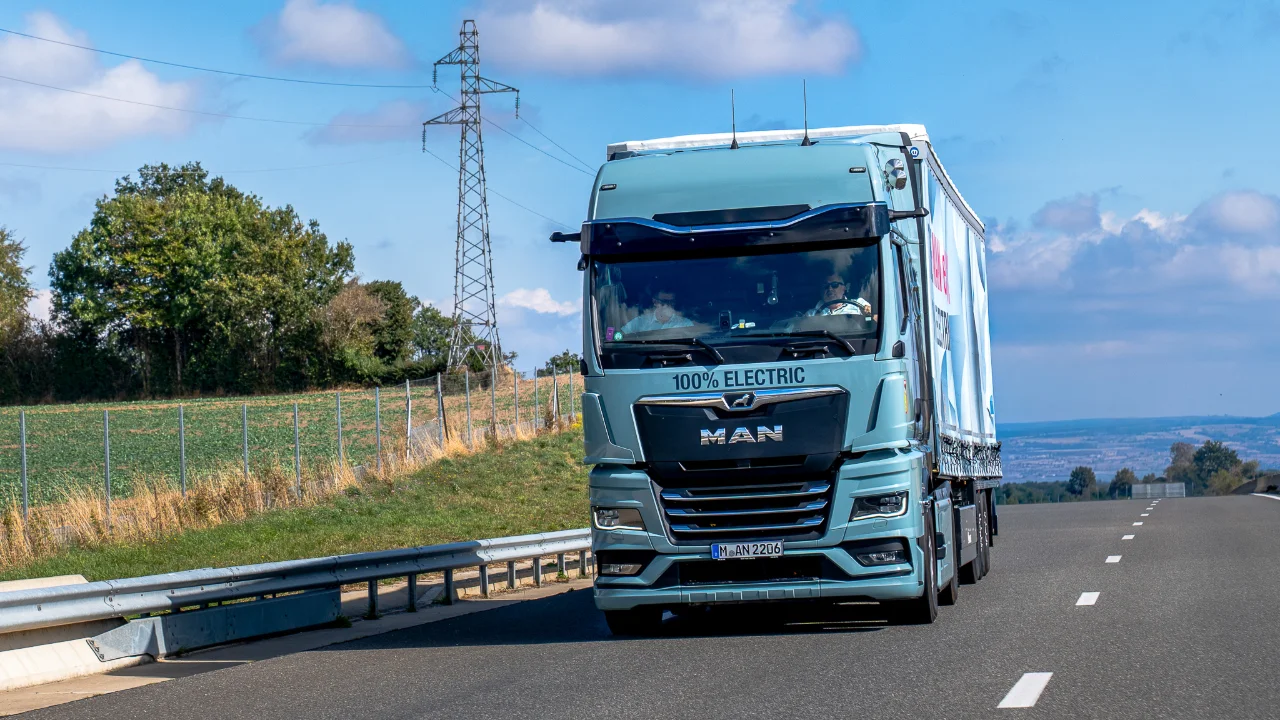
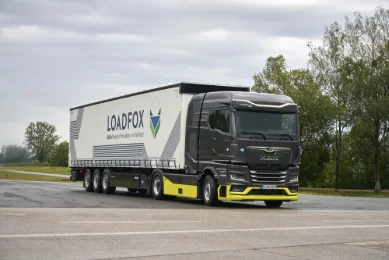
104.2 kWh/100 km! The MAN eTGX 540 has simply just dethroned the Mercedes eActros 600, until then champion of our electric tests. With its 400 kW (540 hp), its six battery packs and its 40 tonnes on the scale, the lion brand signs a hell of a performance. But beyond the consumption, what is this truck worth on the road? We took our Occitanie route again, with its hills, its descents, its roundabouts and its famous passage at Caylus. A TruckStop test as we have the secret of it, unfiltered and without seeking to manufacture a record but believe me, this MAN reserved a few nice surprises for me!
Electric, whether you like it or not, you’ll have to reckon with it!
I know, as soon as we talk about an electric truck, some people are already grinding their teeth. Yet, one must be clear-sighted: electric is now a reality and manufacturers are offering products that work. So yes, Brussels is imposing CO2 emission reduction targets but this regulatory constraint is also beginning to become a real economic equation. At MAN, they have understood it well. With acquisition aids, notably energy savings certificates, and depending on the price of electricity, the TCO can become interesting compared to diesel. Careful, not for everyone! Mileage, recharging, type of transport and operating conditions remain determining factors so study your situation well before taking action.
At TruckStop, we are not here to sell you electric or diesel. We test trucks, we record the figures and we give our impressions. It’s your choice!
540 horsepower, six batteries and 40 tonnes
Our MAN eTGX develops 400 kW, or approximately 540 horsepower. Its particularity? Unlike Mercedes or IVECO, which use an electric axle integrating the propulsion (eAxle), MAN retains a traditional rear axle. In the middle of the chassis, a motor-gearbox assembly from the TraTon parts bank. This motor identical to that of the Scania is associated with a four-speed gearbox. The whole drives an axle with a reduction of 2.53. Well, exactly the same ratio as on the MAN TGX D30 diesel tested previously on our circuit! For this test, our vehicle carries six NMC battery packs representing approximately 534 kWh of nominal capacity, of which a little under 500 kWh are usable. The batteries are assembled at MAN in Nuremberg, from Chinese cells. That’s the technical side. On to the road!
Eurocentre: 350 kW to fill up with electrons
As always, departure from the Arena station, at Eurocentre, north of Toulouse. Usually, we fill up with diesel or HVO. Today, we plug our MAN into a 350 kW charging point.
And this is still the main problem with electric: recharging. With a charging point at the depot and an adapted organisation, the equation works. On the road, it’s more complicated. Of course, infrastructure is progressing, the first megawatt stations are appearing, but the network remains far from that of diesel. For our test, no problem: departure and return to the same location to carry out the calculations.
An important clarification: our semi-trailer is a traditional Tautliner, without fairing or aerodynamic artifice. MAN did not seek to clock a record with a Transformers-series semi-trailer. And that, I appreciate! On this subject, at the beginning of 2027, TruckStop will have its own semi-trailer in order to eliminate the differences related to the towed equipment. Chereau, the flagship of French bodybuilders, becomes our partner by providing us with the top of the fridge for our tests. A story to follow!
First hill: 40 tonnes and a disconcerting ease
Direction Montauban. From the exit of Eurocentre, we attack our first climb. I am at 40 km/h in the bend, with 40 tonnes on the scale. I accelerate and the MAN sets off immediately. No hesitation, no hole. The torque arrives instantly and the truck climbs with disconcerting ease. I quickly reach 80 km/h before losing a little speed at the top. Nothing abnormal with this weight. But what impresses is the linearity: four gears and practically no load break, the truck climbs without jolts. Once at the top, I set the cruise control and there, another observation: this MAN slides enormously! On the false flats and the descents, it cuts the propulsion and benefits from its inertia. Several kilometres without consuming energy! The cruise control slightly varies the speed around 85 km/h to optimise consumption.
First stage: under 100 kWh/100 km!
Montauban, Caussade: the result comes in at 97 kWh/100 km. We consumed 61 kWh and recovered only 7 kWh. Logical, this first stage is relatively flat and requires little regeneration. On the other hand, the MAN exploits its inertia remarkably. The predictive cruise control anticipates the relief, accelerates slightly before certain climbs and then lets the truck slide. All manufacturers use the system in the same way and here the system works particularly well. To summarise, we are under 100 kWh/100 km, at 40 tonnes, without sacrificing commercial speed. Excellent start!
Rear-view: MAN can do better
Not everything is perfect and you know me, I like to say things. First complaint: the rear-view cameras. MAN has large screens that are very pleasant at low speed. Under 15 km/h, the image occupies the entire surface. But at higher speed, the edges become blurry. So yes, you can see perfectly behind. But personally, this peripheral blur bothers me, notably when a vehicle enters the field. Why not take advantage of the entire surface of the screens? I prefer a sharp image everywhere. A detail? Perhaps. But when you spend hours behind the wheel, it counts, so to exchange things, MAN should also dip into the parts available at TraTon!
Second stage: the MAN tackles the serious stuff
From Caussade, we get into the thick of it. Roundabouts, villages, long climbs: this second stage is the most demanding of our circuit. On this terrain the MAN starts strong! In the first ascents, I remain for a long time around 80 km/h and let’s say that at 40 tonnes, it’s impressive. The speed obviously ends up dropping when the gradient steepens, but the restarts are crisp. The silence and the absence of traction break sometimes give the impression of driving empty. Careful, 40 tonnes remain 40 tonnes! In the long climbs, the MAN also ends up sitting down. We sometimes drop to around 60 km/h, the indicator displays 100% solicitation and the battery loses a few points. But as soon as the gradient eases, the 540 horsepower put the whole thing back in motion with remarkable ease.
The One Pedal: frankly, I love it!
On this stage, I particularly appreciated the One Pedal mode. The principle is simple: you manage acceleration and a large part of the deceleration with the right pedal. You press, the truck accelerates. You release, it slows down while recovering energy. In between, you find a neutral point allowing you to slide without consuming or regenerating. And believe me, once the operation is assimilated, it’s a delight!
Between two roundabouts, I restart calmly, benefit from the inertia then release progressively to recover energy before the next one. All without unnecessarily using the brakes. The MAN also offers five levels of recovery accessible on the stalk, like on a traditional retarder, but here the energy returns to the batteries. In interurban driving, the One Pedal becomes very natural. And MAN leaves a real freedom to the driver. Personally, I like to keep my hand on my truck!
Caylus: the descent that changes everything
Regular TruckStop readers know our famous passage at Caylus. A long descent, bends, the village, then a particularly demanding climb back up. With a diesel, you have to manage the retarder or the engine brake, often noisy. With the electric MAN, change of ambiance! I programme 45 km/h and let the truck work. It descends in silence, without using the service brakes. The retardation is powerful, progressive and perfectly controllable. And above all, we are recovering energy!
At the top, the battery displays 80%. At the bottom, 82%! Two points recovered simply by going downhill. In the village, you essentially hear the tyres on the road surface. For the local residents, the difference with a diesel using its engine brake is considerable. For the driver too!
The Caylus climb: torque makes the difference
After the descent, you have to climb back up! We set off again practically at 30 km/h, still at 40 tonnes. I accelerate firmly and the MAN quickly gains speed, to the point of having to ease off before certain hairpins. In the tight bends, the weight of the combination reminds itself to us. But at the exit, the truck sets off again with an ease rarely encountered on a diesel of comparable power.
On our video, available free of charge on the TruckStop application, you will see a thermal truck following us during this ascent. I do not know its load, so there’s no point drawing definitive conclusions. But the MAN’s restarts are visibly crisper. And yet, we only have “just” 540 horsepower! I even feel a gear change in a hairpin. That is sufficiently rare to be noted.
A small figure missing from the dashboard
Since we are talking transmission, another complaint: MAN displays mode D, but not the gear engaged. To know if I am in second, third or fourth, I must intervene on the selector and momentarily switch to manual. You will tell me that I am being nitpicky, admittedly I grant you that in automatic it is not essential, but I must also tell you that as a tester, I like to know which gear I am driving in. A small additional figure would have sufficed. It’s not dramatic, but it’s a shame especially in the modern era of ubiquitous electronics!
Rodez: 140 kWh/100 km on the difficult stage
Direction Villefranche-de-Rouergue, then Rodez. The long climbs put the batteries to work and the wind picks up towards the end. With our traditional semi-trailer, no particular aerodynamic advantage, quite the contrary. On arrival, verdict: 140 kWh/100 km. We consumed approximately 270 kWh on this portion, but recovered 102 kWh thanks to the descents and the slowdowns. Against only 7 kWh on the first stage! That is the whole particularity of electric in hilly terrain: you consume a lot on the climbs, but you recover part of that energy going downhill.
Cumulating the first two stages, our average is around 120 kWh/100 km, with still 53% of battery. I then start looking at the figures of the Mercedes eActros 600. And surprise: the MAN is ahead!
On board: it’s a TGX, and that’s just as well!
Let’s take advantage of our break at Nuces at LCR Events to discover the cab. MAN did not seek to reinvent everything on the pretext of going electric. We are in a TGX, with its controls, its ergonomics and its familiar dashboard. The rev counter has disappeared in favour of energy indicators, and the diesel gauge is replaced by the battery level. For the rest, the environment is perfectly recognisable. For a driver accustomed to diesel, the transition happens naturally. Our truck has the high large cab, with a beautiful interior space, numerous storage areas and two comfortable bunks.
The finish has made a remarkable leap forward. Careful upholstery, leather steering wheel, decorative inserts, pleasant materials: we are far from the austere MANs of the early 2000s. We are approaching the ambiance of a beautiful German saloon. The steering retains a certain firmness, pleasant for maintaining a good sensation of control. With its mechanical suspension at the front, the MAN offers a healthy and comfortable road behaviour. A true driver’s truck.
Third stage: Rodez–Albi–Toulouse, it slides!
After our break, we set off again towards Toulouse. The first climb towards Rodez airport confirms once again the good impressions: the MAN easily restarts its 40 tonnes. Then, the profile becomes particularly favourable for electric. We progressively descend towards Albi, with long rolling sections.
The truck perfectly exploits the terrain. I sometimes cover several kilometres with an instantaneous consumption at zero. The predictive cruise control slides for as long as possible. And the result becomes almost amusing. At Barraqueville, I look at the battery: 40%. A few kilometres further, still 40%. Approaching Albi, still 40%! We have however covered a good distance. But the descents allowed compensating a good part of the energy consumed. On this portion, the computer even momentarily displays 77 kWh/100 km. At 40 tonnes, I remind you!
A coherent range for regional work
Approaching Toulouse, the battery progressively drops below 25%, then below 20%. The truck displays its low range alerts, but we still have more than 90 estimated kilometres while the arrival is very close. With approximately 480 to 490 kWh usable without stress, our MAN demonstrates that it can handle a demanding regional route without intermediate recharging. Care must be taken however not to generalise. Our third stage strongly favours recovery. On flat motorway, with a headwind, other temperatures or a different load, the results would undoubtedly change. And recharging remains to be integrated into the organisation of rounds. But for certain regional applications, the solution already works and I want to add that it works well!
Verdict: 104.2 kWh/100 km, the Mercedes is beaten!
Back at Eurocentre. It is time to pull out the figures. On our third stage, the MAN finishes at only 81 kWh/100 km, with 83 kWh recovered. In total, over the three stages, we recorded 563 kWh of energy consumed and 192 kWh recovered. The net consumption is therefore established at around 370 kWh. That is a final average of 104.2 kWh/100 km!
And there, my friends, we have a new champion! Until now, the electric reference of our Occitanie circuit was the Mercedes eActros 600, with 107 kWh/100 km. The MAN does better, by 2.8 kWh/100 km.
Admittedly, the gap remains limited. But at 40 tonnes, on such a demanding route and without sacrificing commercial speed, the result deserves to be highlighted. The MAN climbed, restarted and held the pace. As of today, the MAN eTGX 540 therefore becomes the new consumption record holder of our Occitanie circuit in the electric heavy goods vehicle category. And dethroning the Mercedes eActros 600, our reference until now, is no small thing!
NMC versus LFP: recharging can make the difference
One important element remains: the batteries. The MAN uses NMC technology, while the Mercedes eActros 600 has LFP batteries.
On the MAN, the charging power can be high in an intermediate range, but decreases progressively as one approaches full charge. The last percentages take more time, as we regularly note at the charging point. The charging time, therefore the break time, remains an important element. The LFP batteries of the Mercedes have other advantages, notably in terms of service life and usable charging range. You can charge fully without risk of damaging the batteries but care must be taken however: the charging curve also depends on the electronic management and above all on the charging point used. A low consumption therefore does not, in itself, guarantee the best productivity. Range, recharging time and organisation of rounds remain essential.
Also note that at the IAA show in September, MAN presented a new proposed configuration with more batteries, notably additional packs behind the cab. Enough to broaden the operating possibilities.
My opinion: MAN strikes hard, very hard!
I am going to tell you things simply. I am a diesel enthusiast, I have never hidden it. I love thermal engines, their character and their sound. But I am not going to criticise an electric truck simply because it has no diesel engine. And this MAN eTGX frankly deserves compliments. It is smooth, comfortable, sufficiently powerful at 40 tonnes and particularly pleasant to drive. Its energy recovery is efficient, its predictive cruise control works very well and its One Pedal is a delight on the winding sections.
Not everything is perfect. I remain reserved about the rear-view cameras and regret the absence of permanent display of the gear engaged. But the essential is elsewhere.
The MAN eTGX has just beaten the Mercedes eActros 600 on our Occitanie circuit!
This does not mean it will be better everywhere. The Mercedes notably retains a higher battery capacity in the configuration we had tested. But on the terrain of consumption, with our usual protocol, the result is there. And at TruckStop, it’s the figures that speak!
Next stage: the electric Scania, cousin of the MAN within the TRATON group. Same drivetrain, but different environment, chassis and suspensions. That promises an interesting comparison!
Safe travels, be careful and see you very soon for a new TruckStop test!
Text: Fabien Calvet Photos: Victor Doutrelon and Fabien Calvet