Renault Trucks T480 Turbo Compound test on our Occitanie route
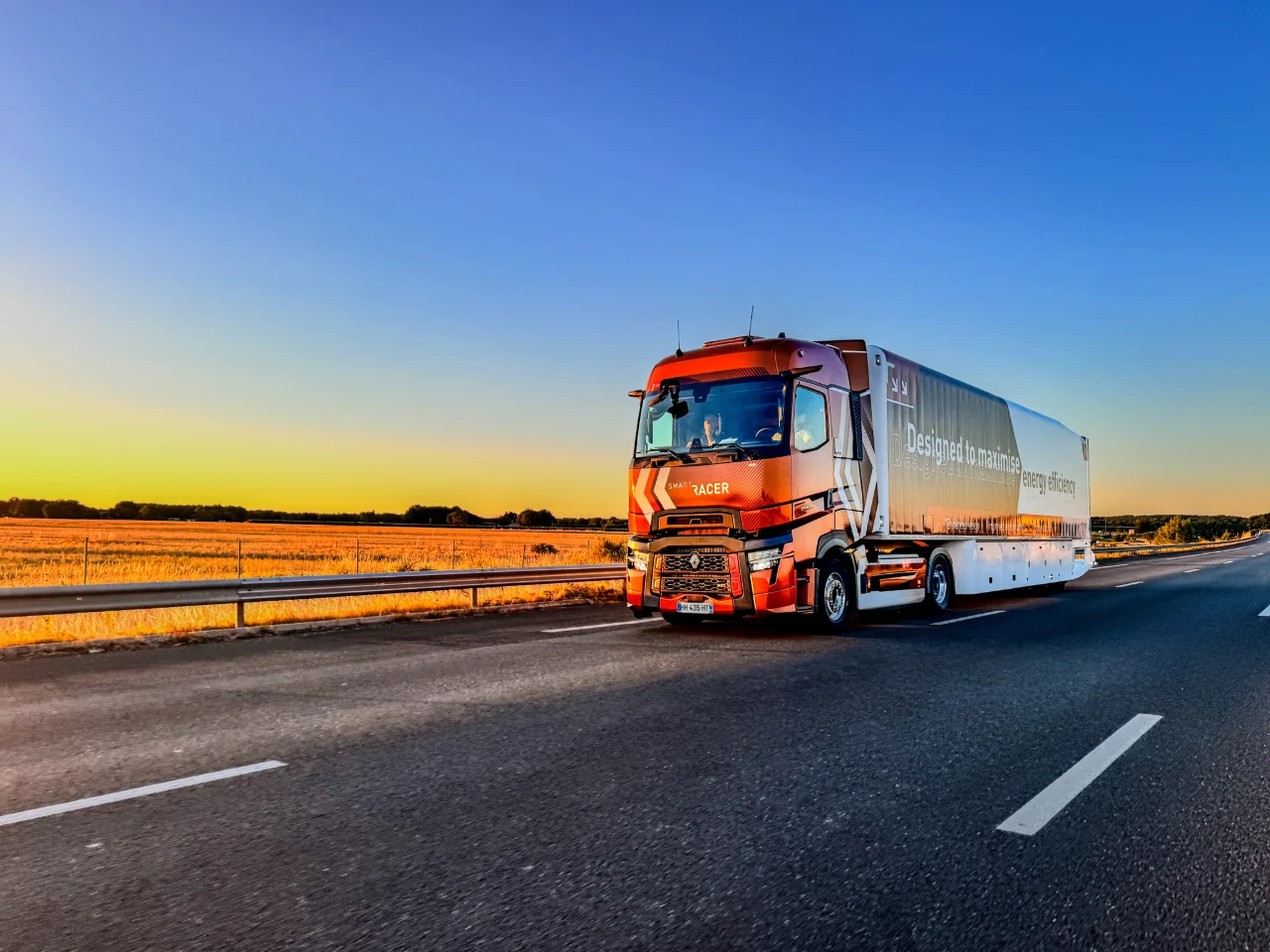
It had been a little while since Renault Trucks had measured itself against the competition on our route. With its brand-new 2026 Renault Trucks T480 High, the mission seemed clear: to demonstrate that this latest evolution of the 13-litre Turbo Compound is still in the game. Between Toulouse, Caussade, Rodez and Albi, it did more than simply deliver convincing fuel consumption. Above all, it reminded us that an efficient truck can still have character, which cannot be said for everyone.
As with every test on our route in south-western France, it is early when we leave the Arena Eurocentre service station, north of Toulouse. Very early indeed. In the middle of summer, with temperatures of more than 40 degrees forecast during the day, we have to take care of the people, the mechanics and, above all, the cameras installed behind the windscreen. The sun has barely risen and we already have a full day ahead of us at the wheel of this Renault Trucks T480 High, loaded to 40 tonnes like all the vehicles that pass through our hands on the Occitanie route.
You know the T. There are thousands of them on the roads and it is the French manufacturer’s best-seller. No aesthetic revolution for this 2026 model year, but a series of developments that deserve more than just a quick walk around the yard. Conventional mirrors have disappeared in favour of cameras, the predictive system has been improved and OptiRoll can now completely switch off the engine during certain coasting phases. Remember, we tested this at Volvo, its cousin. Here, under the cab, we find the 480 hp 13-litre engine paired with Turbo Compound, in its ultimate evolution before the announced arrival of a new generation (which, incidentally, will not have this famous system).
Our benchmark remains unchanged: a first motorway stage between Toulouse and Caussade, a second, much more demanding stage to Rodez via Caylus, then a return towards Toulouse via Albi. Fast roads, hills, villages, roundabouts, roadworks and real traffic. In short, not a laboratory exercise, simply real life.
Torque from the very first kilometres

Barely out of Eurocentre, we tackle the long climb that generally sets the tone for the test. We enter the bend at 40 km/h and the T480 immediately finds itself facing its first difficulty. The verdict is not long in coming: my truck does not panic, does not make a multitude of gear changes and, on the contrary, the new T settles comfortably into its torque.
The Turbo Compound recovers part of the energy from the exhaust gases and returns it to the crankshaft. In driver’s language, which is the tone of our media, this mainly means one thing: the engine pulls much better from low revs. Here, the 2,700 Nm are available from just 900 rpm. On this first climb, the Renault stays around 1,200 rpm, in tenth gear, at 64 or 65 km/h. For a 40-tonne combination, the result is far from ridiculous. The most telling feeling is that nothing seems to be working hard.
The Optidriver gearbox then shifts through eleventh and twelfth gears between 1,000 and 1,200 rpm, exactly where the engine feels most comfortable. From the very first kilometres, the truck gives an impression of reserve. It is not brutal, but it has plenty in reserve. Once the climb is over, the T lets itself roll. And that is where one of the main new features comes into play.
When the engine stops without you noticing

OptiRoll, this coasting function that all drivers now know, goes one step further here. When the conditions are met, the engine no longer remains at idle: it switches off completely. The rev counter drops to zero and the truck continues on its momentum, at 87 or 88 km/h, in a silence that is nevertheless nothing spectacular, as modern engines are already so quiet at low load.
The first time, the idea can be surprising. But in use, everything is imperceptible. The steering remains assisted and a pump driven by the transmission maintains hydraulic circulation. More than eight conditions must be met before the system allows the engine to shut down. If the truck needs power for the air conditioning or cooling, the engine simply continues running at idle.
Behind the wheel, we feel nothing. The T glides, then the 13-litre engine restarts by itself as it approaches a slight uphill section. It returns to around 900 rpm, accelerates the combination and gets back to work as if nothing had happened. What is ultimately most impressive is not the shutdown itself, but the precision with which the truck chooses the right moment.
The predictive system reads the terrain, anticipates climbs and makes use of every descent. Before a hill, it can drop a gear to bring the engine back to around 1,100 rpm. Once the obstacle has been cleared, it releases the transmission and lets the combination roll. This invisible work saves, metre after metre, the litres that will not be burned.
For a long time, Mercedes was the benchmark for predictive driving. The star brand is no longer alone: Renault Trucks now places itself among the best, just like its Volvo cousin, which we tested a few months ago.
An engine brake that does the job

This T480 does not have a secondary hydraulic retarder, notably because its weight and friction penalise the VECTO calculations. For the heaviest applications and routes located mainly in mountainous areas, I nevertheless continue to believe that combining a hydraulic retarder and a compression brake offers the best of both worlds. Our politicians, in addition to not understanding much about it, all seem to be very poorly informed by their experts!
As for the Renault Trucks, however, it must be recognised that the OptiBrake+ has made serious progress. The French manufacturer announces significantly greater braking power than the previous generation and, on our route, it clearly does the job. The stalk offers several levels, including a forced position capable of triggering a downshift to increase engine speed and therefore braking power. It is simple, clear and effective.
We will confirm this later on the descent into Caylus. The truck chooses a target speed of around 35 km/h by itself and accepts a few additional km/h on the downhill. We therefore descend at around 40 km/h, exactly the speed I would have chosen manually with 40 tonnes. When the compression brake reaches its limit, the system briefly applies the service brakes to stabilise the combination. I keep my hands on the steering wheel, but I still have not touched a pedal. We had already discovered this “trailer-brake” system on the Volvo, but many manufacturers now use it.
Cameras: you have to move with the times
On the motorway, the screens are clear and easy to read. The 25- and 50-metre markers help with moving back into the lane and, in bends, the image follows the trailer. For me, let’s be honest, the demonstration no longer needs to be made. In villages, as you can see in our video available on the TruckStop app, when we pass another truck, we no longer have these two large appendages that seem to want to touch each other. The width does not change, but we clearly drive with greater peace of mind.
One point where I still have to be honest with you: in manoeuvring mode, you have to change your habits, but once you gain confidence, it really does the job. One last point for slightly dodgy rest areas: if you hear a noise behind you, from your bunk you do not need to get out; you can check what is happening at night without leaving the cab.
Caussade-Rodez: the truth of the road

The second stage is always the one I prefer. Leaving Caussade, the roundabouts follow one another, then the terrain gradually becomes more demanding. This is where we find out whether the good impression from the motorway holds up on more difficult terrain.
We start by letting the predictive system do its work. As we approach a roundabout, the truck slows down by itself and indicates a passage at around 19 km/h. I keep my foot away from the brake and accelerator, use my indicator, enter the roundabout with the combination and the T accelerates again on the exit. Three levels are available to adapt the speed to the load. With a low and stable load, we selected the fast mode. With suspended cargo, livestock or a higher centre of gravity, the slow mode would obviously be more appropriate.
Careful, I can already read some of the comments, but no, the computer does not replace a good driver. On the other hand, I must also be clear: it smooths out differences, helps those who know the road less well and reduces fatigue. When you prefer to remain in control, the Renault remains pleasant to drive manually; a combination of the two modes is most often the best compromise.
To return to the character of the new T, in the first steep climbs, the 13-litre engine confirms its character. It remains in eleventh gear at 900 rpm without collapsing. When the gradient becomes steeper, the gearbox drops several gears and seeks power around 1,400 to 1,600 rpm, before returning to the torque zone. The combination works without unnecessary agitation and behind the wheel you do not feel like you are driving a gutless truck.
On this route, at first glance, the 2.17 axle ratio may seem long. Yet, combined with the Optidriver and, above all, the 2,700 Nm available at very low revs, it does not penalise the truck. This is why you should never choose a tractor unit by looking only at the number written on the door. The engine, gearbox, axle and tyres form a whole. Here, the powertrain is coherent for the job we are asking the truck to do.
At Caylus, the electronics also find their limit
After the perfectly managed descent, we have to climb back up. At the bottom of Caylus, we reprogram 80 km/h and initially let the truck decide. It approaches the hairpins cautiously, at around 30 to 36 km/h, downshifts and accelerates correctly. Then, in one bend, it gets caught out. Perhaps the collision radar interpreted a car, a crash barrier or a sign as an obstacle. In any case, the T cuts its effort at the wrong moment and forces me to take back control of the accelerator.
You know me, I am not going to keep this to myself: at TruckStop, our role is not to erase what is inconvenient. False triggers exist on trucks as well as on cars. No automated system is infallible and the driver remains the boss on board. All these new systems are far from infallible; you have already experienced this yourselves.
As for me, once I take back control with the accelerator in the middle of my climb up Caylus, the Renault gets going again without hesitation. In the hairpins, I modulate the accelerator, the engine climbs towards 1,300 or 1,400 rpm, closer to its maximum power range, but I have to say that it is above all the 2,700 Nm that save the day. The T accelerates cleanly and, at 40 tonnes, we are never struggling. Of course, this little T cannot compete with the big boys close to 800 hp; it does not pin you to the seat every time you press the accelerator, but for a 480, its behaviour is convincing.
This predictive-system error does not ruin the test. It reminds us of an essential rule: assistance systems perform well provided that you understand them. Reading signs, adapting the set speed, speed through roundabouts: many parameters can be adjusted. A truck configured to suit its driver will always be more efficient and less annoying, but the perfect test does not exist.
Plenty of safety, sometimes far too many “beeps”
The 2026 model year comes with the equipment required by GSR2 regulations: traffic-sign recognition, attention monitoring, vulnerable road-user detection, emergency braking and lane-keeping assistance. It is still not autonomous driving and your hands must remain on the steering wheel, but it is difficult to claim that this serves no purpose. The audible side is less enthusiastic. At 81 km/h in an 80 km/h zone, the truck beeps. At 33 in a 30 zone, it beeps again. If I adjust the cameras, the attention monitoring adds its warning. Too many beeps can sometimes kill the beep, as you know my saying.
A familiar cab, a finish that makes all the difference
At Rodez, at LCR Events, the break gives us the opportunity to look around the truck. Externally, this model year does not radically change the T. The lights and overall design are familiar, the visor has disappeared to improve aerodynamics and the cameras provide a smoother silhouette, and our truck looks genuinely good.
Inside, the volume does not change either. What stands out most is the treatment carried out by the C11 workshop in Bourg-en-Bresse. The colour accents and inserts on the storage compartments, handles, door panels and refrigerator give the cab real personality.
We are a long way from the image of the “all-plastic” Renault that some people continue to carry around out of habit. This truck is warm and genuinely premium. The driving position and ergonomics directly contribute to the pleasure behind the wheel and, let’s be clear, our national manufacturer is on a par with the best in this respect.
Return via Albi in more than 40-degree heat

The third stage combines the hills of Aveyron with the faster sections of the N88 and then the A68. As soon as we leave Rodez, the T480 gets back into its stride. At 40 tonnes, in tenth gear and at around 1,300 rpm, it climbs without reluctance and even gains speed. This liveliness is what distinguishes it in terms of driving feel: it never seems sluggish.
The heat nevertheless eventually changes its operation. With more than 40 degrees outside, the air conditioning is running at full power and cooling requires energy. OptiRoll continues to put the transmission into coasting mode, but the engine almost never stops. The truck protects its reserves and returns to a more conventional operating mode, around 500 rpm as on previous generations.
On the N88, the predictive system remains remarkable. The truck builds momentum, anticipates the next climb, selects its gear and uses OptiBrake+ on descents. It can remain in eleventh gear to increase engine speed and braking power without consuming a drop, since fuel injection is cut off. It then shifts back into twelfth when accelerating again. Everything seems natural, even though continuous work is taking place behind the dashboard.
Added to this are the hazards of real life: roadworks, traffic jams, holiday departures and temperatures rising from 18 degrees early in the morning to more than 40 in the afternoon. These constraints affect both journey time and fuel consumption, but they are part of everyday life.
30.5 l/100 km: the T480 takes a podium finish

Back at Eurocentre, we refuel and look at the figures. The first, very fast stage ends at around 22 l/100 km. The second, the toughest, rises to around 43 l/100 km. The third, combining hills and fast sections, drops back to 25.2 l/100 km. Overall, the Renault Trucks T480 Turbo Compound achieves 30.5 l/100 km, with a journey time of 5 h 06.
It is not the fastest to have completed our route. A Scania 500 posted a better time with comparable fuel consumption. But the gaps have narrowed and the difference is now made just as much by driving comfort, ergonomics and the quality of the predictive system as by a few tenths of a litre. This Renault nevertheless takes a podium finish on the Occitanie route despite the heat and roadworks. With more favourable weather, it would undoubtedly have done even better, and that is the point to remember.
When it is time to hand back the keys, the figure only tells part of the story. What I remember above all is the pleasure of driving. The T480 is well planted on the road, its cab is pleasant, and its C11-made finish gives it a genuine premium dimension. Its 480 hp engine is not that of its cousin, now available in 17 litres and close to 800 hp, but let’s be clear: for this power range, it often feels more generous than its stated power would suggest, thanks to its TC system. What is certain is that the predictive system has improved enormously, OptiBrake+ inspires confidence on descents and the overall package rarely gives the feeling of being overwhelmed by the terrain.
Not everything is perfect: the false trigger at Caylus reminds us of the limitations of electronics and the accumulation of audible alerts can become tiring. But a good test is not judged by the total absence of faults. It is judged by the overall balance and the confidence the truck inspires over the kilometres. On both points, the verdict is clear: this Renault Trucks T480 Turbo Compound gets the job done, and it does so with character. Test approved on my side.
Text: Fabien Calvet Photos: Fabien Calvet and Nadège Cesse