Liquid hydrogen
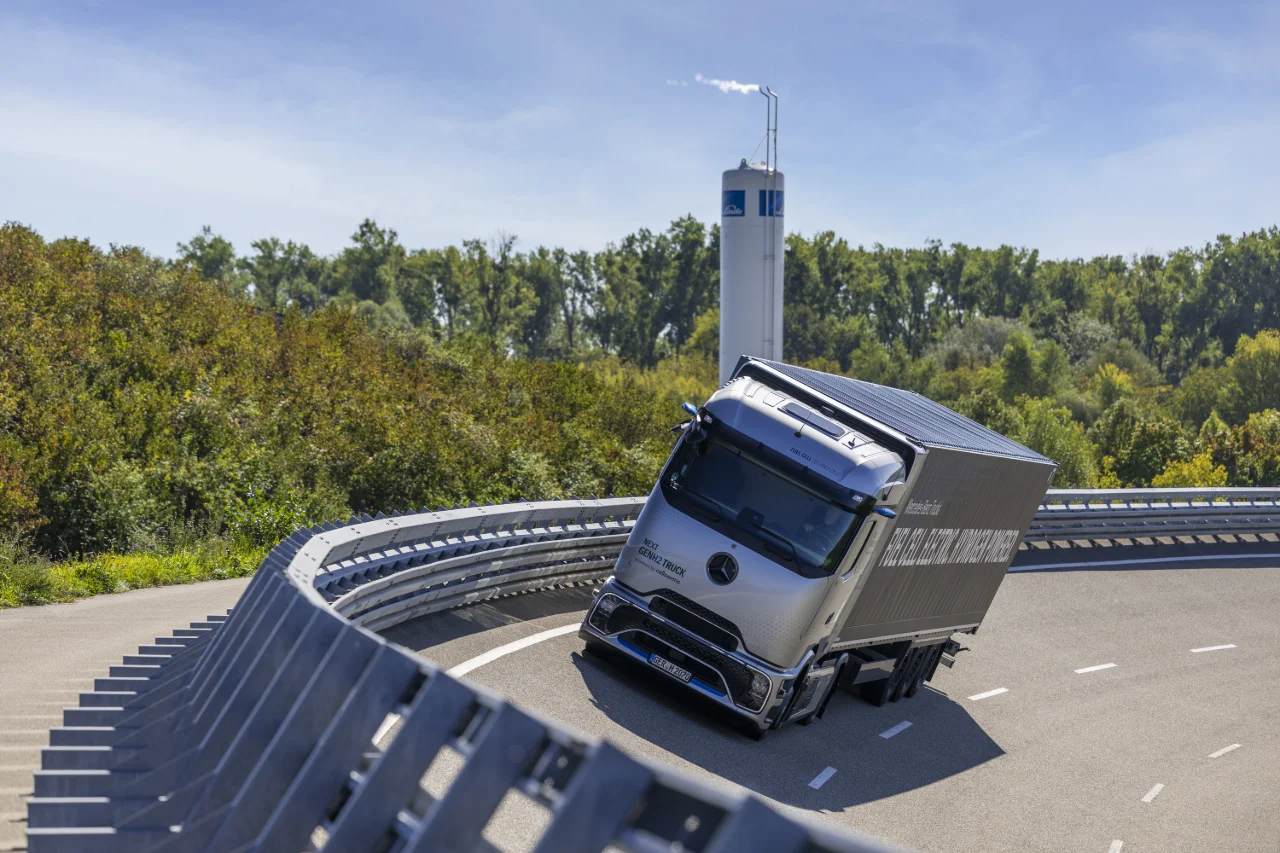
Daimler Truck is pursuing a dual strategy to decarbonize road transport: battery-electric trucks and hydrogen trucks. For its fuel cell trucks, Mercedes-Benz Trucks has chosen liquid hydrogen. The NextGenH2 Truck, which will be produced in 100 units at the Wörth am Rhein plant from 2027, embodies this bet.
What liquid hydrogen brings
Stored at around −253 °C, liquid hydrogen offers a higher energy density than batteries and compressed gaseous hydrogen, for equal storage volume. The NextGenH2 Truck's tank can hold up to 85 kg of liquid hydrogen, for more than 1,000 km of range at full load on a single fill.
Its predecessor, the GenH2 Truck, had already covered 1,047 km on a single fill in September 2023, at around 40 tonnes GCW, during the #HydrogenRecordRun.
On the refueling side, the ISO 13984 standard, co-developed by Daimler Truck, allows a 40-tonne truck to be filled in 10 to 15 minutes. The tank is also lighter than a battery system, which can benefit payload, even though payload depends on the vehicle's configuration. For comparable range, it also requires much less space than compressed gaseous hydrogen.
Conclusive customer trials
Since summer 2024, five first-generation GenH2 Trucks have been running with ten customers, in various logistics applications. They have already covered well over 600,000 km. According to Mercedes-Benz, fuel cell trucks, with long range and fast refueling, can in principle be integrated into regular logistics operations. Almost half of the small series has already been allocated, despite a still limited infrastructure.
The crux of the matter: the stations
The manufacturer acknowledges it: the limited availability of liquid hydrogen stations is the main obstacle. Today, operations remain confined to defined routes, with refueling points at Wörth am Rhein and in the Duisburg region.
On the logistics side, a 40-tonne tanker truck carries 3.9 tonnes of liquid hydrogen, or around 45 complete fills. The sLH₂ pilot station in Wörth, developed with Linde, consumes around 0.05 kWh per kilo, since there is no compression on site.
A joint initiative was presented at IAA Transportation 2026 in Hanover. It brings together Daimler Truck, Volvo Group, Toyota, Bosch, Air Liquide, TotalEnergies, TEAL Mobility and MB Energy. Its aim is to develop stations along major European corridors, in parallel with fleets, with hydrogen at a competitive price. Daimler specifies, however, that it does not replace the continued rollout of infrastructure.
The NextGenH2 in brief
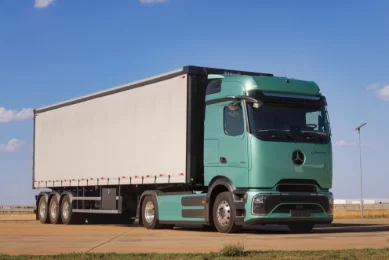
Presented in early 2026 and exhibited at the IAA in September, the NextGenH2 Truck is fitted with cellcentric's BZA150 fuel cell. It carries over several components from the eActros 600: aerodynamic ProCabin cab, new-generation electric axle, Multimedia Cockpit Interactive 2 and the latest driver assistance systems.