the Rise of Chinese Manufacturers
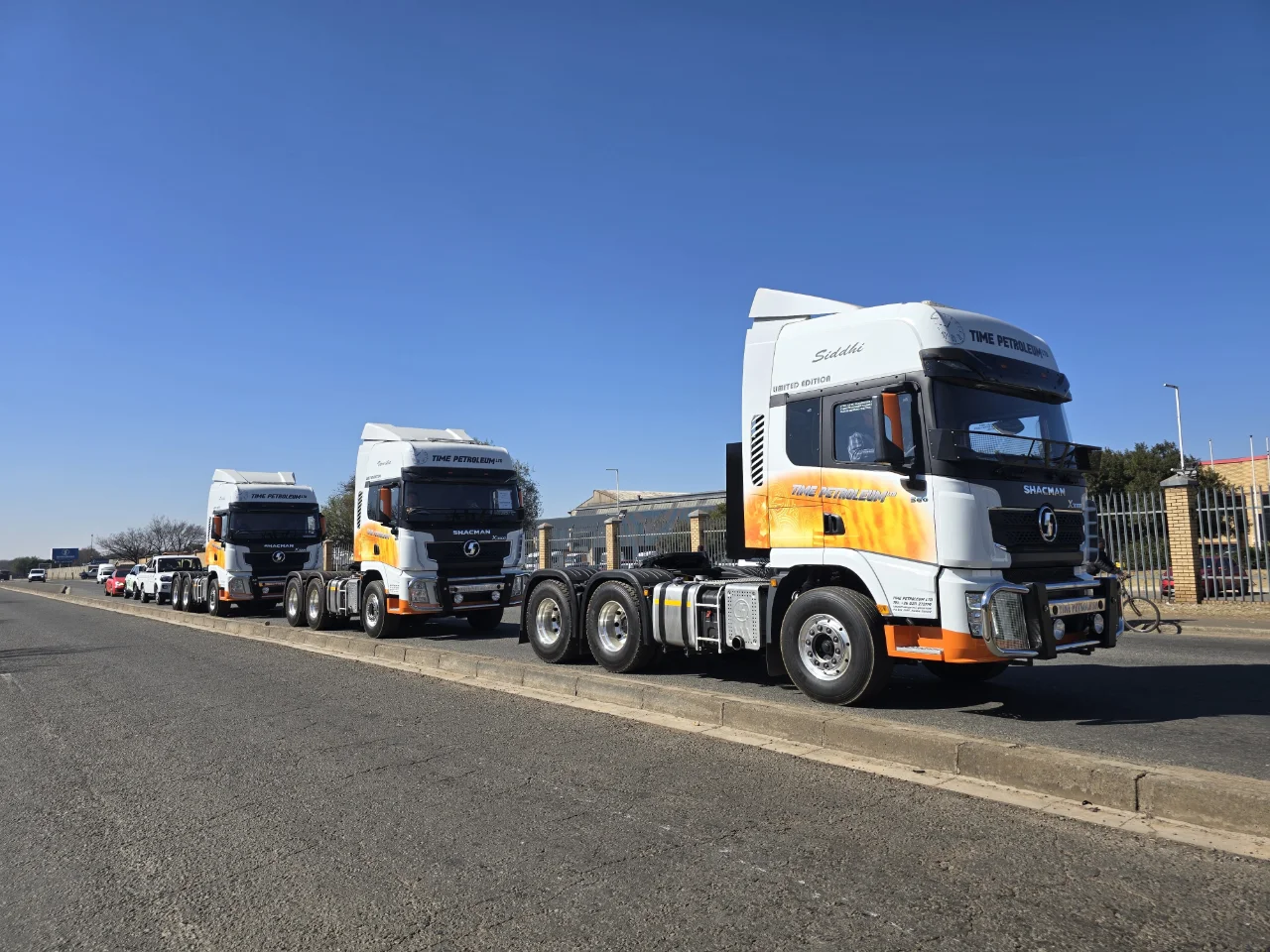
In four years, the Chinese manufacturer has built a network, a plant and a genuine industrial strategy that is beginning to shake up the established players. An evolution that South African journalist Charleen Clarke, a member of the International Truck of the Year jury, was able to observe on the ground.
For TruckStop, her investigation sounds like a strong signal: what is happening today in Africa could well foreshadow the evolution of the European market tomorrow.
When Malcolm Gush recalls the beginnings of Shacman Africa in 2022, he remembers with a smile that he did not even have… a stapler. An anecdote that perfectly illustrates how far the Chinese manufacturer’s South African subsidiary has come in just four years.
Today, the picture has changed radically. The company employs more than 200 people, has its own assembly plant in Wadeville, near Johannesburg, relies on a network of twenty dealerships and plans to sell nearly 800 trucks on the South African market alone this year.
To these volumes would be added nearly 800 vehicles intended for other African markets. Figures that do not yet rival those of the major European manufacturers, but which demonstrate spectacular progress.
This transformation was closely observed by Charleen Clarke, a recognised journalist in South Africa and a member of the International Truck of the Year jury, during her visit to Shacman Africa’s facilities.
Her findings go far beyond the case of a manufacturer experiencing strong growth: they illustrate a profound transformation of the global commercial vehicle market.
Much more than simply a cheaper truck

For a long time, Chinese brands were perceived as economical alternatives reserved for transport operators unable to access European or Japanese products. That era now seems to be over.
In South Africa, the economic pressure weighing on transport companies is now pushing operators to analyse every investment in terms of total operating cost. Purchase price, fuel consumption, vehicle availability, maintenance costs, residual value… all parameters are now scrutinised.
This is precisely the area in which Shacman intends to change its image.
“Since 2024, Chinese brands have gradually been changing the balance of the South African market,” explains Malcolm Gush. “Transport operators are looking for less expensive vehicles, but ones capable of doing exactly the same job as the established benchmarks.”
An evolution that Charleen Clarke considers particularly revealing of transport operators’ new expectations.
A strategy built before selling

Unlike other brands that came to try their luck on the African continent before disappearing due to a lack of structure, Shacman adopted a particularly cautious approach.
Even before seeking to conquer the South African market on a massive scale, around 90% of the first trucks were intended for export to neighbouring countries.
The objective was not simply to sell.
It was above all to establish a genuine ecosystem: dealer network, spare-parts distribution, maintenance contracts, 24-hour assistance, financing, call centre, driver training…
A philosophy summed up by Malcolm Gush:
“Selling the first truck is easy. What really matters is succeeding in selling the second.”
This approach is all the more essential because the vehicles often travel several thousand kilometres between South Africa, Zambia, Namibia, Botswana and the Democratic Republic of Congo.
Under these conditions, a truck immobilised due to a lack of spare parts immediately represents a considerable financial loss.
A plant already under pressure

The Chinese manufacturer’s commercial success is, moreover, beginning to create a new challenge: production capacity.
The Wadeville plant, designed to assemble around 1,500 vehicles per year, is currently operating at a rate of around four trucks per day.
This pace could quickly double without any major modification to the production line.
Since the launch of the X5000 and X6000 tractor units, demand has accelerated considerably. To such an extent that some vehicles practically leave the assembly line and go directly to their customer.
The problem is no longer simply convincing transport operators. It has now become industrial: producing quickly enough while maintaining an impeccable level of quality.
Making people forget the clichés about Chinese trucks

One of the most interesting lessons from Charleen Clarke’s investigation concerns the evolution of the perceived quality of Chinese vehicles.
Shacman’s executives know perfectly well that prejudices remain widespread. To address them, they rely on globally recognised components: Cummins engines, automated gearboxes, Knorr-Bremse braking systems and Wabco equipment.
The objective is simple: to demonstrate that quality is no longer limited to the country of origin, but is based on a technological package that is now comparable with international standards.
This strategy is coupled with a desire to quickly provide adaptations specific to the African market.
Where some major international groups can take several years to validate a technical development, Shacman claims to be able to react much more quickly thanks to a more flexible organisation between China and South Africa.
Fuel consumption: the ultimate test
In road transport, commercial promises are never enough because the real verdict is measured on the road.
That is why Shacman will take part in Truck Test 2026, the benchmark independent comparison test in Southern Africa.
Same route, same trailer, same load, same operating conditions: this protocol will make it possible to objectively compare fuel consumption and performance against competing manufacturers.
An essential step to convince the most demanding transport operators.
Africa, tomorrow’s laboratory
Beyond the South African market, Shacman’s growth is largely based on the major logistics corridors serving mining operations in Central Africa.
The needs there are immense, particularly between Zambia and the Democratic Republic of Congo.
To support this activity, the manufacturer has built up significant stocks of spare parts on the continent, an essential condition for keeping vehicles in operation in regions sometimes several thousand kilometres away from the main ports.
A reality that reminds us that in Africa, even more than elsewhere, the quality of after-sales service often makes the difference.
A warning for Europe?

For TruckStop, the interest of this investigation goes far beyond the case of Shacman Africa.
It highlights a trend that members of the International Truck of the Year jury observe with every new presentation by new manufacturers.
Chinese manufacturers are no longer seeking only to attract customers with their prices. They are now investing in networks, engineering, services, manufacturing quality and customer support.
In other words, they are gradually adopting the recipes that have made European manufacturers successful.
South Africa thus appears to be a formidable full-scale laboratory. Transport operators there are already testing a new generation of Chinese trucks capable of competing on operating costs, service quality and reliability.
It would undoubtedly be premature to announce an immediate upheaval in the European market. Established brands still have a considerable technological, industrial and commercial lead.
But the South African example shows that a gradual, methodical and perfectly structured rise can quickly reshuffle the cards.
What is happening today in the south of the African continent could well be a foretaste of what European transport operators will observe in the years to come.
And that is precisely what makes Charleen Clarke’s analysis particularly fascinating: it does not simply tell the story of a rapidly rising Chinese manufacturer, it may shed light on one of the major developments in the heavy truck industry of tomorrow.
Warning, the Chinese are no longer very far away and the next IAA show in September could well set the stage!
Investigation: Charleen Clarke, French adaptation: Fabien Calvet